
Personal Brand for Engineers: A Systems Approach
73% of B2B decision-makers trust thought leadership over marketing. Engineers do not have a talent problem. They have a distribution problem.
I have watched engineers who write mediocre code get promoted over engineers who write exceptional code. I have watched technical founders with inferior products outsell competitors who built better ones. I have watched developers with half the experience command double the consulting rates.
The pattern is always the same. The people getting the opportunities are not necessarily the most skilled. They are the most visible to the right people.
This is not a comfortable observation for engineers. We prefer meritocracy as a mental model. We like to believe the best work wins. But distribution is part of the product, and most engineers treat it as an afterthought.
The typical advice does not help. Most content about personal branding is written for marketers and influencers: post daily, build a personal story, find your niche. That advice is not wrong for its audience. It is just written for a completely different problem. Engineers do not need a content strategy. They need a distribution architecture.
This post is about that architecture.
Key Takeaways
- 73% of B2B decision-makers trust thought leadership over marketing materials, and 86% say it makes them more likely to invite a company to bid (Edelman-LinkedIn, 2024)
- Engineers do not have a talent problem. They have a distribution problem.
- Audience is a compounding asset. Social reach resets every post. An email list does not.
- The right channel for most engineers is almost never Instagram.
Does personal brand actually matter for engineers?
73% of B2B decision-makers say thought leadership is a more trustworthy basis for assessing capabilities than marketing materials, and 86% say high-quality thought leadership makes them more likely to invite that company to bid on a project (Edelman-LinkedIn, 2024). These numbers are not about marketing teams. They are about the technical founders and individual experts behind the content.
The skepticism is understandable. Most “personal brand” content is written by people with bad advice to sell. The hustle-culture version (post every day, build an audience of millions, monetize your passion) is not what this is about.
But there is a version of personal brand that is just reputation management at scale. Engineers, who build systems for a living, are well-positioned to approach it that way.
Weber Shandwick found that 44% of a company’s market value is attributed by global executives to CEO personal brand and reputation strength (Weber Shandwick, 2020). For individual contributors and founders, the mechanism is the same. Your reputation is a business asset. You can manage it deliberately or let it happen by default.
Most engineers choose default. That is the opportunity.
The 2024 Edelman-LinkedIn B2B Thought Leadership Impact Report, surveying 3,500 management-level professionals, found that 73% trust thought leadership over marketing materials and 86% are more likely to invite a company to bid based on quality content (Edelman-LinkedIn, 2024). For technical founders, this is not a content marketing metric. It is a sales metric.
For a systems view of how distribution fits into broader growth strategy, see the growth experimentation system framework.
Why most personal brand advice fails technical people
Technical documentation is the top learning resource for 67.8% of developers, while blogs and podcasts rank at just 34.8% (Stack Overflow, 2025). That gap explains why generic personal brand advice does not translate for engineers: it is written for audiences that consume content in a completely different way.
The standard advice gets the channel wrong. Instagram. TikTok. Viral storytelling. Emotional hooks. Personal journey content. This works for lifestyle influencers and B2C creators. It does not map onto how technical people learn, communicate, or make purchasing decisions.
The Stack Overflow 2025 Developer Survey, with over 49,000 respondents, shows exactly this split. Non-course video sits at 50%. Blogs and podcasts trail at 34.8%.
The implication is direct: engineers respond to technical depth, not personal storytelling. They read documentation before they watch a keynote. A tutorial that solves a real problem reaches more engineers than a dozen LinkedIn posts about your journey.
This does not mean format is everything. It means channel selection has to start with how your audience learns, not how influencers in adjacent industries make content.
Write for how engineers actually consume information. Long-form, specific, and useful over short-form, broad, and inspirational.
Audience is a compounding asset, not a vanity metric
Substack now has more than 5 million paid subscriptions, more than double the 2 million it counted before (Backlinko, 2026). That growth is not a coincidence: it reflects a structural shift in how technical creators think about owned vs. rented channels.
Here is the distinction most engineers miss. Social media reach resets every time you post. An email list does not. GitHub stars do not. A well-ranked piece of content does not.
Think of audience channels on a spectrum from ephemeral to durable. A tweet has a half-life of hours. A LinkedIn post persists for days. A blog post indexed by Google can generate traffic for years. An email newsletter is a direct line to people who asked to hear from you, and it does not depend on any algorithm to reach them.
Most engineers do not apply their systems thinking to distribution. They treat each piece of content as an isolated output. The compounding happens when you treat content as infrastructure.
The average newsletter open rate is 38.7%. Social media organic reach averages around 10%. Email marketing returns $44 for every $1 spent (Beehiiv/ConvertKit via Whop, 2025). These are not comparable channels. They are a different class of asset.
Email newsletters outperform social media on every durability metric. The average newsletter open rate is 38.7%, versus approximately 10% for social media organic reach. Email marketing returns $44 per $1 spent (Beehiiv/ConvertKit via Whop, 2025). For engineers building an audience, owned channels are the only ones worth treating as infrastructure.
For a related perspective on compounding systems in growth, see the AI marketing stack architecture post.
Where should engineers actually build?
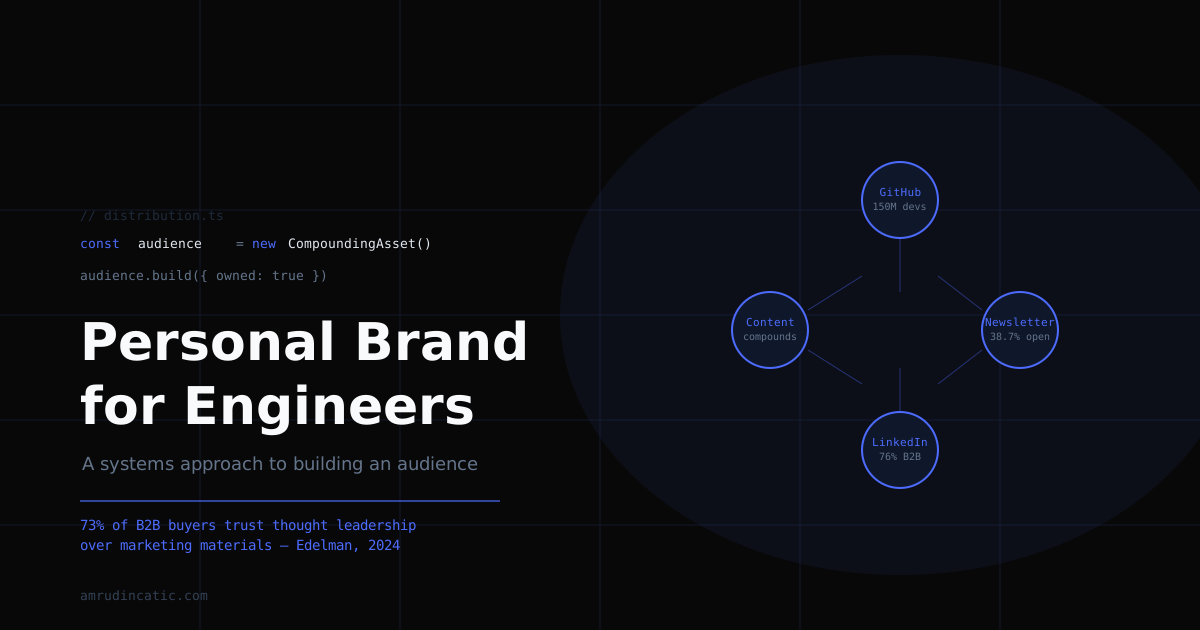
GitHub now hosts more than 180 million developers and added more than 36 million in 2025 alone (GitHub Octoverse, 2025). LinkedIn, meanwhile, is where B2B buyers read thought leadership. The right channel depends entirely on who you are trying to reach and what outcome you are after.
Platform selection is a strategy question, not a preference question.
GitHub is underrated as a reputation surface. A useful open source library or a well-maintained repository gets discovered passively. It signals craft without requiring you to write a single piece of content about yourself. If you are a technical founder, your GitHub profile is a credential.
Newsletter is the owned moat. Every other platform can change its algorithm, reduce reach, or shut down. Your email list cannot be taken from you. Start one early, even before you have a large audience. The compounding starts from day one, not when you hit 1,000 subscribers.
LinkedIn is the B2B distribution layer. 76% of B2B marketers say it is the most effective platform for thought leadership, and 89% use it for lead generation (Sprout Social, 2026). If your goal is clients, partnerships, or hiring, LinkedIn is where the decision-makers are.
The platform stack for most technical founders: GitHub for credibility, newsletter for ownership, LinkedIn for reach to decision-makers. Pick one to build first. Do not try to operate three simultaneously from the start.
What to write when you have nothing to say
There are 47.2 million developers worldwide as of 2025 (SlashData, 2025). Every one of them is solving problems, making decisions, and hitting walls that other developers will face next week. The raw material for content is everywhere. What is missing is the habit of writing it down.
The most common objection is “I do not have anything interesting to share.” This objection is usually backwards.
It mistakes a habit problem for a material problem. If the blank page is the blocker rather than the material, the content idea generator on this site turns one topic into a set of angles to write against.
The most useful framing I have found is “digital exhaust.” Every day of engineering work produces exhaust: decisions made, problems solved, tradeoffs weighed. Most of it evaporates. Writing it down turns it into content.
A Slack message explaining a decision to a teammate is a blog post draft. A detailed commit message explaining why something was done a certain way is an article introduction. An internal postmortem is a case study waiting to be anonymized.
The format guide is simple. Tutorials build trust because they prove you know what you are talking about. Opinions build reach because people share things they agree or disagree with strongly. Case studies build leads because they show specific results in recognizable contexts.
Pick one format. Write consistently in that format for 90 days. Then evaluate what is working.
How to start when you have no audience
Leads generated through employees’ social media convert 7 times more often than other leads (IBM via DSMN8, 2025). The compounding is real. The catch is that it requires consistency before it produces signal.
The biggest mistake is optimizing for scale before you have signal.
Do not think about reaching 10,000 people. Think about one specific person. Who is the engineer or founder you would want to read this? Write for them. When you can describe exactly who you are writing for, the content gets sharper. Sharper content gets shared.
The second mistake is optimizing for volume before consistency. Trust comes from showing up on a schedule readers can predict. One high-quality piece per week outperforms five mediocre ones.
The compounding kicks in around the six-month mark for most engineers who publish consistently. Before that, it feels like you are shouting into nothing. That is normal. The infrastructure is being built. You just cannot see the returns yet.
Start small. Pick one owned channel: a newsletter, a GitHub profile, or a blog on your own domain. Write one piece. Ship it. Repeat.
If you want to see how this approach plays out in practice, read more about my work on the About page.
Frequently Asked Questions
Is personal brand worth it for software engineers who are not founders?
Yes. Engineers with visible technical authority get better job offers, more interesting project assignments, and higher consulting rates. Weber Shandwick found that 44% of company market value is linked to leadership reputation (Weber Shandwick, 2020). The same mechanism applies to individual contributors inside organizations.
Which platform should engineers start with?
If you are B2B or looking for clients: LinkedIn first, then a newsletter. If you are building developer tools or open source: GitHub first, then a newsletter. The newsletter is always the long-term play because you own the channel. 76% of B2B marketers say LinkedIn is the most effective platform for thought leadership (Sprout Social, 2026).
How often do engineers need to publish to build an audience?
Consistency beats frequency. One high-quality piece per week compounds faster than five mediocre pieces. Define a cadence you can hold for 12 months and stick to it.
Does open source count as personal brand?
Yes. GitHub has more than 180 million developers and added 36 million in 2025 alone (GitHub Octoverse, 2025). A useful library, a well-documented project, or a repository with clean commit history signals technical depth that no LinkedIn post can replicate. For engineers, code is credibility. Open source is credibility at scale.
How long before personal brand starts producing results?
Expect 6 to 12 months before meaningful compounding. The first 90 days are mostly infrastructure. The second quarter is where you start getting signal on what resonates. By month 6 to 9, the flywheel starts moving. Do not measure results in the first 90 days. Measure consistency.
Final thought
Reputation is infrastructure. Most engineers treat it as a byproduct.
The engineers who consistently get the best opportunities are not always the best coders. They are the ones who have built distribution for their thinking. A useful tutorial that lives at the top of Google for three years is worth more than 100 LinkedIn posts that each lived for 48 hours.
Build the owned channel. Write for depth, not reach. Document what you are already building.
The audience compounds. The algorithm does not.