
Beyond A/B Tests: A Growth Experimentation System
Only a third of A/B tests produce a significant win, and the median lift is 0.08%. The problem is altitude, not tools. Here is a system for testing strategy.
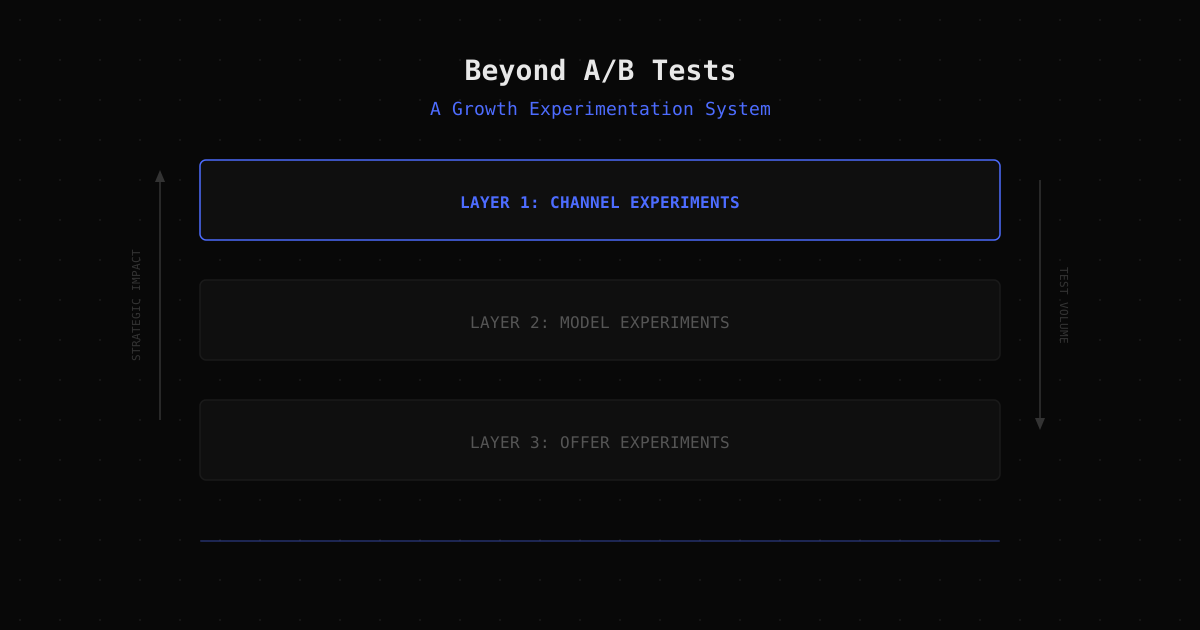
A team I worked with last year ran 247 A/B tests in a single quarter.
They had a dedicated experimentation platform. A full-time optimization analyst. Weekly readouts. Executive dashboards showing test velocity, win rate, and cumulative revenue impact.
By every internal metric, the experimentation program was a success.
Revenue was flat.
I asked the head of growth to walk me through their test backlog. It was exactly what you would expect. Button colors. Headline variations. CTA placement. Form field order. Hero image swaps. Email subject lines with and without the recipient’s first name.
Two hundred and forty-seven tests, and not a single one questioned whether they were selling the right product, to the right audience, through the right channel, using the right growth model.
They had perfected the art of testing things that did not matter.
This is the growth experimentation gap. Most companies have testing programs. Few have experimentation systems. The difference is not volume. It is altitude.
A/B testing optimizes the surface. A growth experimentation system tests the structure underneath.
The teams running the most tests are often learning the least. They have built a machine that produces statistical significance on questions nobody needed answered. Meanwhile, the questions that actually determine whether the company grows, questions about channels, growth models, positioning, and offer architecture, go completely untested.
Not because those questions are unanswerable. Because the experimentation program was never designed to ask them.
This post is a tactical guide to building that system. Three layers of experimentation, concrete methods for running each type, and a framework for making strategic experimentation a repeatable process instead of a one-off exercise.
Key Takeaways
- Only 33.5% of A/B tests produce a statistically significant win; median lift across all tests is just 0.08% (Analytics-Toolkit, 2022)
- Businesses with mature experimentation programs are 69% more likely to grow significantly (Speero + Kameleoon, 2024)
- 91% of programs feel underfunded (Speero via Wingify, 2024); only 13% have well-integrated tools (Speero, 2024)
- The fix is altitude: run experiments at three layers (channel, model, and offer), not just surface UI
Why do most experimentation programs fail?
Only 33.5% of A/B tests produce a statistically significant win. Across 1,001 tests, the median lift is just 0.08%, and even the winners deliver a median lift of only 7.5% (Analytics-Toolkit, 2022). AppSumo’s founder reported a lower hit rate still: only 1 out of 8 of his A/B tests drove significant change (Noah Kagan via VWO, 2011). The testing machine is running. The growth engine is not.
The problem is not that teams lack testing tools. Most experimentation programs are designed around three structural traps that guarantee irrelevance.
Trap 1: Testing only what is safe
Most test backlogs are filled with low-risk variations. Change the button from blue to green. Try “Get Started” versus “Start Free Trial.” Move the testimonial above the fold.
These tests feel productive. They generate data. They produce winners.
But they are safe by design. No stakeholder will object to testing a button color. No executive will question an email subject line experiment. The backlog naturally gravitates toward tests that are easy to approve, easy to run, and easy to interpret.
The result is a program that systematically avoids testing anything that could produce a genuinely new insight. Tests that would actually inform growth strategy, testing a new channel, a different pricing model, a repositioned offer, never make it to the backlog. They feel too risky, too complex, or too political.
Safety is the enemy of signal.
Trap 2: Measuring only what is easy
Click-through rates. Conversion rates. Open rates. These metrics are easy to capture, easy to dashboard, and easy to report.
They are also downstream symptoms, not upstream causes.
A 15% lift in landing page conversion rate means nothing if the traffic coming to that page is the wrong traffic. A higher email open rate is irrelevant if the email sequence is nurturing prospects toward a product they do not need.
Easy metrics create the illusion of learning. The team sees numbers going up and assumes the program is working. But the metrics that actually determine growth, customer acquisition cost by channel, payback period by segment, expansion revenue by cohort, are harder to measure and rarely appear in experimentation dashboards.
Trap 3: Optimizing only what is visible
The visible parts of a growth system are the ones users interact with: landing pages, emails, ads, onboarding flows. These are the surfaces that experimentation programs test obsessively.
The invisible parts are the structural decisions: which market segment to prioritize, whether to pursue sales-led or product-led growth, how to architect the referral loop, what pricing model aligns with customer behavior.
Structural decisions carry far more weight than surface decisions. But they are invisible, so they go untested.
The three traps compound. Teams test safe, visible things using easy metrics. They generate impressive test velocity numbers. And they learn almost nothing about what actually drives growth.
This is experimentation theater. High activity, zero strategic signal.
According to Speero’s 2024 Experimentation Program Benchmark Report (206 companies), 47% of programs lack clear goals and 91% feel underfunded (Speero via Wingify, 2024), and only 13% have well-integrated tools (Speero, 2024). These are not tactical gaps. They are structural gaps that guarantee the wrong experiments get run.
The three layers of growth experimentation
Companies with mature experimentation programs are 69% more likely to grow significantly. When product and marketing strategy are aligned around experimentation, that figure rises to 81% (Speero + Kameleoon, 2024). The difference between those companies and the ones running 247 tests with flat revenue is not tools. It is altitude.
The fix is not running fewer tests. It is running tests at three distinct altitudes, each with different methods, timelines, and success criteria.
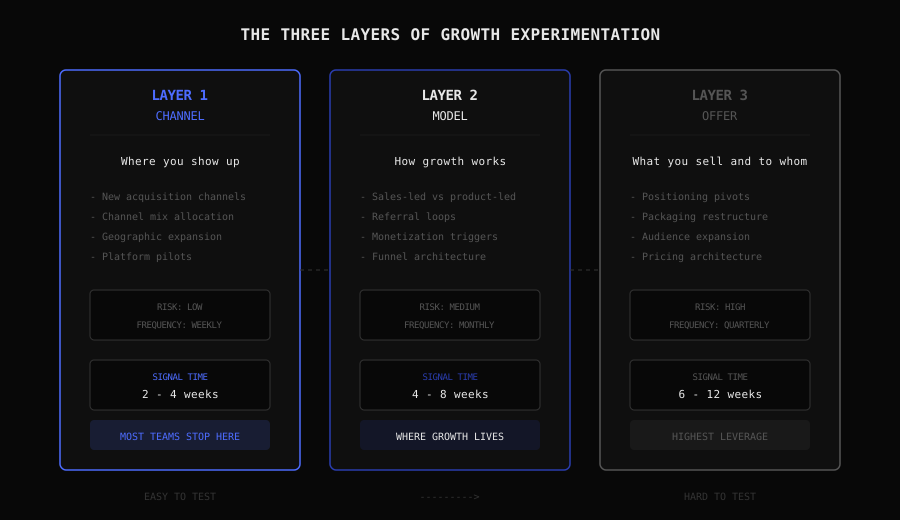
Layer 1: Channel experiments test where you show up. Which acquisition channels work for your business? What is the right mix? Where is there untapped demand?
Layer 2: Model experiments test how growth works. Is your growth engine correct? Should you be product-led or sales-led? Does a referral loop exist? What triggers monetization?
Layer 3: Offer experiments test what you sell and to whom. Is your positioning right? Is your packaging structured correctly? Are you targeting the right audience segment?
Most teams operate exclusively at Layer 1, and even then, only at the surface level within that layer. They test ad creative variations on existing channels rather than testing new channels entirely.
Layers 2 and 3 are where the highest-impact decisions live. They are also where most teams have zero experimental data.
Layer 1: Channel experiments
Brands using three or more marketing channels are 73% more likely to achieve higher ROAS (Nift, 2024). Most companies lock into one or two channels early and never run a single experiment to question whether that mix is right.
Channel experiments answer the question: are we showing up in the right places?
Most companies found that Google Ads and LinkedIn work reasonably well, so they pour budget into those two channels indefinitely. The channel mix becomes an assumption, not a hypothesis.
This is how companies miss entire acquisition channels that could outperform the ones they already run.
How to run channel experiments
The 10% rule. Allocate 10% of your acquisition budget to testing channels you are not currently using. This is not a suggestion. It is a structural requirement. Without a dedicated budget, channel experiments will never survive prioritization against “proven” channels.
Time-boxed pilots. Every new channel gets a defined pilot window. Four weeks is the minimum for most channels to produce a meaningful signal. Anything shorter and you are measuring noise.
Here is what a channel pilot brief looks like in practice:
- Channel: TikTok organic (short-form educational content)
- Hypothesis: Our target buyer (director-level ops leaders at mid-market SaaS) consumes short-form video for professional learning at higher rates than LinkedIn carousel posts
- Duration: 4 weeks
- Budget: $3,000 (production) + 10 hours/week (content creation)
- Primary metric: Qualified traffic to site (not views, not followers)
- Secondary metrics: Cost per qualified visit, content-to-lead conversion rate
- Kill criteria: Fewer than 50 qualified visits in 4 weeks, or cost per qualified visit exceeds 3x LinkedIn baseline
Kill criteria before you start. This is the single most important element. Define exactly what would make you stop the experiment before you begin. Without pre-defined kill criteria, losing experiments drag on indefinitely because nobody wants to admit the channel is not working.
Rotate systematically. Build a channel experiment calendar. Every quarter, pilot at least one channel you have never tested and re-test one channel you abandoned more than twelve months ago. Markets shift. A channel that did not work two years ago might work today because the audience moved.
What to watch for
Channel experiments produce two types of signal. The obvious signal is performance: did the channel generate qualified demand at an acceptable cost? The less obvious signal is structural: did the channel reveal a segment of your audience you did not know existed?
Some of the most valuable channel experiments I have seen did not produce a new acquisition channel. They produced a new audience insight that reshaped the entire growth strategy.
Optimizely’s analysis of more than 127,000 experiments found that impact per test peaks at just 1-10 annual tests per engineer (Optimizely, 2024). Beyond 30 tests per engineer, expected impact drops by 87%. Volume without strategic direction is not experimentation. It is noise production.
Layer 2: Model experiments
Product-led companies in the first-half 2018 IPO cohort traded at revenue multiples 48% greater than their non-PLG peers (OpenView Partners, 2018). Most companies never test which growth model fits their business. They inherit one from a founder instinct or a competitor benchmark.
Model experiments are where most teams have zero data and maximum assumptions.
Your growth model is the underlying engine: how customers discover, evaluate, adopt, and expand their use of your product. Most companies have a growth model. Almost none of them have tested it.
They chose sales-led because the founders came from enterprise sales. They built a freemium tier because a competitor has one. They invested in content marketing because someone read that it compounds.
These are not strategies. They are inherited assumptions.
So how do you find out which model actually fits your business? You test it.
What model experiments look like
Sales-led versus product-led on a single segment. You do not need to transform your entire go-to-market to test this. Pick one customer segment. Run a 6-week experiment where that segment gets a self-serve product experience instead of a sales call. Measure conversion rate, time to revenue, and customer acquisition cost for that segment against your sales-led baseline.
One team I advised ran this experiment on their small-business segment. The product-led motion converted at a lower rate, but at one-eighth the customer acquisition cost. They moved that entire segment to self-serve and redeployed the sales team to enterprise accounts. That single experiment restructured their growth model.
Referral loop testing. Most companies assume referrals either happen or they do not. They are wrong. Referral is a mechanism that can be engineered and measured. Design a referral experiment: give one cohort of customers a referral incentive, give a control cohort nothing. Measure viral coefficient over 8 weeks. If the coefficient is above 0.1, there is a loop worth investing in. If it is below 0.05, stop pretending referrals are part of your growth model.
Monetization trigger experiments. When does your product become valuable enough that a user will pay? Most companies guess, then build their pricing around that guess. Test it. Take one cohort and trigger the paywall at a different usage milestone. Move the upgrade prompt from day 14 to the moment a user completes their third project. Measure conversion rate and retention at 90 days.
The rules for model experiments
Model experiments are fundamentally different from channel experiments. They take longer, carry more risk, and require more careful isolation.
Isolation is critical. A model experiment must be isolated to a specific segment, cohort, or geography. You cannot test a new growth model across your entire business simultaneously. If the experiment fails, you need a blast radius you can contain.
Longer timelines. Channel experiments produce a readable signal in about four weeks. Model experiments need four to eight weeks minimum, sometimes longer. Growth model changes have second-order effects that take time to manifest. A product-led motion might show lower conversion in week 2 but higher retention in week 8. Kill the experiment too early and you miss the real signal.
Decision criteria, not success metrics. Do not frame model experiments around “did this win?” Frame them around “what did this teach us about how growth works?” A model experiment that shows your referral coefficient is 0.02 is not a failure. It is a signal that your growth model should not depend on virality. That is valuable information.
Layer 3: Offer experiments
Most positioning is set once and never tested again. Yet tests with four or more variations are 2.4x more likely to win and deliver 27.4% higher uplifts than single-variation tests (Optimizely, 2024). The companies that test their positioning at a structural level are playing a different game.
Offer experiments test the highest-impact question in growth: are you selling the right thing to the right people in the right way?
This is not A/B testing a headline. This is testing whether your positioning, packaging, and audience targeting are correct at a structural level.
Most companies set their positioning during a brand exercise, build their packaging during a product launch, and define their audience during a strategy offsite. Then they never test any of it again.
The positioning becomes sacred. The packaging becomes fixed. The audience definition becomes an assumption that nobody questions.
How to run offer experiments
Positioning tests. Create two versions of your core value proposition. Not two headlines, two fundamentally different framings of what your product does and why it matters. Run them against the same audience on the same channel.
Example: a project management tool positioned as “the fastest way to manage tasks” versus “the operating system for how your team works.” These are not copy variations. They are positioning architectures. One frames the product as a utility. The other frames it as infrastructure. The audience response to each framing tells you something fundamental about how your market perceives the problem you solve.
Run this as a landing page experiment with dedicated traffic for 4 weeks. Measure not just conversion rate, but downstream metrics: trial-to-paid conversion, time to activation, and 30-day retention. Positioning that converts at a higher rate but retains worse is not better positioning. It is misleading positioning.
Packaging restructure tests. Take one customer segment and offer them a restructured package. Bundle features differently. Change what is included in each tier. Shift the upgrade trigger.
The goal is not to find the “optimal” package. It is to understand how packaging architecture affects behavior. Do customers who start on a higher tier retain better? Does unbundling a key feature increase or decrease overall revenue?
Audience expansion tests. Pick an adjacent market segment you are not currently targeting. Build a dedicated landing page, run targeted acquisition, and measure whether that segment converts and retains at rates that justify the expansion.
This is how companies discover that their real market is different from their assumed market. I have seen B2B companies run audience expansion experiments and discover that their product resonated more strongly with a segment they had never considered. That insight reshaped their entire go-to-market.
How to run strategic experiments without breaking everything
At Google and Bing, only about 10% to 20% of experiments generate positive results, and Microsoft, Amazon, Booking.com, Facebook and Google each run more than 10,000 online controlled experiments a year (Harvard Business Review, 2017). Failure at that rate only teaches something when the experiment was written down first: a brief with pre-defined decision criteria. Not instinct. Architecture.
The reason most teams avoid Layer 2 and Layer 3 experiments is fear. Model experiments can disrupt existing revenue. Offer experiments can confuse the market. The perceived risk keeps teams locked into surface-level testing.
The solution is not courage. It is structure.
The experiment brief
Every strategic experiment starts with a written brief. Not a Jira ticket. Not a Slack thread. A document that forces clarity before action.
The brief contains seven elements:
- Hypothesis. One sentence. “We believe [change] will produce [outcome] for [segment] because [reason].”
- Layer. Channel, model, or offer. This determines the expected timeline and risk profile.
- Isolation boundary. Which segment, cohort, or geography will be affected. Everything outside this boundary operates unchanged.
- Duration. How long the experiment runs before evaluation. Defined before launch, not adjusted mid-flight.
- Primary metric. One metric that determines whether the hypothesis held. One. Not three.
- Decision criteria. Written before the experiment starts: “If primary metric exceeds X, we scale. If below Y, we kill. If between X and Y, we extend for Z weeks.”
- Rollback plan. How you reverse the change if the experiment causes damage. If you cannot define a rollback plan, the experiment scope is too broad.
Time-boxing and minimum viable signal
Strategic experiments are not open-ended. Every experiment has a defined window. When the window closes, you evaluate against your pre-defined decision criteria and act.
The concept of minimum viable signal matters here. You do not need statistical significance at p < 0.05 for a model experiment. You need enough signal to make a directional decision. Sometimes that is 50 data points, not 5,000.
Waiting for perfect data is a form of avoiding the decision. Define what “enough signal” looks like before you start, and commit to deciding when you reach it.
Isolation and blast radius
Every strategic experiment must have a containable blast radius. If a model experiment goes wrong, it should affect one segment, not your entire customer base.
Practical isolation methods:
- Geographic isolation. Run the experiment in one market only.
- Segment isolation. Apply the change to one customer tier or persona.
- Cohort isolation. Only new customers starting after a specific date experience the experiment. Existing customers are unaffected.
- Revenue isolation. Cap the revenue exposure. If the experiment could affect more than 10% of monthly revenue, narrow the scope.
Building the cadence
At Bing, continuous experimentation surfaces dozens of revenue-related changes every month, improvements that have collectively increased revenue per search by 10% to 25% each year (Harvard Business Review, 2017). That is cadence, not heroics. Cadence is what separates a one-off experiment from a self-improving growth system.
A growth experimentation system is not a project. It is an operating rhythm. Without cadence, strategic experiments happen once, produce insight, and then the team reverts to testing button colors.
Quarterly experiment planning
Once per quarter, the growth team reviews three inputs:
- Intelligence signals. What has changed in the market, competitive landscape, or customer behavior since last quarter? This connects directly to the Intelligence Layer of your marketing stack.
- Experiment results. What did last quarter’s experiments teach? What new hypotheses emerged?
- Strategic gaps. Where does the growth model rely on untested assumptions?
From these inputs, the team selects experiments for the next quarter: at least one per layer. One channel experiment, one model experiment, one offer experiment. This is the minimum. Teams with more capacity can run multiples, but every team should be testing at all three layers every quarter.
Weekly signal reviews
A 30-minute weekly meeting where running experiments are reviewed. Not to make decisions, because decisions happen at the pre-defined evaluation point, but to monitor for two things:
- Contamination. Is something outside the experiment affecting the results? A competitor launched a campaign. A product bug changed user behavior. A seasonal pattern is skewing the data.
- Safety triggers. Is the experiment causing unexpected damage? If a model experiment is tanking retention in the isolated segment beyond the acceptable threshold, you kill it early. This is why the rollback plan exists.
Weekly reviews are monitoring, not meddling. The most common failure mode in strategic experimentation is premature termination. Someone sees an early negative signal, panics, and kills the experiment before it reaches minimum viable signal. The weekly review should reinforce discipline, not undermine it.
The experiment backlog
Maintain a ranked backlog of experiment hypotheses across all three layers. Every time someone on the team says “I think we should try X,” that hypothesis goes into the backlog with a layer designation and a rough effort estimate.
During quarterly planning, you pull from this backlog based on strategic priority and capacity. The backlog prevents good hypotheses from being lost, and it makes the quarterly planning conversation faster because you are selecting from existing options rather than brainstorming from scratch.
Structure the backlog simply:
- Hypothesis (one sentence)
- Layer (1, 2, or 3)
- Expected signal time (weeks)
- Effort estimate (low, medium, high)
- Strategic priority (1 to 5)
Sort by strategic priority divided by effort. High-priority, low-effort experiments run first. This is basic prioritization framework logic applied to experimentation.
How does this integrate with existing A/B testing?
77% of experiments test only two variations, and only 31% of teams running personalized experiments believe it is improving their bottom line (Optimizely, 2024). Surface testing is the default. Strategic testing is rare. The three-layer system adds what the surface layer cannot provide.
A three-layer growth experimentation system does not replace your existing A/B testing program. It sits above it.
Your current testing infrastructure handles surface optimization: landing page variations, email subject lines, ad creative, onboarding flows. This work is valuable. It is also Layer 0, the foundation that the three strategic layers build on.
The integration looks like this:
Layer 0 (existing A/B tests) runs continuously. High velocity, low risk, fast signal. This is the engine that optimizes what you already have.
Layers 1, 2, and 3 (strategic experiments) run on a quarterly cadence. Lower velocity, higher risk, slower signal. This is the engine that discovers what you should have.
Layer 0 makes the current system better. Layers 1 through 3 make sure it is the right system.
Most companies have a sophisticated Layer 0 and no strategic layers at all. They are optimizing a machine they have never validated. The three-layer system provides the validation mechanism.
The distinction between Layer 0 and strategic layers is not about test sophistication. It is about the questions being asked. Surface tests ask “which version of this performs better?” Strategic tests ask “should this exist at all?” Most programs are exclusively answering the first question. The second question is where growth is found.
Frequently Asked Questions
What is the difference between A/B testing and a growth experimentation system?
A/B testing optimizes individual elements: headlines, buttons, layouts. A growth experimentation system tests at three altitudes: which channels to use (Layer 1), how your growth model works (Layer 2), and whether you are selling the right thing to the right audience (Layer 3). Only 33.5% of A/B tests produce a statistically significant win (Analytics-Toolkit, 2022). The system explains why.
Why do most experimentation programs fail to drive growth?
Three structural traps: testing only what is safe, measuring only what is easy, and optimizing only what is visible. The result is high test velocity and low strategic signal. Speero’s 2024 benchmark found that 47% of programs lack clear goals and 91% feel underfunded (Speero via Wingify, 2024). Volume does not fix a structural problem.
How long should a strategic experiment run?
Channel experiments: four weeks minimum. Model experiments: four to eight weeks minimum, sometimes longer. Growth model changes have second-order effects that take time to surface. Define the minimum duration before launch and do not shorten it based on early data. Early signals are usually noise.
What is a good A/B test win rate?
At Google and Bing, only about 10% to 20% of experiments generate positive results (Harvard Business Review, 2017). Across 1,001 A/B tests in one meta-analysis, 33.5% produced a statistically significant win (Analytics-Toolkit, 2022). A low win rate is not a sign of a broken program. It is a sign of an honest one. The goal is not to win tests. It is to learn what drives growth.
What is an experiment brief and why does it matter?
An experiment brief is a written document that defines the hypothesis, layer, isolation boundary, duration, primary metric, decision criteria, and rollback plan before the experiment launches. It is what separates experiments from guesses. Without pre-defined decision criteria, losing experiments drag on and winning experiments never get scaled.
Final thought
The companies that stall are not the ones running too few tests. They are the ones running hundreds of tests at the wrong altitude.
Button color tests will not tell you whether your growth model works. Email subject line tests will not tell you whether you are selling to the right audience. Landing page optimizations will not tell you whether you are in the right channels.
Those answers come from a different kind of experimentation. One that is slower, less comfortable, and harder to dashboard. But it is the only kind that actually determines whether a company grows.
Build the system. Three layers. Quarterly cadence. Written briefs with pre-defined decision criteria. Isolation boundaries. Rollback plans.
Then run the experiments that actually matter.
The teams that win will not be the ones with the highest test velocity. They will be the ones who tested the right things.