
Amrudin Ćatić
Strategy, creativity, and technology are combined to craft digital experiences that perform. Smart marketing meets creative execution, always focused on growth, problem-solving, and real impact.
Writing for decision makers, not algorithms: 7 powerful shifts that actually influence action
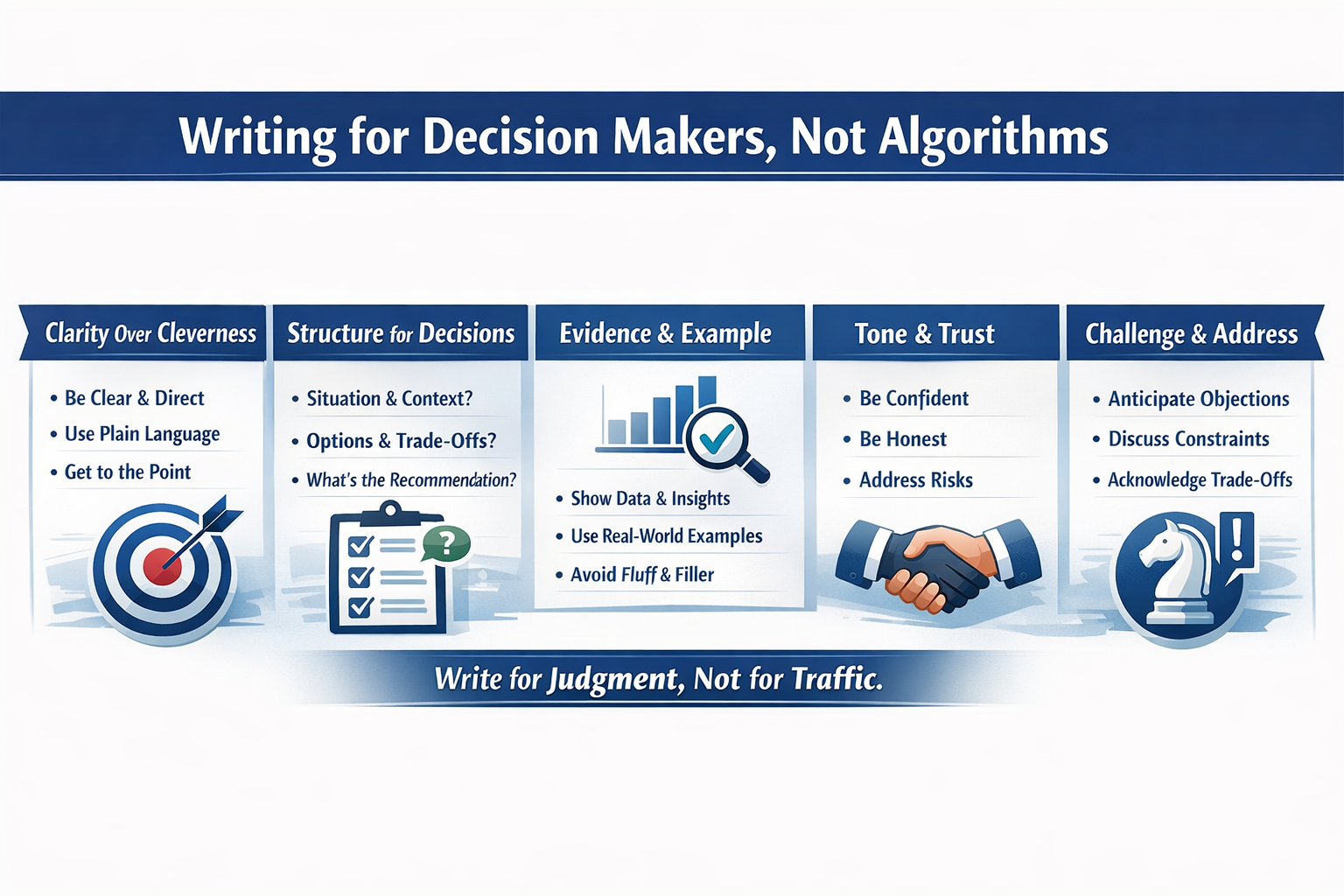
Writing for decision makers. Not algorithms is a smarter, human-first approach that prioritises clarity, credibility, and real-world impact over keyword stuffing and empty optimization.
Introduction: Writing for decision makers. Not Algorithms
In boardrooms, executive inboxes, and strategy decks, one truth stands out: decision makers don’t read like algorithms. They scan for value, judge credibility instantly, and decide quickly whether something is worth their time. That’s why Writing for decision makers. Not algorithms, but also critical skills become critical skills in modern business communication.
While algorithms reward keywords, backlinks, and formatting tricks, decision makers reward insight, clarity, relevance, and trust. This article explores how to shift your writing from machine-first to human-first, without sacrificing visibility, and how that shift leads to influence, buy-in, and real outcomes.
Why writing for algorithms falls flat with executives
Algorithms optimize for signals, humans optimize for meaning
Search engines look for patterns. Executives look for answers. When content is written primarily for algorithms, it often becomes:
- Overloaded with keywords
- Repetitive and generic
- Light on original thinking
- Heavy on fluff and light on substance
Decision makers notice this immediately. They’ve seen it all before.
The cost of algorithm-first content
When writing fails to respect the reader’s intelligence, it leads to:
- Loss of credibility
- Skipped emails and unread reports
- Missed opportunities to influence strategy
Writing for decision makers. Not algorithms flip the priority: human judgment comes first.
How decision makers actually read
They scan before they commit
Executives rarely read word-for-word. They:
- Skim headings
- Look for bold insights
- Jump to conclusions and recommendations
Your structure must reward scanning while still delivering depth.
They ask one core question
“Is this useful to me right now?”
If your writing doesn’t answer that within seconds, it’s dismissed, no matter how well it’s optimized.
7 shifts that make writing matter to decision makers
1. Lead with insight, not introductions
Decision makers don’t need warm-ups. Start with:
- A sharp insight
- A surprising data point
- A clear business implication
Weak opening:
“Digital transformation is important in today’s fast-paced world…”
Strong opening:
“Companies that delay digital transformation by just one year lose measurable market share, often permanently.”
2. Replace keywords with clear positions
Algorithms like neutral phrasing. Decision makers value the point of view.
Instead of listing possibilities:
- Take a stance
- Explain why it matters
- Acknowledge trade-offs
Clarity beats coverage every time.
3. Write like you’re accountable for the outcome
Ask yourself:
- Would I defend this recommendation in a meeting?
- Would I sign my name under this claim?
Writing for decision makers. Not algorithms means standing behind your words with confidence and evidence.
4. Use structure to signal intelligence
Smart structure builds trust:
- Short sections
- Clear subheadings
- Bullet points for decisions and implications
This shows respect for the reader’s time and cognitive load.
5. Translate complexity into decisions
Decision makers don’t want theory, they want implications.
For every insight, answer:
- What should we do?
- What happens if we don’t?
- What changes if we act now?
6. Prioritise credibility over volume
Long content doesn’t equal valuable content. Executives prefer:
- Fewer words
- Better judgment
- Relevant experience
Cite credible sources when helpful (for example, frameworks from trusted consultancies like McKinsey or HBR), but don’t hide behind them.
7. Optimize for humans first, then Machines
The irony? Content written for humans often performs better with algorithms anyway.
Why?
- Clear structure improves readability
- Genuine insight earns backlinks
- Trustworthy content gets shared
Human-first writing and SEO are not enemies, priority is the difference.
Common mistakes when writing for decision makers
| Mistake | Why it fails |
|---|---|
| Overexplaining basics | Feels condescending |
| Hiding conclusions | Wastes time |
| Buzzword-heavy language | Signals shallow thinking |
| No clear recommendation | Creates friction |
Writing for decision makers. Not all algorithms avoid all four.
Most business content doesn’t fail because it’s badly written. It fails because it’s fundamentally invisible. If you’re publishing “useful” articles that never rank, never get shared, and never convert, the problem isn’t effort, it’s positioning. I break this down in detail in why most business content is invisible, including the structural mistakes that keep brands trapped in zero-impact content loops and what actually makes content earn attention instead of begging for it.
When SEO still matters (and how to handle it)
SEO isn’t useless, it’s just secondary.
Best practice:
- Write the article for humans first
- Edit for clarity and flow
- Lightly optimize headlines and meta data afterward
This keeps your content discoverable without sacrificing authority.
For balanced guidance, resources like Search Engine Journal explain how human-centred content aligns with long-term search performance.
Frequently asked questions
Is SEO completely irrelevant when writing for decision makers?
No. SEO helps content get found. But once found, human judgment determines impact. Optimize lightly, write deeply.
How long should the content for decision makers be?
As long as necessary, and no longer. Brevity with substance is ideal.
Can storytelling work for executives?
Yes, if the story reveals insight. No, if it delays the point.
Should I use technical language?
Only when it increases precision. Never to sound impressive.
What’s the biggest mistake writers make?
Trying to sound smart instead of being useful.
How do I know if my writing is effective?
If readers reference it in meetings or decisions, it worked.
Conclusion: Write for humans who decide
Algorithms don’t approve budgets.
They don’t hire leaders.
They don’t choose strategies.
People do.
Writing for decision makers means respecting their time, intelligence, and responsibility. When you stop writing for machines and start writing for judgment, your words gain real power.
That’s when writing stops being content, and starts being influence.