
Amrudin Ćatić
Strategy, creativity, and technology are combined to craft digital experiences that perform. Smart marketing meets creative execution, always focused on growth, problem-solving, and real impact.
Why quality breaks at scale (and what testing usually misses)
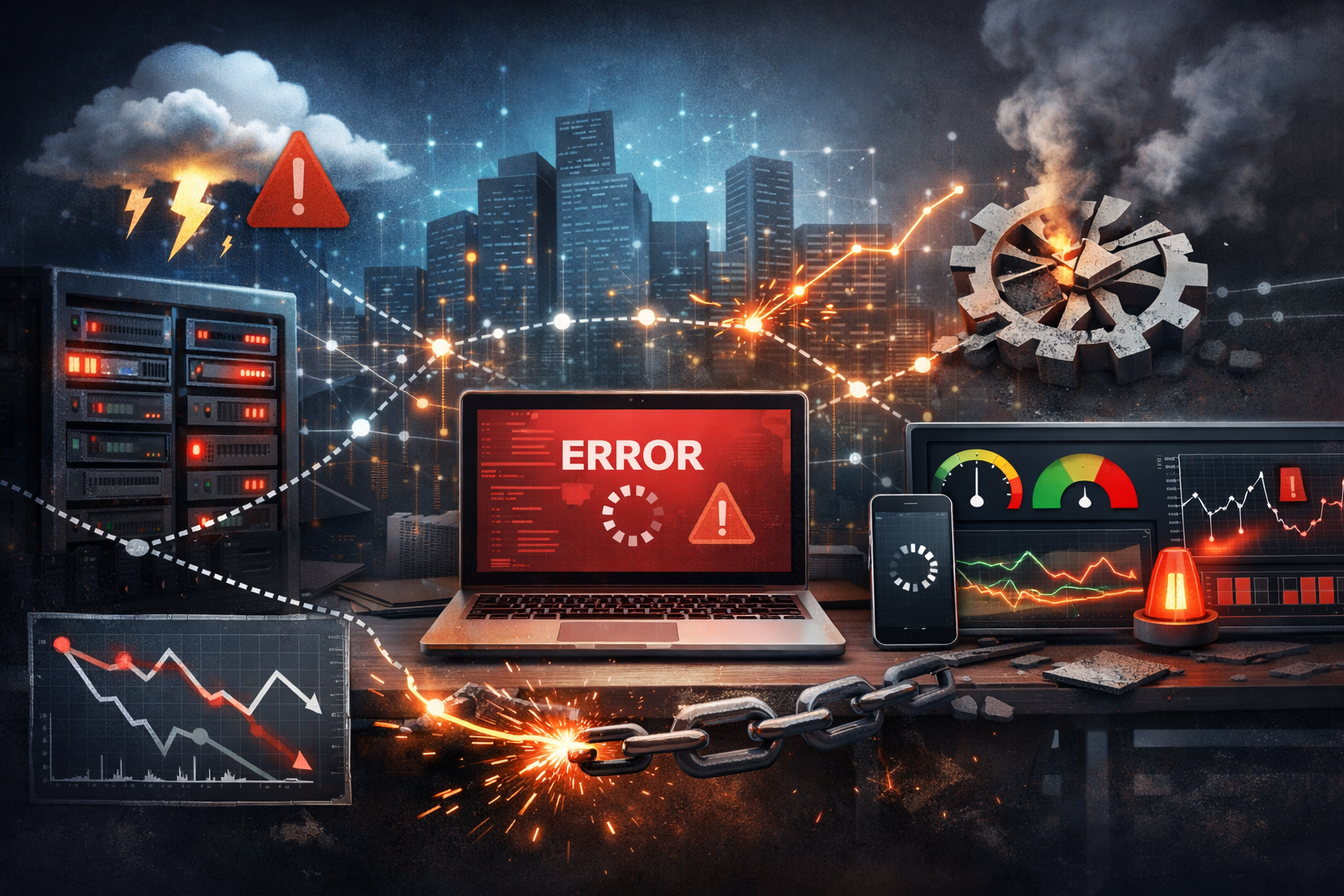
Why quality breaks at scale (and what testing usually misses) explains the hidden risks of growth, overlooked testing gaps, and practical strategies to protect quality as systems, teams, and products expand.
Understanding “Quality” beyond bugs
When people talk about quality, they often mean “Does it work?” In small systems, that definition can be enough. But why quality breaks at scale (and what testing usually misses) starts with a deeper truth: quality is more than bug-free code.
Functional vs. Experiential quality
Functional quality asks whether a feature behaves as designed. Experiential quality asks whether users trust, enjoy, and succeed with the system. At scale, users don’t experience features in isolation, they experience latency, inconsistency, confusing edge cases, and rare failures that testing environments rarely reproduce.
Quality as a system property
Quality is not owned by a single function or test suite. It emerges from how infrastructure, code, data, and people interact. As scale increases, these interactions multiply, making quality harder to predict and easier to break.
Why scale changes everything
Complexity explosion
At a small scale, systems behave almost linearly. Double the users, double the load, simple enough. At scale, relationships turn exponential. Small changes trigger large effects, and tiny defects suddenly matter.
This is a core reason why quality breaks at scale (and what testing usually misses): tests are designed for controlled conditions, not complex ecosystems.
Non-linear failure patterns
Failures at scale are rarely clean or isolated. Instead, they cascade. A minor delay becomes a timeout. A timeout triggers retries. Retries overload a service. Suddenly, the whole system degrades, even though no single component is “broken” in tests.
The illusion of passing tests
Why test coverage is not safety
High test coverage looks comforting. Yet coverage only proves that code paths were executed, not that the system behaves correctly under real conditions. Tests rarely simulate:
- Millions of concurrent users
- Partial outages
- Corrupted or unexpected data
False confidence from green dashboards
Teams often equate green CI pipelines with quality. This creates blind spots. When quality breaks at scale, teams are surprised, not because warning signs were absent, but because dashboards didn’t show them.
What traditional testing usually misses
Edge cases at volume
A one-in-a-million bug sounds harmless until you have ten million users. At scale, rare events become daily events. Most testing strategies ignore statistical inevitability.
Real-world user behaviour
Users don’t follow test scripts. They click fast, reload pages, abandon flows, switch devices, and operate on slow networks. These behaviours expose flaws that scripted tests never cover.
Cross-system interactions
Modern products depend on APIs, third-party services, caches, and queues. Each may pass its own tests, yet fail collectively. This interaction gap is a classic example of what testing usually misses.
Organisational causes of quality breakdown
Team silos and ownership gaps
As organisations scale, ownership fragments. No single team sees the whole picture. Quality issues slip through the cracks because everyone owns a part, but no one owns the experience.
Speed pressure, and incentives
Growth rewards speed. Quality work, like resilience testing or refactoring, often lacks a visible short-term payoff. Over time, this imbalance quietly erodes quality.
Data, scale, and silent failures
Monitoring vs. Testing
Testing asks, “Does this work under expected conditions?”
Monitoring asks, “What is happening right now?”
At scale, monitoring becomes more important than testing. Many failures are silent, users struggle, but systems stay “up.”
When metrics hide reality
Aggregated metrics can lie. Averages hide pain. Ten percent of users suffering badly may not move the average at all. Quality breaks quietly while dashboards stay calm.
Designing for quality at scale
Shift-left and shift-right Testing
- Shift-left: Think about quality early, design, architecture, and data modelling.
- Shift-right: Validate quality in production using real traffic, feature flags, and controlled experiments.
Together, they address why quality breaks at scale (and what testing usually misses) more effectively than tests alone.
Chaos and resilience thinking
Instead of asking, “Will this fail?” ask, “How will this fail, and how fast can we recover?” Designing for failure is a hallmark of high-quality systems at scale.
Case patterns: How quality actually fails
Gradual degradation
Performance slowly worsens. Users adapt or leave. The system technically “works,” but quality is gone.
Sudden cascading failure
A small incident triggers a chain reaction. Recovery is slow because no one has tested this exact combination of failures.
Also, Netflix, on their TechBlog, openly documents production failures, chaos engineering, and scaling lessons, perfect real-world proof of my “arguments”.
Practical strategies to prevent quality decay
Test what matters, not what’s easy
- Focus on user journeys, not just functions
- Prioritise high-impact failures
- Use production-like data carefully
Invest in observability
Logs, metrics, and traces tell stories that tests never will. Observability turns unknown failures into known problems.
In my deep-dive on SEO vs. PPC vs. Social Media – Full Funnel, I break down how each core digital channel plays a distinct role across the customer journey: SEO builds sustainable organic authority and long-term visibility, PPC delivers immediate demand capture at the top of search results, and social media fuels engagement, brand awareness and community connection. Rather than choosing one over the others, the post lays out how a full-funnel strategy that intelligently blends these tactics drives both short-term results and compounding growth, with clear guidance on when and why to lean into each based on business goals.
FAQs
Why does quality often decline after rapid growth?
Rapid growth increases complexity faster than processes adapt, exposing gaps that testing was never designed to catch.
Is more testing the solution?
Not necessarily. Smarter testing, combined with monitoring and resilience practices, matters more than quantity.
What is the biggest misconception about testing at scale?
That passing tests equals safety. At scale, it rarely does.
How can teams detect quality issues earlier?
By listening to users, tracking behaviour, and monitoring real-world performance, not just test results.
Does automation solve scale-related quality problems?
Automation helps, but it cannot replace system-level thinking and observability.
What’s the first step to improving quality at scale?
Accept that failures are inevitable, and design systems to handle them gracefully.
Conclusion
Why quality breaks at scale (and what testing usually misses) is ultimately about mindset. Quality is not a checkbox, a test suite, or a dashboard colour. It is an ongoing practice shaped by scale, complexity, and human behaviour. Organisations that recognise this early don’t eliminate failure, but they survive it, learn from it, and build systems users can trust.