
Amrudin Ćatić
Strategy, creativity, and technology are combined to craft digital experiences that perform. Smart marketing meets creative execution, always focused on growth, problem-solving, and real impact.
Why most business content is invisible (and deserves to be): 7 uncomfortable truths about modern marketing
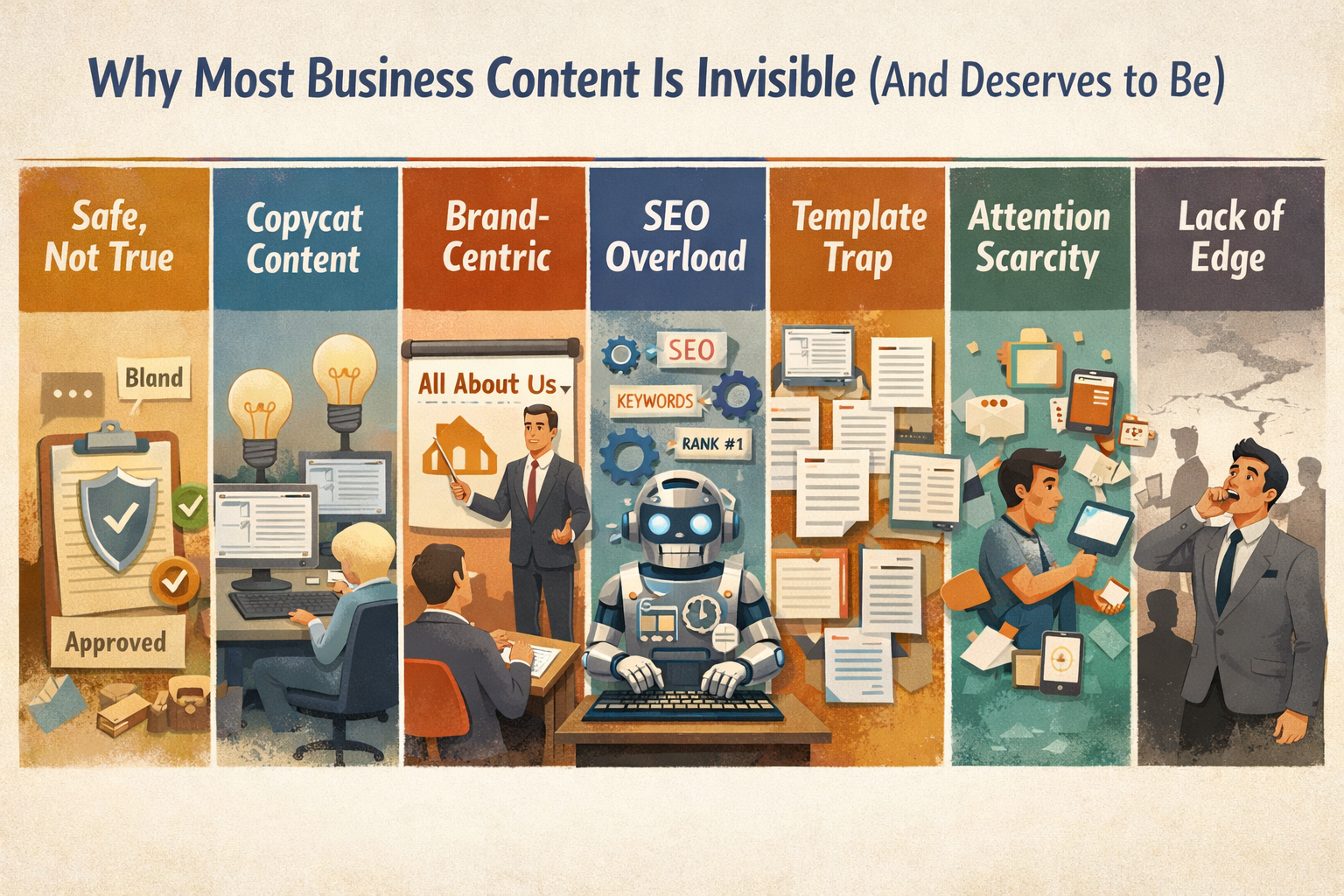
Why most business content is invisible (and deserves to be) because it’s generic, risk-averse, and disconnected from real audiences. This out-of-the-box breakdown explains why content fails and what professionals must do instead.
The uncomfortable reality of modern business content
Let’s start with a truth most professionals sense but rarely say out loud: the internet is not short on content, it’s short on meaning.
Every day, companies publish blogs, whitepapers, LinkedIn posts, newsletters, and “thought leadership” pieces that technically check all the boxes. They’re polished. They’re grammatically correct. They follow SEO rules. And they vanish without a trace.
This is Why most business content is invisible (and deserves to be) isn’t an insult. It’s a diagnosis.
Content isn’t invisible because audiences are lazy. It’s invisible because it gives people nothing to hold onto. No friction. No tension. No new thinking. Just familiar phrases wrapped in professional language.
Everyone is publishing, nobody is remembered
In professional spaces, publishing content has become performative. Companies publish because they’re supposed to, not because they have something urgent to say. The result? A flood of interchangeable insights that all sound vaguely correct and deeply forgettable.
Visibility doesn’t disappear randomly. It disappears when content adds no value to the mental landscape of its audience.
This isn’t just anecdotal. Research published by Harvard Business Review has repeatedly shown that undifferentiated content blends into the background, especially when it avoids clear points of view in favor of safe, consensus-driven messaging.
Why most business content is invisible (and deserves to be): The core reasons
It’s written to sound safe, not true
Most business content is engineered to avoid risk. Every sentence is filtered through legal, brand, and reputational safety nets. What survives is language so neutral it barely says anything at all.
Safe content rarely offends, but it also rarely resonates.
Truthful content, on the other hand, creates tension. It draws lines. It risks disagreement. That’s exactly why people remember it.
It copies competitors instead of challenging them
Open ten blogs in the same industry, and you’ll notice something eerie: they all sound like they were written by the same person on different days.
That’s because much of today’s content is reverse-engineered from competitors. Instead of asking, “What do we actually believe?” teams ask, “What are others ranking for?”
Imitation doesn’t create authority. It creates noise.
It talks about the brand, not the reader
Professionals don’t wake up wanting to read about your company’s “journey” or “mission.” They want clarity, insight, and help navigating complexity.
When content is brand-centric instead of reader-centric, it fails instantly. Attention is selfish, and rightly so.
It’s optimized for algorithms, not humans
SEO matters, but when keywords drive thinking instead of supporting it, content collapses into mechanical filler. Search engines are increasingly human-like, but audiences spot inauthentic writing immediately.
The paradox? Content that genuinely helps people often performs better anyway.
The illusion of “Best practices”
How templates quietly kill originality
Frameworks, formulas, and templates are useful, until they become substitutes for thinking. When everyone follows the same “proven structure,” originality suffocates.
Professionals don’t need more polished templates. They need sharper ideas.
Best practices should be starting points, not creative ceilings.
Attention is earned, not requested
Why disruption beats consistency
Consistency is often praised in branding, but consistency without insight is just repetition. The brands and professionals who break through aren’t louder, they’re clearer.
They:
- Say fewer things, but mean them deeply
- Challenge assumptions instead of reinforcing them
- Choose perspective over politeness
Disruption doesn’t mean being provocative for shock value. It means being honest when honesty feels uncomfortable.
To build trust and convert readers without sounding desperate, you need a content strategy that sells with authority rather than begging for attention. In my recent deep-dive guide on crafting high-impact content, I break down the exact structure and psychological triggers that turn casual visitors into buyers – no gimmicks, just proven mechanics businesses use to scale organically. Check out how to create business content that sells with authority here and start reshaping your messaging for real results.
What visible content actually does differently
Clear thinking beats clever wording
Memorable content isn’t verbose, it’s precise. It reflects time spent thinking, not just writing. Professionals respect clarity because clarity is rare.
Strong content sounds simple after it’s been thought through deeply.
Point of view beats volume
Publishing more won’t fix invisibility. Publishing with intent will.
Content that works usually has:
- A clear stance
- A defined audience
- A reason to exist beyond traffic
When people recognise your point of view, they start looking for your name, not just your keywords.
Frequently asked questions
Why do most professional blog posts fail to get attention?
Because they prioritize safety, sameness, and volume over originality, relevance, and insight.
Is invisibility always a bad thing for business content?
No. Content that exists only to “check a box” should be invisible. Attention should be reserved for ideas that earn it.
Can SEO content still be original?
Absolutely. SEO should support clarity, not replace thinking. Human-first content often performs best long term.
Do professionals really want bold content?
Yes. When it’s thoughtful, informed, and respectful of their intelligence.
How long does it take to build visible content authority?
Consistency with a clear point of view compounds faster than high-volume generic publishing.
What’s the first step to fixing invisible content?
Stop asking, “What should we publish?” and start asking, “What do we believe that others won’t say?”
Conclusion: Invisibility is earned, too
Why most business content is invisible (and deserves to be) isn’t about shaming marketers. It’s about freeing them.
Invisible content fails because it’s cautious, copied, and disconnected from real thinking. Visible content succeeds because it respects the audience enough to challenge them.
If your content disappears, don’t ask how to promote it harder. Ask whether it deserved attention in the first place.
Because in today’s attention economy, silence isn’t the enemy; insignificance is.