
Amrudin Ćatić
Strategy, creativity, and technology are combined to craft digital experiences that perform. Smart marketing meets creative execution, always focused on growth, problem-solving, and real impact.
SEO vs PPC vs Social media: Full funnel marketing explained
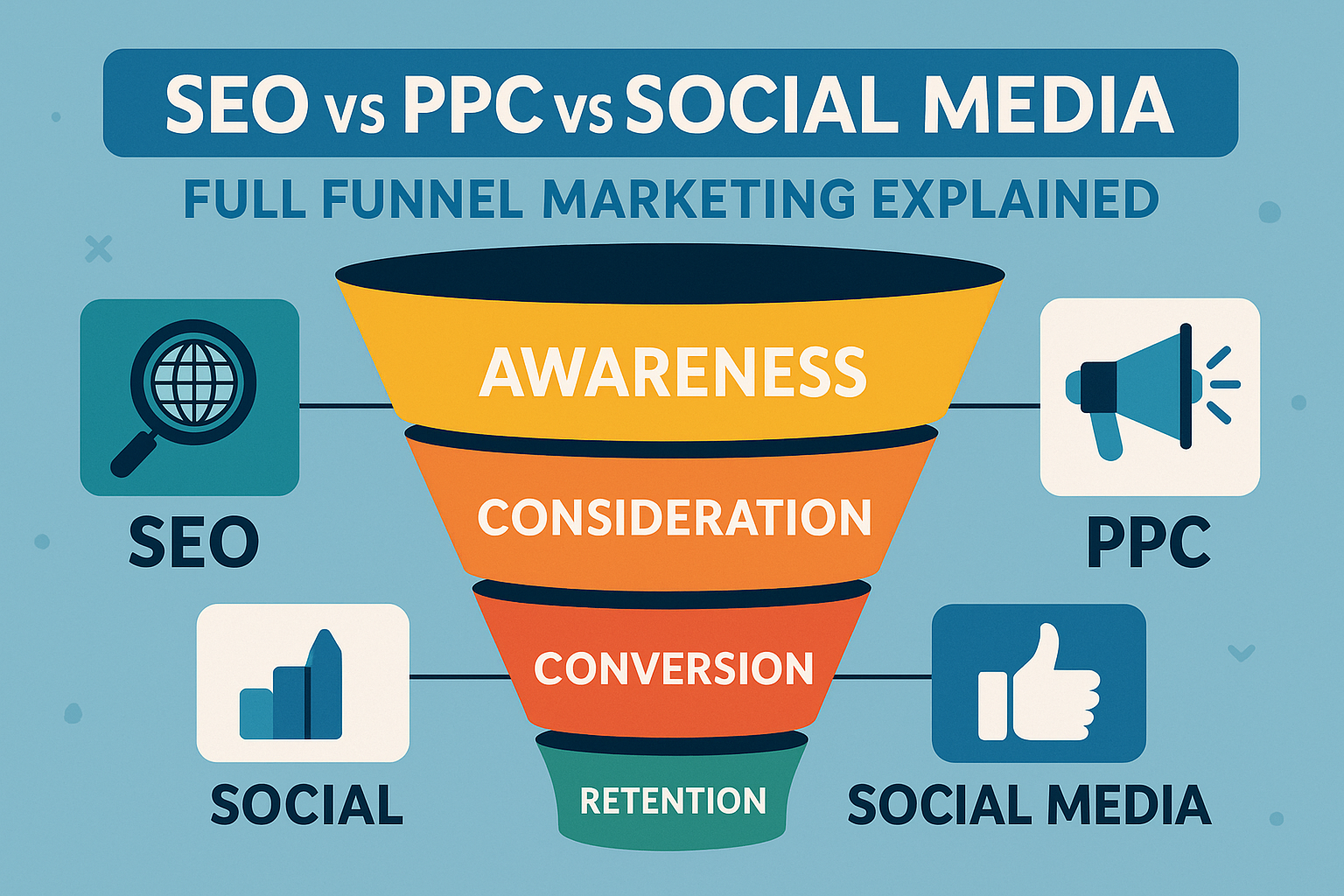
SEO vs PPC vs Social media: Full funnel marketing explained. Learn how each channel works at every stage of the marketing funnel, how they compare, and how to build the perfect multi-channel strategy to grow your business.
Understanding the full funnel marketing framework
Full funnel marketing is a powerful way to guide people from discovering your brand to becoming loyal customers. To understand how SEO vs PPC vs Social media: Full funnel marketing explained works, you first need to understand how the funnel itself operates.
What is a marketing funnel?
A marketing funnel is a framework that illustrates the journey a customer takes, from discovering a brand to making a final purchase. Think of it like a path that narrows as a person moves from curiosity to commitment.
The stages of the funnel
Most funnels include these four major stages:
- Awareness – People learn about your brand.
- Consideration – They compare options and gather information.
- Conversion – They make a purchase.
- Retention – They keep interacting with your brand long-term.
Understanding these stages helps you see how SEO, PPC, and social media impact each step differently.
Awareness stage: Top-of-funnel traffic drivers
When you want people to discover your brand, visibility matters more than ever. Here’s how each channel contributes.
Role of SEO in awareness
SEO shines at the top of the funnel by helping your content rank for broad, informational keywords. It attracts users who are searching for information related to your industry. It’s slow but sustainable.
Social media for rapid reach
Social media platforms, like Instagram, TikTok, and Facebook, can create a massive reach almost instantly. Viral content, short videos, and trending hashtags help you get in front of the right audience quickly.
PPC for instant visibility
PPC ads put your brand in front of potential customers even if they’ve never heard of you. You can bid on general keywords like “best running shoes” and appear instantly at the top of search results.
Consideration Stage: Nurturing warm prospects
At this point, people know about your brand but still need more information.
SEO for informational intent
SEO helps answer questions that users have while comparing options. Articles like “How to choose the right marketing tool” or “Best laptops for students” perform well in this stage.
PPC for high-intent searches
PPC can target people who are nearly ready to buy. Keywords like “marketing agency pricing” or “software demo” indicate stronger interest.
Social media for engagement and retargeting
Social media retargeting ads gently remind users who already interacted with your brand to return and explore more.
Conversion stage: Turning interest into sales
This is the bottom of the funnel, where money is made.
PPC as a direct conversion channel
PPC is powerful for conversions because it targets keywords like “buy now,” “discount,” or “free trial.” These are high-intent searches.
SEO for organic conversions
People often trust organic search results more than ads. Product pages, service pages, and comparison articles help convert organic traffic.
Social media conversion paths
With improved shopping tools, social media now enables in-app purchases, link-in-bio funnels, and influencer-driven conversions.
Comparing SEO vs PPC vs Social Media across the funnel
Let’s compare all three across key performance areas.
Cost differences
- SEO: Lower cost long-term, higher cost upfront.
- PPC: High cost but predictable.
- Social: Flexible budget depending on content and ads.
Time to results
- SEO: Slow and steady.
- PPC: Instant gratification.
- Social: Fast, but requires consistency.
Audience behavior
Each channel attracts unique users, and understanding this helps you build a smarter strategy.
Multi-channel synergy in a full funnel strategy
Your marketing works best when all channels support each other.
How SEO, PPC, and Social work together
For example:
- SEO creates demand
- PPC captures demand
- Social fuels awareness and engagement
Avoiding channel silos
When teams work separately, data gets lost. A combined approach leads to better targeting and reduced costs.
Budget allocation strategies across the funnel
Startup budget allocation
- 40% Social (awareness)
- 30% PPC (quick wins)
- 30% SEO (foundation)
Enterprise budget allocation
- 50% SEO
- 25% PPC
- 25% Social
Industry-specific strategies
E-commerce may need more PPC. B2B may lean more on SEO.
Measuring full funnel performance
Top-of-funnel metrics
- Impressions
- Reach
- CTR
Mid-funnel metrics
- Time on site
- Engagement
- Retargeting click-throughs
Bottom-of-funnel metrics
- Conversions
- Cost per acquisition
- ROAS
Want to future-proof your career and know exactly what digital marketers need to win in 2026? Check out Digital Marketing Career 2026, a strategic breakdown of the roles, skills, and trends that will define success in the next chapter of online marketing.
Tools to implement full funnel marketing
SEO Tools
PPC Tools
Social Media Tools
Common mistakes in full funnel marketing
Over-reliance on one channel
Businesses often depend on PPC only, which becomes costly.
Ignoring attribution models
A user may have seen your brand multiple times before converting.
Case study: A realistic full funnel mix
E-commerce example
- SEO for product guides
- PPC for Google Shopping
- Social ads for retargeting
SaaS example
- SEO for comparisons
- PPC for demos
- Social for webinars
Future trends: AI, Predictive analytics, and Personalization
AI-driven insights will help better forecast user behavior and personalize every step of the funnel. Automation will make strategies smarter, faster, and more effective.
FAQs about SEO vs PPC vs Social media
1. Which channel works fastest?
PPC delivers the quickest results because ads show instantly.
2. Is SEO still worth it in 2026?
Absolutely. SEO remains the highest-ROI channel long-term.
3. What is the best channel for brand awareness?
Social media dominates the top of the funnel for awareness.
4. Can these channels work together?
Yes! Using all three creates a stronger, more efficient funnel.
5. What’s the most affordable option?
SEO is cost-effective long term but requires time.
6. How do I know which channel to prioritize?
It depends on goals, awareness, traffic, and conversions.
Conclusion: Building a winning full funnel marketing strategy
Understanding SEO vs PPC vs Social media: Full funnel marketing explained helps you build a lasting, powerful marketing system. When used together, these channels create a pipeline of traffic, leads, and loyal customers.
The concept of the purchase funnel explains how different channels like SEO, PPC, and social media contribute at each stage of the customer journey, from awareness to conversion and beyond (see the purchase funnel definition on Wikipedia).