
Amrudin Ćatić
Strategy, creativity, and technology are combined to craft digital experiences that perform. Smart marketing meets creative execution, always focused on growth, problem-solving, and real impact.
SEO vs Google Ads in 2025 recap

This guide delivers a full SEO vs Google Ads in 2025 recap, covering performance, costs, trends, and strategies to help businesses choose the right approach.
In the fast-changing world of digital marketing, comparing SEO vs Google Ads in 2025 has become more important than ever. With Google integrating AI deeply into its search ecosystem and user behavior evolving fast, businesses need updated insights to decide which channel gives them the best ROI. This recap breaks down everything you need to know in a clear, practical, and future-ready guide.
Understanding the fundamentals in 2025
What SEO means in 2025
SEO in 2025 is no longer just about rankings, it’s about search experience optimization. Google’s AI-driven Search Generative Experience (SGE), voice search, semantic indexing, and E-E-A-T have reshaped how webpages earn visibility.
Modern SEO focuses on:
- Answering user intent with precision
- Structuring content for AI summaries
- Building brand trust and authority
- Delivering fast-loading, mobile-friendly experiences
SEO remains a long-term, sustainable strategy that compounds over time.
What Google Ads means in 2025
Google Ads in 2025 is far more automated than earlier years. AI now handles:
- Smart bidding
- Audience segmentation
- Ad copy variations
- Predictive analytics
Marketers spend more time on strategy and less on manual adjustments. Google Ads is still the fastest way to drive traffic and conversions, especially for high-intent searches.
Key differences between SEO and Google Ads today
Cost structure comparison
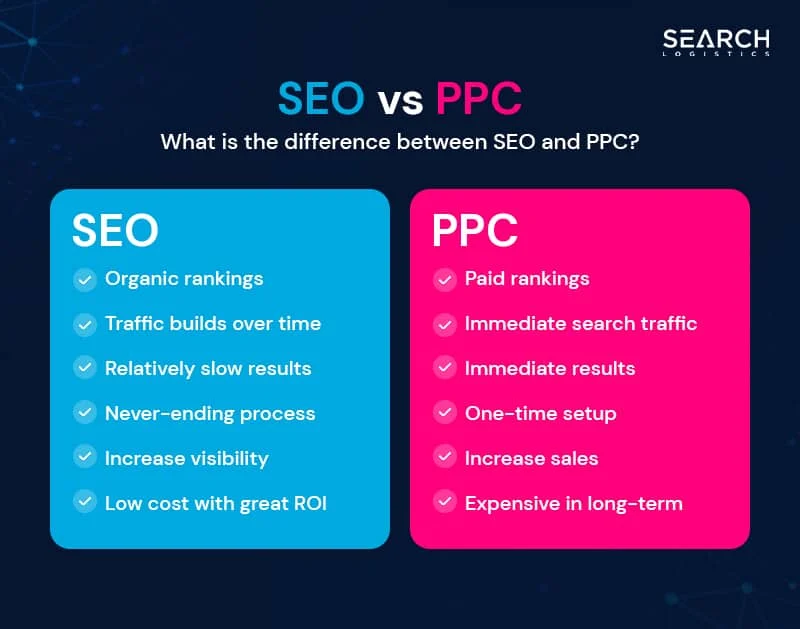
SEO requires upfront investment in content, optimization, and technical improvements. However, once pages rank, they can drive long-term traffic without paying per click.
Google Ads, on the other hand:
- Charges for every click
- Increases in cost annually due to competition
- Requires continuous spending to stay visible
In 2025, PPC costs have risen by 12–20% across most industries.
Targeting and user intent
SEO captures broad, mid-funnel, and long-tail traffic effectively.
Google Ads excels at:
- High-intent buyer searches
- Hyper-targeted audiences
- Local conversions
This difference helps brands choose where to allocate their budgets.
Speed of results in 2025
SEO = Takes months but lasts for years.
Google Ads = Instant visibility but disappears once you stop paying.
A balanced strategy uses both.
SEO vs Google Ads in 2025 recap – Performance breakdown
Traffic quality and conversion trends
Studies throughout 2024–2025 show:
- Organic traffic has higher long-term trust
- Paid traffic converts faster
- SEO leads are 60–80% cheaper
- Google Ads leads are more predictable
Quality depends on industry, audience, and offer.
AI-Driven Ranking and Ad Optimization
AI impacts both channels:
SEO changes:
- Google rewards human experience
- High-quality, original content is essential
- AI summaries often reduce click-through rates
Google Ads changes:
- Machine learning optimizes ads automatically
- Smart bidding enhances ROI
- Predictive targeting boosts conversions
In 2025, the game is about adapting, not resisting, the AI shift. If you want to understand where Google is leading technical SEO through the next cycle, especially in the context of performance, stability and UX signals, check out my detailed guide on SEO Core Web Vitals 2026 and the new metrics coming into play.
When to choose SEO
Long-term brand visibility
SEO builds authority and reputation.
Brands that invest consistently enjoy:
- Evergreen rankings
- Lower long-term acquisition costs
- Multi-touch visibility across search surfaces
Cost efficiency over time
SEO is ideal for:
- Blogs
- E-commerce
- SaaS companies
- Local businesses
It’s the best option for organic growth and brand trust.
When to choose Google Ads
Instant traffic and testing
Google Ads is unbeatable when you need:
- Immediate sales
- Split-testing landing pages
- Seasonal or event-based traffic
High-intent keyword targeting
Google Ads captures users ready to buy right now.
Perfect for lead generation, B2B, service businesses, and e-commerce.
Using both SEO and Google Ads together
Omnichannel presence
Consumers now expect brands to appear everywhere.
Combining both channels:
- Strengthens brand recall
- Covers the entire search funnel
- Improves keyword dominance
Data integration benefits
When used together:
- Ad data reveals high-converting keywords
- SEO reduces your long-term PPC costs
- Analytics becomes more robust
This hybrid strategy gives businesses the best of both worlds.
SEO vs Google Ads in 2025 recap – Comparison Table
| Feature | SEO | Google Ads |
|---|---|---|
| Cost | Low long-term cost | High ongoing cost |
| Speed | Slow (months) | Instant |
| Trust | Very high | Moderate |
| Control | Limited | Very high |
| Sustainability | Strong | Disappears when budget stops |
| Best For | Long-term growth | Short-term wins |
For more industry insights, you can explore Google’s marketing resources.
FAQs
1. Is SEO better than Google Ads in 2025?
Not necessarily, SEO is better long-term, while Google Ads is better for instant results.
2. Are Google Ads becoming too expensive?
Yes, CPC rates continue rising, making SEO crucial for balancing budgets.
3. Is SEO still worth it with AI search?
Absolutely. AI highlights authoritative content, making strong SEO even more valuable.
4. Should small businesses use SEO or Google Ads?
Both. Local SEO builds trust; Google Ads drives immediate leads.
5. How long does SEO take in 2025?
Most websites see results within 3–6 months with consistent effort.
6. Are Google Ads necessary for new websites?
They’re not required but very helpful for generating early traffic.