
Amrudin Ćatić
Strategy, creativity, and technology are combined to craft digital experiences that perform. Smart marketing meets creative execution, always focused on growth, problem-solving, and real impact.
SEO vs GEO vs AEO: Powerful breakdown (What actually matters)
Most marketers talk about SEO like it’s still 2018. They cling to outdated playbooks, obsess over backlinks, and treat “visibility” like it’s one uniform channel. That’s why they lose.
The truth:
You’re not competing in one arena anymore, you’re competing in three completely different ecosystems, each with its own rules, ranking logic, and failure points.
- SEO controls who survives the long game.
- GEO decides who gets paid today.
- AEO determines who exists in the AI world at all.
Most brands misunderstand all three. Let’s fix that.
What “SEO vs GEO vs AEO” really means today
Search is no longer a website ranking contest, it’s a visibility war across engines, maps, and AI models. If you don’t optimise for all three, you’re invisible in at least one major discovery channel.
And no, these channels don’t overlap as much as you wish they did.
They collide, they cannibalise, they punish laziness.
Let’s break each one down properly.
SEO: The long game most businesses pretend they’re playing
Traditional SEO still matters, but only if you approach it like a strategist, not a blogger.
SEO is about earning algorithmic trust:
- Depth > length
- Authority > volume
- Strategy > hacks
Even Moz’s foundational SEO principles point directly to trust, expertise, and topic depth.
Most people fail because they treat SEO like a checklist instead of what it is:
a compounding asset that grows only if you stop writing trash.
What SEO actually impacts
- Whether Google takes your brand seriously
- Whether you own long-tail queries that your competitors ignore
- Whether your site ages like wine instead of milk
- Whether AI engines use your content as source material
Strengths
- Scales infinitely if done right
- Builds authority that AEO pulls from
- Owns intent-rich users
Weaknesses
- Slow if you’re not producing true expertise
- Punishing in competitive niches
- Fragile if your strategy is shallow
SEO works, but only if your content earns its place.
GEO: The most brutal but profitable channel
GEO isn’t about “local marketing.” That’s amateur hour.
GEO is about dominating Google Maps, and Google Maps plays by prison rules:
- Proximity beats authority.
- NAP errors destroy rankings overnight.
- Reviews are your oxygen.
- Inconsistent citations suffocate you.
- LSAs (Local Service Ads) are eating the top of the SERP alive.
Whitespark’s Local Ranking Factors study shows citations and review velocity still directly impact Map Pack results.
Most local businesses think they’re doing SEO when they’re actually ignoring the only channel that could save them.
Who needs GEO?
If you rely on foot traffic, local service delivery, or regional demand, GEO is not optional, it’s your lifeline.
Gyms, clinics, plumbers, auto repair, agencies, legal…
If you don’t dominate Maps, nothing else matters.
Strengths
- Insanely high conversion rates
- Mobile-first visibility
- Map pack = money
Weaknesses
- Can’t scale geographically without real locations
- Highly sensitive to inconsistencies
- Review velocity makes or breaks you
If SEO grows your brand, GEO feeds your family.
AEO: The New Gatekeeper
AEO (Answer Engine Optimisation) is where everyone pretends to be an expert, but almost no one is.
This is the battlefield where you fight for:
- AI Overviews
- ChatGPT answers
- Gemini snapshots
- Perplexity citations
- Voice assistant replies
And this is not “SEO but shorter.”
This is a precision-engineered answer architecture.
What AEO really optimises for
- Fast, accurate definitions
- Clean, structured data
- Zero ambiguity
- “Explain it to a machine” clarity
- Topic authority that models trust
If SEO is about winning page one, AEO is about becoming the source that AI tools quote.
If you’re not optimising for AEO, you’re feeding AI models your competitors’ answers.
Strengths
- Massive visibility in no-click environments
- Brand authority without traditional ranking battles
- AI engines prefer concise, consistent sources
Weaknesses
- Requires flawless accuracy
- Hard to monetise directly
- Destroys fluff content instantly
AEO rewards expertise. It kills filler.
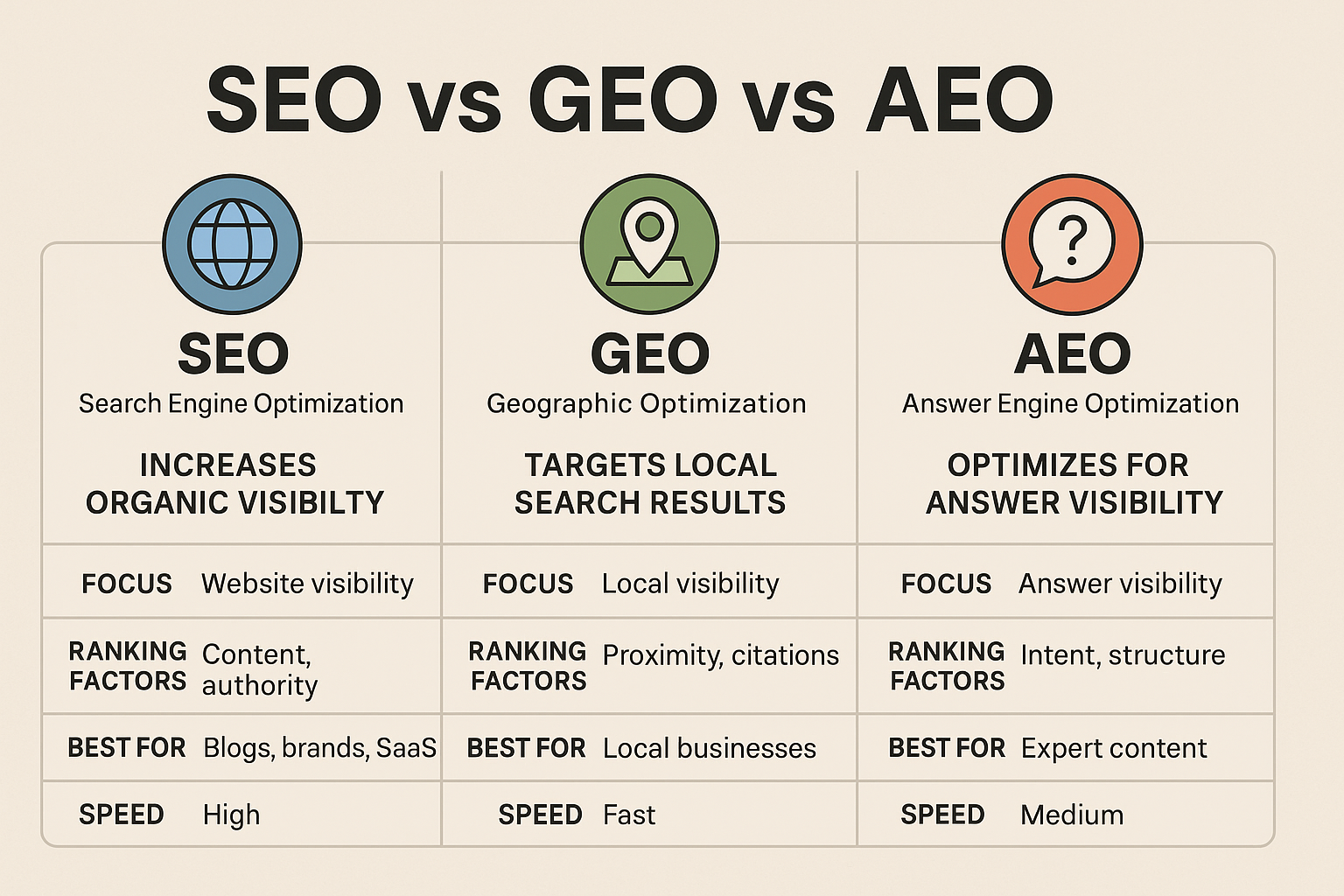
SEO vs GEO vs AEO compared
| Factor | SEO | GEO | AEO |
|---|---|---|---|
| Focus | Website visibility | Local visibility | Answer visibility |
| Ranking factors | Content, authority | Proximity, citations | Intent, structure |
| Best for | Blogs, brands, SaaS | Local businesses | Expert content |
| Speed | Medium | Fast | Medium |
| Scalability | High | Low-medium | High |
SEO vs GEO vs AEO. The stuff that actually matters
Here’s the truth nobody writes in polite blog posts:
| Factor | SEO | GEO | AEO |
|---|---|---|---|
| Visibility Type | Website | Maps | AI |
| Ranking Logic | Authority | Proximity | Clarity + Authority |
| Intent | Research & purchase | Immediate action | Instant answers |
| Scalability | High | Low–medium | High |
| Speed | Slow | Fast | Medium |
| Great For | Brands, SaaS, blogs | Local businesses | Experts, educators |
Most marketers treat these like overlapping circles.
They’re not. They’re three different universes.
When to use each (No hand-holding version)
Use SEO when:
You want to dominate long-term.
You’re playing the algorithmic trust game.
You produce content worth bookmarking.
If your blog looks like everyone else’s, forget SEO — no amount of optimisation will save mediocre thinking.
Use GEO when:
Revenue depends on Maps and local visibility.
A 5 km radius decides your income.
Your customers search “near me.”
If your NAP data is messy, your GEO strategy is dead. Fix that first.
Use AEO when:
You need visibility in AI ecosystems.
Your expertise can be broken into answers.
You want to influence the AI that influences your audience.
If your content is bloated, AEO will expose you instantly.
The only strategy that actually wins: Full-stack optimisation
Most businesses pick one channel and hope it works. That’s how you stay mediocre. If you want the real playbook for stacking channels, read my breakdown on combining SEO with Google Ads.
Winners stack all three:
- SEO builds depth
- GEO captures local demand
- AEO puts you inside AI models
This isn’t a “nice to have.”
This is the 2025 survival stack.
If you’re not visible in all three ecosystems, someone else owns the parts of the market you’re ignoring.
The real mistakes that kill brands
Let’s cut the fluff and hit the real screw-ups:
- Writing long articles with zero definitional clarity for AEO
- Targeting local keywords while ignoring local signals
- Obsessing over backlinks while your on-page intent is trash
- Publishing content that machines can’t parse
- Treating AI Overviews like a temporary phase
- Pushing updates everywhere except your citations and GMB
These aren’t small mistakes, they’re death sentences.
FAQs (Answered without bullshit)
Is AEO replacing SEO?
No. It’s replacing weak SEO.
Do all businesses need GEO?
No. Only the ones that care about customers who use Maps.
(Which is 99% of service businesses.)
Is SEO still worth it?
If you’re capable of producing actual expertise – yes.
If not, skip it. You won’t survive.
Can you combine all three?
If you don’t, your competitors will, and they’ll bury you.
Conclusion
SEO wins the long game.
GEO wins the local game.
AEO wins the AI game.
If you’re not playing all three, you’re not playing to win.