
Amrudin Ćatić
Strategy, creativity, and technology are combined to craft digital experiences that perform. Smart marketing meets creative execution, always focused on growth, problem-solving, and real impact.
SEO Core Web Vitals in 2026: What’s changed and what still matters?
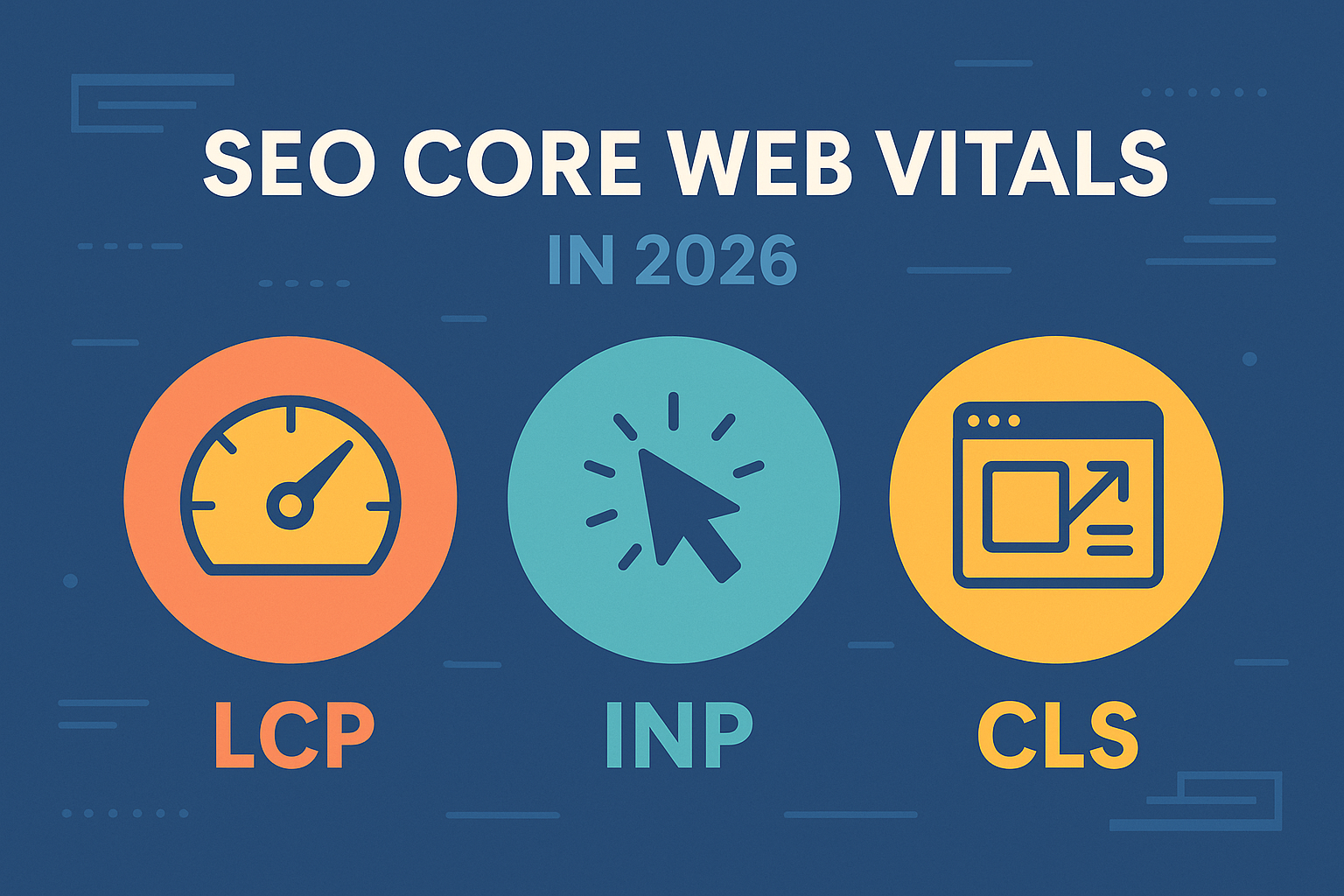
SEO continues to evolve at lightning speed, and SEO Core Web Vitals in 2026: What’s changed and what still matters? is one of the most important topics for site owners, developers, and digital marketers. As Google sharpens its focus on real user experience, Core Web Vitals have gone from “nice to have” to non-negotiable ranking factors.
This guide breaks down every update in 2026, what’s stayed the same, what’s new, and how you can optimize your site for today’s standards.
Understanding SEO Core Web Vitals in 2026
Core Web Vitals are Google’s essential performance metrics that evaluate how users experience your website. In 2026, these metrics are more accurate, more user-focused, and more predictive than ever.
They still revolve around three pillars:
- Loading performance
- Interactivity
- Visual stability
But with 2026 updates, each metric now reflects deeper insights that capture real-world user behavior.
Why Google continues to prioritize web vitals
Google’s ranking algorithm relies on user satisfaction signals. The better the experience, the higher your chances of ranking. Since 2021, Web Vitals have played a huge role, and by 2026, they’re even more tightly integrated into mobile-first indexing and UX scoring models.
What’s new in Core Web Vitals for 2026
Google introduced notable enhancements to improve accuracy and predict user frustration more effectively.
The rise of INP (Interaction to Next Paint)
INP officially replaced FID (First Input Delay) in 2024, but in 2026 it’s now stricter and more refined. This metric measures the time between a user action and the browser’s visual response.
What’s changed in 2026:
- INP now evaluates full interaction chains, not just single delays
- JavaScript-heavy sites feel the impact most
- Google rewards experiences with consistently fast interaction patterns
Evolution of CLS (Cumulative Layout Shift)
CLS remains critical, but in 2026 the thresholds have changed to reflect modern browsing habits. Websites now load more dynamic content, and CLS calculations now weigh predictive layout shifts, not accidental movement alone.
New 2026 metric: Visual Stability Index (VSI)
A major addition this year, VSI measures how stable the layout remains during the entire session.
VSI penalizes:
- Sticky ads pushing content
- Late-loading elements
- Unpredictable animation behaviors
It’s one of the biggest changes affecting rankings in 2026.
What has stayed the same?
Despite improvements, the core philosophy hasn’t changed.
Why LCP still matters in 2026
Largest Contentful Paint (LCP) still determines how fast your primary content loads. Keep it under 2.5 seconds for best results. Modern performance stacks rely on:
- Next-gen compression
- 5G/6G mobile connectivity
- Lighter frameworks
Mobile optimization standards
Mobile-first indexing remains dominating.
In 2026, the winning formula is:
- Adaptive layouts
- Priority-loading strategies
- Server-side rendering for image-heavy sites
How to optimize for SEO Core Web Vitals in 2026
Let’s explore practical, real-world optimization strategies.
Improving LCP in 2026
- Use AVIF 2.0 and WebP2 image formats
- Implement edge caching
- Remove render-blocking resources
- Utilize intelligent preloading
Boosting INP for faster interactions
- Break long tasks using scheduler APIs
- Minimize third-party scripts
- Use async frameworks
- Optimize event handlers
Minimizing CLS and VSI issues
- Always reserve space for media
- Avoid lazy-loading elements above the fold
- Preload fonts to avoid shifts
- Use CSS containment for animations
Tools to measure Core Web Vitals in 2026
Key tools include:
- Google Search Console
- PageSpeed Insights with real-device testing
- Chrome User Experience Report (CrUX)
- Real User Monitoring (RUM) dashboards
A great resource to stay updated is Google’s own guidelines:
https://web.dev
Common myths about Core Web Vitals in 2026
- “They don’t impact rankings anymore.” – They absolutely do.
- “Great scores guarantee #1 ranking.” – SEO is multifactorial, and technical performance is only one pillar. If you want to see where modern grey-hat approaches come into play and what still works in 2026, check out my detailed guide: Grey Hat SEO in 2026.
- “Only developers need to care.” – Marketers rely on UX too.
Future predictions beyond 2026
- AI-based ranking scores
- Personalized performance metrics
- Behavior-adaptive UX scoring
- Dynamic thresholds by industry
FAQs about SEO Core Web Vitals in 2026
1. What are the biggest changes in 2026’s Core Web Vitals?
The introduction of VSI and updated INP evaluation.
2. Does INP completely replace FID now?
Yes, FID is no longer used at all.
3. Will poor Web Vitals drop my rankings?
Yes, especially on mobile results.
4. Are Core Web Vitals the same for desktop and mobile?
The metrics are the same, but thresholds vary slightly.
5. How often should I check my Web Vitals?
Monthly for small sites, weekly for large dynamic sites.
6. Can AI improve Core Web Vitals?
Yes, AI-driven CDNs and predictive loading are common in 2026.
Conclusion
SEO Core Web Vitals in 2026 bring major changes, new metrics, and tougher standards, but the mission is the same: deliver fast, stable, responsive experiences. By adapting early, you gain long-term ranking advantages in a competitive digital world.