
Amrudin Ćatić
Strategy, creativity, and technology are combined to craft digital experiences that perform. Smart marketing meets creative execution, always focused on growth, problem-solving, and real impact.
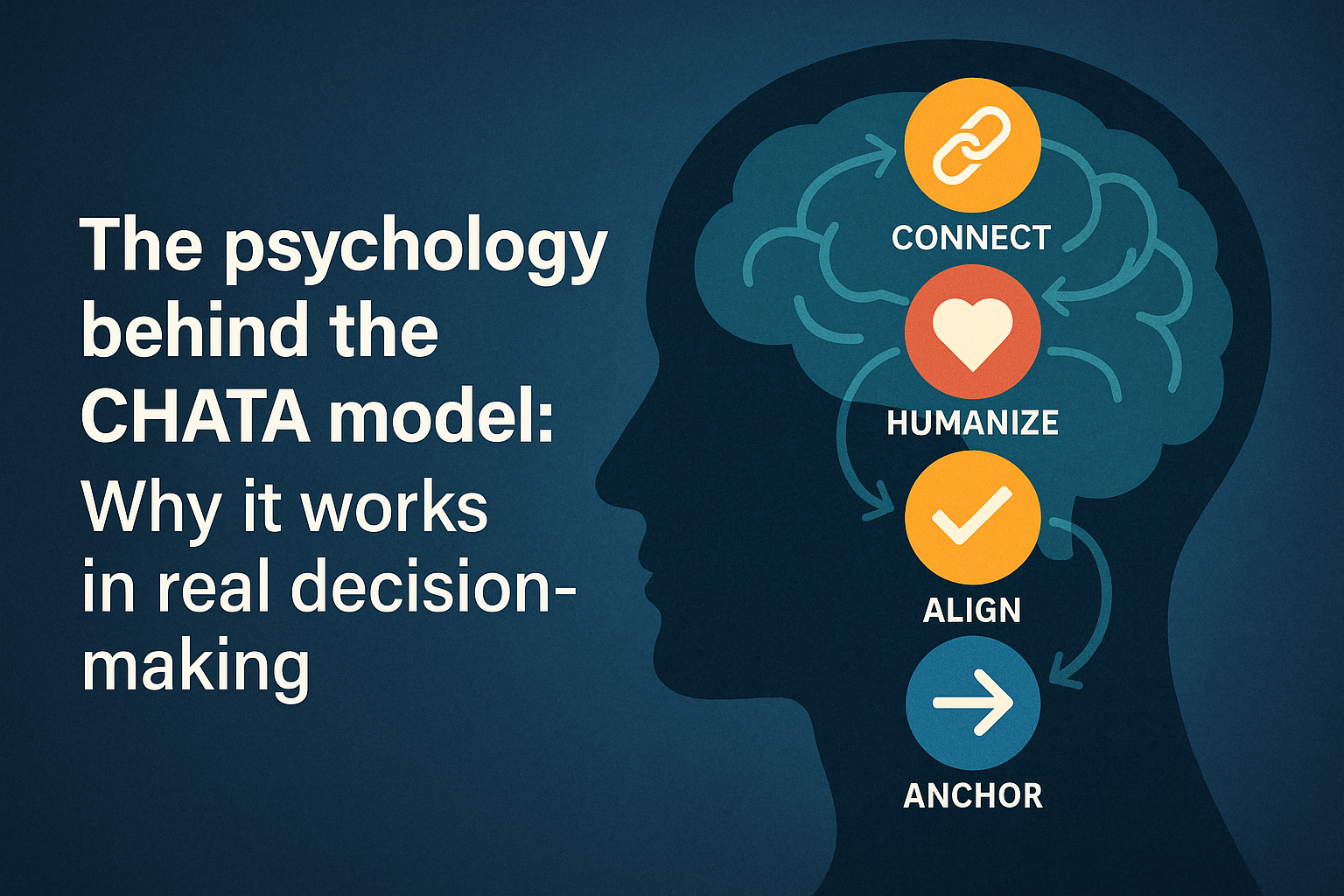
The psychology behind the CHATA model: Why it works in real decision-making
Marketing frameworks fail when they simplify human behaviour into linear formulas. Humans don’t think in steps. They don’t follow funnels.
Instead, people navigate decisions based on context, identity, uncertainty, cognitive load, trust cues, relevance, and emotional resonance.
CHATA model is based on psychology and built around these realities, not outdated sales logic. This is why it works.
CHATA (Connect → Humanize → Align → Transition → Anchor) maps directly to the actual cognitive mechanisms behind modern decision-making.
It doesn’t force behaviour, it mirrors it.
This article breaks down the psychological foundation behind each CHATA stage and how the model aligns with behavioural science, SGE-era user behaviour, and real-world cognition.
Why modern decision-making breaks old models
Before we unpack CHATA, we need to acknowledge a basic truth:
Humans make decisions irrationally, emotionally, and socially, then justify them logically.
This is proven across:
- behavioural economics
- neuroscience
- UX psychology
- cognitive science
- persuasion research
But legacy models assume the opposite.
The problem with linear persuasion models
Models like AIDA assume:
- users pay attention first
- then develop interest
- then build desire
- then act
But real behaviour looks like this:
- people scan, not read
- they decide emotionally first
- they seek validation before exploring
- they jump back and forth between tabs
- they trust familiarity, not logic
- they abandon anything confusing in < 3 seconds
CHATA was built around those truths.
It’s a psychological model disguised as a communication model.
How CHATA mirrors human cognition
Below is the psychological foundation of each CHATA step, with real behavioural logic behind it.
C – CONNECT: Cognitive relevance & Instant recognition
“Connect” works because the brain filters information using relevance heuristics.
Humans don’t look for the “best” information, they look for what feels immediately relevant.
Psychological triggers behind Connect
1. Selective attention
The brain ignores anything that doesn’t map to existing beliefs or current goals.
Your message must match the user’s internal narrative in the first 2–3 seconds.
2. Cognitive ease
If the message looks hard to process, the brain rejects it.
Connection reduces thinking cost.
3. Schema activation
Users recognise patterns instantly.
“Connect” mirrors familiar problems, frustrations, or contexts — triggering recognition.
This is why CHATA starts with relevance, not attention.
Humans don’t want entertainment.
They want orientation.
Psychological research consistently shows that people pay attention only to information that mirrors their internal narrative. Stanford’s analysis of what makes people care confirms this behavioural pattern.
H – HUMANIZE: Emotional validation & Trust formation
Humanization works because humans don’t trust abstract messages, they trust people, context, and specific details.
Psychological triggers behind Humanize
1. Social proof processing
We trust messages grounded in lived experience, not generic claims.
2. Emotional contagion
Subtle emotional cues in tone, context, and specificity change how the user “feels” the message.
3. Narrative transportation
Mini-stories, micro-examples, and specific insights activate the brain’s narrative circuitry.
4. E-E-A-T alignment
Google’s trust model mirrors human cognition:
We respond better when messages carry expertise, specificity, and identity.
This is why CHATA requires “your voice,” not a generic script.
Humans read emotions first, facts second.
A – ALIGN: Cognitive fit, identity, & JTBD mapping
Alignment works because decisions are driven by:
- identity
- context
- goals
- Job-To-Be-Done
- risk reduction
- self-protection
Psychological triggers behind Align
1. Identity-based decision making
People choose solutions that match who they think they are.
If the offer doesn’t align with identity → rejection.
2. Relevance mapping
Users mentally calculate:
“Is this for me?”
“Is this my problem?”
“Does this fit my timing?”
Alignment answers these instantly.
3. Mental model matching
Users have internal models of how a solution should work.
Alignment ensures your offer fits their expectation.
Alignment isn’t persuasion, it’s psychological compatibility.
T – TRANSITION: Friction reduction & Commitment psychology
Transitions work because people don’t take big leaps, they make micro-commitments.
Psychological triggers behind transition
1. Choice architecture
People choose the path with the lowest friction.
2. The default effect
If the next step feels natural, it becomes the default action.
3. Commitment bias
Once a user takes a tiny step, they’re more likely to take a bigger one.
4. Loss Aversion
Users avoid steps that feel costly (time, effort, uncertainty).
Transition is the bridge between interest and action, not the push.
Legacy models force a CTA.
CHATA guides the CTA.
If you want to see how this psychological flow looks when applied to a real landing page structure, I broke down the full CHATA landing page methodology.
A – ANCHOR: Memory, familiarity & Retention loops
Anchoring is where CHATA becomes uniquely powerful.
This final stage is rooted in:
- familiarity bias
- memory encoding
- relationship loops
- associative recall
- long-term brand imprinting
Psychological triggers behind anchor
1. The mere exposure effect
The more users see your structure, voice, or themes, the more trustworthy you become.
2. Associative memory
Frameworks stick because the brain loves structures.
3. Long-term recall
People return to brands that give them repeat value, not one-off convincing.
4. Narrative consistency
Anchoring builds a coherent story that users can remember.
AIDA ends with an action. CHATA ends with a relationship.
That’s the key distinction.
Why CHATA works in real decision-making (5 reasons)
1. It aligns with how the brain filters information.
Relevance → trust → fit → action → familiarity.
2. It mirrors the emotional-first nature of decisions.
Humans feel → then rationalise.
3. It reduces cognitive load at every step.
CHATA lowers friction, confusion, and effort.
4. It supports non-linear user journeys.
Real people bounce, compare, skim, return, CHATA adapts to that.
5. It builds long-term brand memory.
Frameworks become part of how people think.
This is why CHATA is not just a communication model, it’s a behaviour model.
Real example: Applying CHATA to a decision flow
Let’s take a common situation:
A user lands on a landing page for a project management tool.
AIDA flow:
- Attention → headline
- Interest → features
- Desire → benefits
- Action → sign up
This fails because users don’t care yet.
CHATA flow:
Connect → “Your team isn’t slow, your system is fragmented.”
(Recognition)
Humanize → “We analysed 127 teams, and all high-performing ones shared one behaviour pattern…”
(Specificity, insight)
Align → “If your bottleneck is visibility, this solves it. If it’s accountability, here’s what works.”
(Intent mapping)
Transition → “See the dashboard live, no signup.”
(Micro-commitment)
Anchor → “Get weekly workflow breakdowns that help teams ship faster.”
(Familiarity loop)
This maps directly to real cognitive behaviour.
How CHATA fits modern cognitive environments (SGE, AI & Scanners)
Humans online behave differently from humans reading a book.
They:
- scroll at high speed
- skim headlines
- sample content
- compare multiple tabs
- rely on summaries (SGE)
- distrust generic writing
- prefer real insights over “tips”
CHATA was built for this environment.
It reduces cognitive friction → increases comprehension → strengthens recall.
This is why CHATA survives where AIDA collapses.
FAQ (Search-intent aligned)
Is the CHATA model based on psychology?
Yes. Each stage maps to a specific cognitive mechanism involved in decision-making.
How does CHATA differ from persuasion frameworks?
CHATA isn’t built to force action, it aligns communication with natural behaviour patterns.
Does CHATA work for B2B?
Perfectly. B2B buying is non-linear and trust-driven, which CHATA mirrors better than AIDA.
Can CHATA be used in UX and product?
Yes, Connect, Align, and Transition map directly to UX principles.
Why is Humanize part of the model?
Because trust is emotional first, logical second.
Conclusion: CHATA works because it mirrors reality, not theory
CHATA isn’t powerful because it’s clever.
It’s powerful because it’s human.
It reflects how people:
- recognise relevance
- form trust
- evaluate fit
- move forward
- remember brands
- return for more
AIDA was built for linear persuasion.
CHATA is built for real human decision-making in a noisy, fast, AI-saturated environment.
That’s why it works.
That’s why it spreads.
And that’s why it’s becoming a modern standard.