
Amrudin Ćatić
Strategy, creativity, and technology are combined to craft digital experiences that perform. Smart marketing meets creative execution, always focused on growth, problem-solving, and real impact.
What is a marketing funnel in 2026 (and why most don’t work)
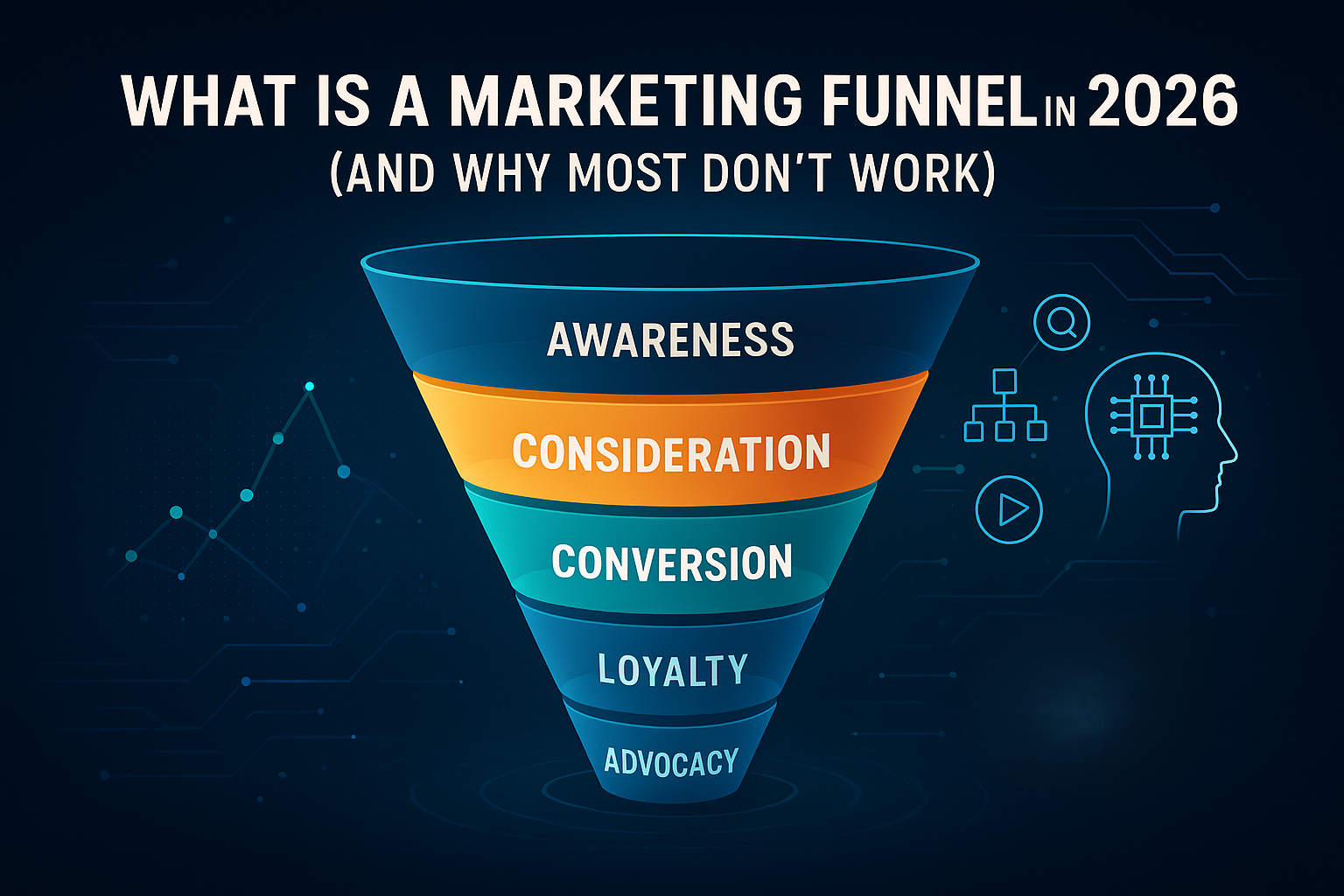
What is a marketing funnel in 2026 (and why most don’t work) – Discover how modern funnels work in 2026, why traditional ones fail, and what businesses must change to convert customers effectively.
Marketing has changed more in the last five years than in the decade before it, and nowhere is that more obvious than in the modern marketing funnel. If you’re wondering what is a marketing funnel in 2026 (and why most don’t work), you’re not alone. Businesses everywhere are realising that the funnel they used back in 2020 simply can’t keep up with today’s customer behaviour.
Consumers now jump between platforms, devices, and content formats without following a neat or predictable path. This means traditional funnels, linear, slow, and generic, fall flat. To succeed, brands must use the updated, adaptive, data-driven funnel designed for 2026 and beyond.
Let’s break it all down clearly, simply, and fully.
Understanding the modern marketing funnel
Evolution from 2020–2026
Between 2020 and 2026, digital behaviour shifted dramatically. People now interact with brands in micro-moments, quick searches, short videos, DMs, AI chats, and email snippets. Long, stretched-out funnels became too slow to keep up.
Why the 2026 consumer journey is nonlinear
Consumers today hop from TikTok to Google to podcasts to email, in any order. This creates a web rather than a funnel, requiring marketers to meet customers wherever they land.
Core stages in the 2026 funnel
While the journey is nonlinear, the stages still exist:
- Awareness
- Consideration
- Conversion
- Loyalty
- Advocacy
But they happen out of sequence, sometimes all in a single day.
What makes the 2026 funnel different?
AI-driven personalization
AI tools instantly tailor messages, timing, and offers based on real behaviour, not assumptions.
Behaviour-driven lead segmentation
Leads aren’t grouped by demographics anymore. Instead, they’re segmented by intent, action, and engagement patterns.
Multichannel touchpoint blending
In 2026, a funnel must work across:
- Social media
- Search
- AI chat
- SMS
- Video platforms
- Communities
Customers experience them all as one unified journey. If you want to see how social strategy fits into the modern funnel, read my detailed guide to social media strategy for 2026.
Why most funnels don’t work anymore
Outdated linear assumptions
Most marketers still expect customers to move step-by-step. That simply isn’t reality anymore.
Poor audience understanding
Businesses collect data but rarely use it effectively.
Lack of relevance and real-time interaction
People expect brands to respond instantly, anything slower loses them.
Common mistakes businesses make
Treating all leads the same
Every customer has a unique path. One-size-fits-all funnels feel generic.
Ignoring mobile-first customers
In 2026, the majority of buyers make decisions on mobile devices, often within minutes.
Over-automation without strategy
Automation is powerful, but only when paired with a human-centred strategy.
Building a high-converting funnel in 2026
Creating micro-experiences
Small, meaningful interactions build trust faster than long-form content alone.
Leveraging conversational AI
AI agents handle early-stage questions, qualify leads, and offer personalised content.
Designing adaptive user paths
Funnels adjust themselves in real time based on user behaviour.
Essential funnel stages (Updated for 2026)
Awareness 3.0
Short-form video dominates this stage.
Consideration with intent signals
Customers expect brands to understand what they want before they say it.
Conversion through real value
Free trials, demos, and AI-guided product tours boost conversions.
Advocacy through community
Communities, not ads, create long-term loyalty.
FAQs about marketing funnels in 2026
Q1: What is a marketing funnel in 2026 (and why most don’t work)?
A modern funnel is an adaptive, behaviour-based customer journey. Many don’t work because they’re outdated and too linear.
Q2: Are funnels still relevant in 2026?
Yes, if updated with AI, personalisation, and multi-channel integration.
Q3: What’s the biggest change since 2020?
The rise of nonlinear journeys and AI-driven buyer behaviour.
Q4: Do small businesses need advanced funnels?
Absolutely. Even simple funnels must use personalised, adaptive content.
Q5: What tools power best-in-class 2026 funnels?
AI CRMs, CDPs, and automation platforms like HubSpot and ActiveCampaign.
Q6: How long does it take to build a modern funnel?
Anywhere from two weeks to three months, depending on complexity.
Conclusion
If you want to thrive in today’s digital world, you must rethink your approach to customer journeys. The outdated funnel is gone, replaced by an adaptive, data-driven, fast-moving ecosystem. Understanding what is a marketing funnel in 2026 (and why most don’t work) gives you the chance to build stronger, smarter systems that truly convert.