
Amrudin Ćatić
Strategy, creativity, and technology are combined to craft digital experiences that perform. Smart marketing meets creative execution, always focused on growth, problem-solving, and real impact.
Google’s AI Overviews (SGE): Should you panic or prepare?
Google’s AI Overviews (SGE) are shaking up the search world, or as many call it, the new Google AI Overviews (SGE) era of search. The search giant has quietly rolled out a new experience where AI-generated summaries appear at the top of Google Search results, changing how users find and engage with information online.
If you’re a marketer, content creator, or SEO professional, you might be asking: “Should I panic or prepare?” Let’s dive deep into what SGE really means and how you can not just survive but thrive in this new era of AI-driven search.
Understanding Google’s AI Overviews (SGE)
SGE (Search Generative Experience) is Google’s next major evolution in search, powered by generative AI technology. Instead of showing only blue links, Google now provides a dynamic, conversational summary at the top of search results.
This AI overview synthesizes data from multiple reliable sources to give users a direct, contextual answer, often followed by links for further reading.
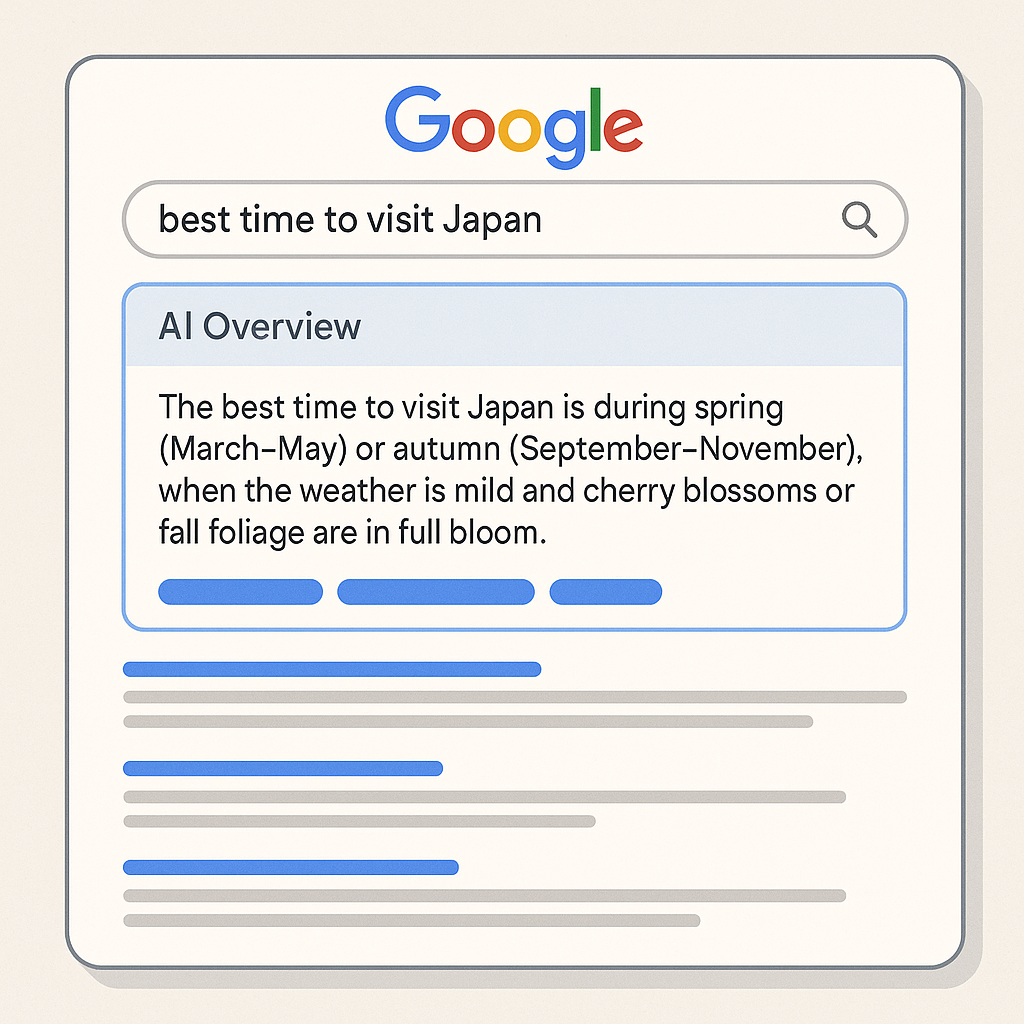
For example, if you search for “best time to visit Japan”, SGE might instantly display:
“The best time to visit Japan is during spring (March–May) or autumn (September–November), when the weather is mild and cherry blossoms or fall foliage are in full bloom.”
Then, it may list 3–5 citations to credible websites underneath.
This is Google’s answer to ChatGPT-style conversational AI, integrated directly into its massive search ecosystem. The concept behind Google AI Overviews (SGE) is simple: deliver instant, conversational summaries directly in search results.
Why Google introduced AI Overviews
The rise of ChatGPT, Perplexity, and other AI assistants has changed how users expect to interact with information. Instead of scrolling through multiple pages, users now want concise, contextual, and trustworthy answers right away. If you’re interested in how AI is transforming marketing itself, read my article on how I combined AI and marketing and why everyone should learn to do the same.
SGE helps Google stay competitive by:
- Enhancing user experience with instant, synthesized answers.
- Encouraging more nuanced search interactions (conversational queries).
- Reducing misinformation by highlighting reliable, E-E-A-T-compliant sources.
In short, Google’s move isn’t about replacing SEO, it’s about reshaping it.
How SGE changes the search landscape
Traditional SEO was built around ranking blue links and driving clicks. SGE, however, shifts focus toward earning citations within AI-generated answers.
Some of the biggest changes include:
- CTR (Click-Through Rate) volatility – fewer users may click through when answers are visible at the top.
- Query intent evolution – users are asking deeper, more conversational questions.
- Information credibility – sites that demonstrate expertise are more likely to be featured.
This is a major shift from “ranking for keywords” to “earning AI trust.”
The SEO shockwave: What SGE means for businesses
Businesses dependent on organic search traffic are understandably nervous also must understand how Google AI Overviews (SGE) impacts visibility and traffic metrics. With SGE summaries answering user queries upfront, impressions may rise, but clicks might drop.
But here’s the key insight: SGE isn’t replacing visibility, it’s redistributing it.
Brands that create comprehensive, expert-driven content stand to gain even more prominence as Google cites them within its AI overviews.
To win in this era:
- Focus on experience and authority (E-E-A-T).
- Strengthen content clusters and internal linking.
- Make your brand synonymous with credibility.
The opportunities hidden in AI Overviews
Every major Google update has caused waves of uncertainty, but also opened doors for smart creators.
AI Overviews (SGE) is no exception. Instead of viewing it as a threat, think of it as an opportunity to get featured “above the fold” in new and dynamic ways.
Here’s how:
- Authority content advantage: Google’s AI draws from sources with strong E-E-A-T (Experience, Expertise, Authoritativeness, and Trustworthiness). If your content demonstrates expertise through detailed explanations, firsthand experience, or cited sources, it’s more likely to be cited in AI summaries.
- Featured snippets 2.0: Think of SGE as the new form of featured snippets, except now, AI decides what’s most relevant.
- Content that fuels AI Summaries: Create comprehensive, factual, and well-structured content that’s easy for algorithms to parse. This includes using schema markup, lists, FAQs, and clear headings.
In other words, the new SEO battlefield is not just ranking on page one, it’s earning a citation inside AI’s mind.
How publishers can optimize for SGE
Here’s how to future-proof your content strategy for AI Overviews:
1. Strengthen E-E-A-T signals
Include author bios, references, and first-hand insights in every piece. Google’s AI favors content that shows real-world expertise.
2. Use structured data
Mark up your pages using schema.org. Structured data helps AI interpret your content and connect it to user queries more accurately.
3. Keep facts verifiable
SGE uses cross-verification. If your data doesn’t align with other trustworthy sources, your chances of being cited drop.
4. Focus on semantic search
Use natural, conversational phrasing and related terms (LSI keywords). AI understands context, not just exact-match keywords.
Pro Tip: Write for intent, not just keywords. Google’s AI now looks for content that directly satisfies a user’s purpose, whether it’s “learning,” “buying,” or “solving.”
Case studies: Early impact of SGE on websites
Several publishers have already begun tracking early SGE trends.
- Example 1: Healthline noticed that being cited in AI Overviews drove fewer clicks but higher-quality traffic. Visitors stayed longer and engaged more.
- Example 2: NerdWallet maintained visibility through structured data and topic authority, even when click-throughs dipped.
- Example 3: Niche blogs saw gains when focusing on conversational, in-depth content addressing long-tail search queries.
The lesson? It’s not about fighting AI Overviews, it’s about teaching AI to trust your site.
Should you panic? The common fears around SGE
Let’s address the elephant in the room.
Many SEO professionals fear that SGE will “steal” clicks, turning Google into a “zero-click” search platform. But here’s the truth:
While some traffic redistribution is inevitable, panicking helps no one.
Key misconceptions include:
- “SGE will kill SEO.” → SEO is evolving, not dying.
- “No one will visit websites anymore.” → Users still click for depth, credibility, and visuals.
- “It’s impossible to optimize for AI.” → You already can, through structured data and authoritative writing.
So no, you shouldn’t panic. You should prepare intelligently.
Or should you prepare? Smart strategies moving forward
Here’s how to stay ahead of the curve:
- Build topic clusters: Create interconnected content around a specific niche so Google recognizes your topical authority.
- Optimize for user intent: Write content that answers why behind a question, not just what. For a deeper dive into building content that converts, check out my guide on how to create high-converting content in 2025, backed by AI and data.
- Diversify traffic sources: Use newsletters, YouTube, and social media to reduce reliance on Google.
- Monitor AI overview mentions: Use analytics and tools like Ahrefs or Semrush to track SGE exposure (as these tools expand AI metrics).
- Invest in brand identity: AI trusts recognizable, consistent brands. Your brand reputation may become the new ranking factor.
Remember, AI doesn’t replace credibility. It amplifies it!
How AI Overviews benefit users (and content creators)
SGE isn’t only a win for Google, it’s also good for users and creators.
For users, it means faster, more contextual results. For creators, it means quality content gets rewarded.
When your article gets cited by AI Overviews:
- You gain implicit endorsement from Google’s AI.
- Your brand builds trust and recognition.
- You attract qualified visitors who value depth over speed.
SGE encourages a race to quality, not quantity, rewarding accuracy, clarity, and genuine insight.
The role of trust and authority in the AI Era
Trust is the currency of the future web.
AI systems like Google SGE don’t “trust” every site equally, they rely on patterns of reliability built over time.
To build this trust:
- Use bylines and cite credible sources.
- Maintain consistent editorial tone and expertise.
- Encourage backlinks from authoritative domains.
Think of it this way: if your site is where humans and AI both go for truth, you’ve already won the SEO game.
Technical SEO adjustments for SGE optimization
The technical foundation still matters.
Here are key areas to optimize:
- Core web vitals: Fast, responsive websites earn AI preference.
- Clean metadata: Ensure titles, meta descriptions, and headers clearly describe your topic.
- Semantic HTML: Use heading tags properly to structure content for machine understanding.
- Schema for people and reviews: Enhance content credibility.
Technical SEO remains your silent partner in building AI-ready websites.
Content creation in the Age of generative search
AI doesn’t eliminate the need for human creativity, it enhances it.
Writers should now focus on:
- Narrative clarity – AI favors well-structured arguments.
- Unique perspectives – Include experience that no AI can replicate.
- Ethical AI use – Always disclose and verify any AI-assisted content.
By combining human insight with AI efficiency, content creators can dominate the generative search ecosystem.
Predictions: The Future of Google Search beyond SGE
Here’s where we’re headed:
- Personalized AI search journeys – Results will adapt to your habits, tone, and preferences.
- Integration with Google Gemini – Expect multimodal responses with visuals, charts, and summaries.
- Evolving SEO metrics – “AI Visibility Rate” may soon join CTR and impressions in analytics dashboards.
By 2026, SEO won’t just be about search rankings, it’ll be about AI reputation management.
FAQs about Google’s AI Overviews (SGE)
1. What is Google’s SGE?
SGE stands for Search Generative Experience, Google’s AI-driven feature that provides summarized answers at the top of search results.
2. How does SGE affect SEO?
It changes how traffic flows, rewarding expert content and structured data instead of simple keyword targeting.
3. Can my site still get traffic under SGE?
Absolutely. Sites that demonstrate E-E-A-T and focus on long-form, value-driven content will thrive.
4. How can I optimize for SGE?
Use schema markup, trust signals, and context-rich writing. Focus on intent-based optimization.
5. Will SGE replace featured snippets?
Not entirely, but it will absorb and evolve them into more intelligent, conversational summaries.
6. Is AI content bad for SEO?
Not if it’s factual, ethical, and reviewed by humans. Google rewards accuracy and transparency.
7. Should small businesses worry?
No, this is a chance to shine. Niche experts often perform better in AI-driven searches due to their focused authority.
Conclusion: The Calm before the AI Storm
So, should you panic or prepare?
The answer is simple: prepare intelligently.
Google’s AI Overviews mark the beginning of an AI-augmented search era, not the end of SEO. Businesses that embrace change, with structured, credible, and human-centered content, will emerge stronger.
Instead of fearing the shift, lead it.
Be the website Google’s AI wants to cite, not the one it forgets.
External Resource:
Learn more directly from Google’s official documentation: https://blog.google/products/search/generative-ai-search