
Amrudin Ćatić
Strategy, creativity, and technology are combined to craft digital experiences that perform. Smart marketing meets creative execution, always focused on growth, problem-solving, and real impact.
The death of third-party cookies didn’t kill programmatic – Lazy marketers did: A Shocking Truth in 7 Insights
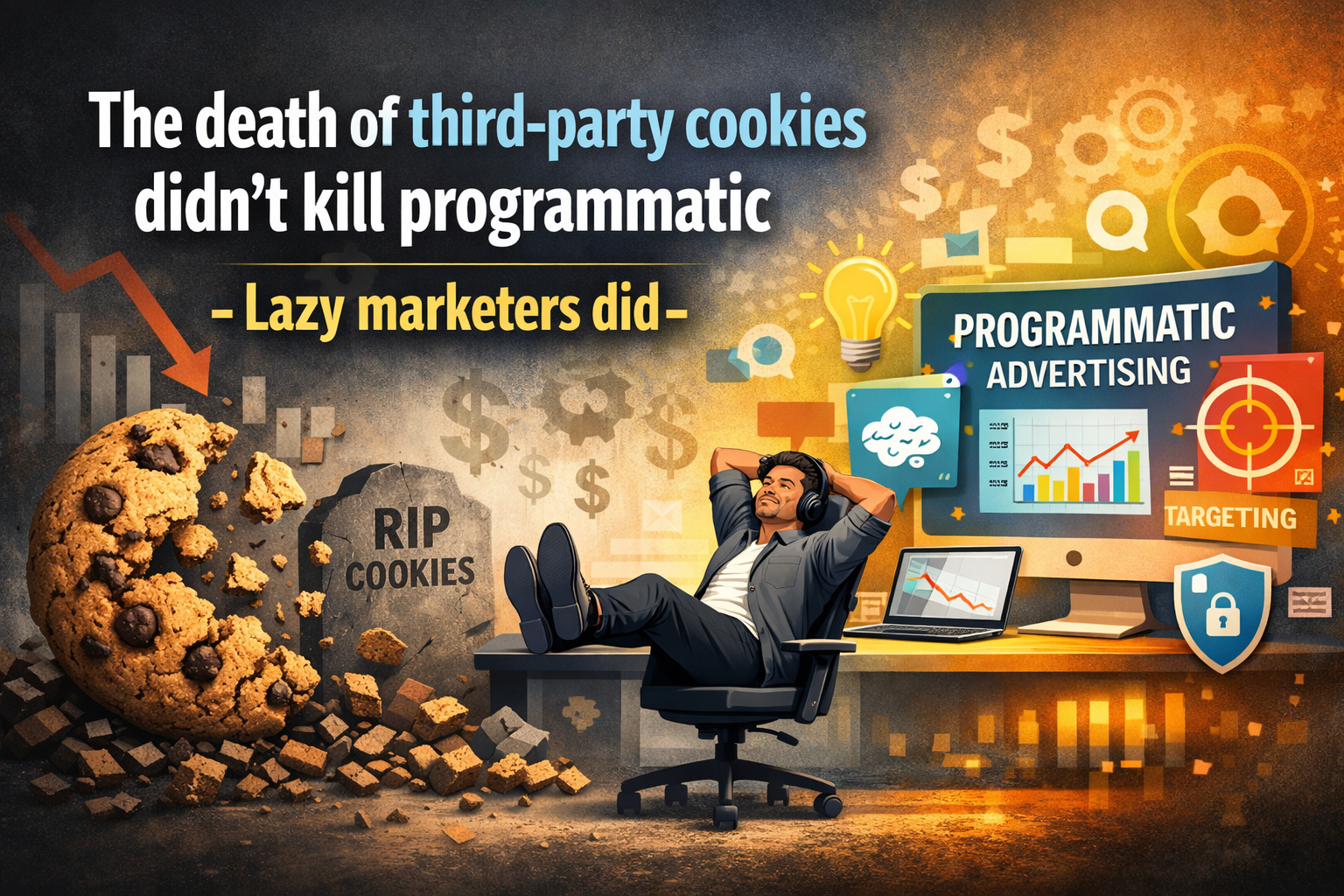
The death of third-party cookies didn’t kill programmatic – Lazy marketers did. Discover why programmatic advertising is still alive, evolving, and powerful when used correctly.
Introduction: Understanding the real problem behind programmatic advertising
The phrase The death of third-party cookies didn’t kill programmatic – Lazy marketers did may sound bold, but it reflects a hard truth shaping modern digital advertising. Over the last few years, marketers have blamed privacy changes, browser restrictions, and evolving regulations for declining ad performance. However, programmatic advertising itself remains robust. What truly failed was the mindset of marketers who relied too heavily on outdated tactics.
Programmatic advertising was never meant to be a “set-it-and-forget-it” channel. It thrives on strategy, testing, creativity, and data literacy. As third-party cookies faded, proactive advertisers adapted. Lazy ones did not, and they paid the price.
What are third-party cookies and why did they matter?
Third-party cookies were small pieces of data stored by browsers to track users across websites. They powered:
- Cross-site tracking
- Behavioral targeting
- Frequency capping
- Attribution models
For years, they were the backbone of digital advertising. But increasing privacy concerns and regulations changed everything.
Why third-party cookies are disappearing
Major browsers, especially Google Chrome, announced plans to phase out third-party cookies to improve user privacy. Combined with GDPR and CCPA, advertisers faced a new reality: less personal data and more responsibility.
Yet, this shift didn’t destroy programmatic advertising. It challenged marketers to evolve.
The death of third-party cookies didn’t kill programmatic – Lazy marketers did
This statement captures the core issue perfectly. Programmatic advertising still offers automation, scalability, and precision. What failed was the lack of effort to:
- Learn new identity solutions
- Invest in first-party data
- Update measurement models
- Test contextual and creative strategies
Marketers who kept running the same campaigns with outdated assumptions saw declining results, and blamed the industry instead of their approach.
How smart marketers adapted and thrived
1. First-party data became the new gold
Forward-thinking brands doubled down on:
- CRM systems
- Email subscriptions
- Loyalty programs
- Website engagement data
First-party data is privacy-compliant, accurate, and future-proof. Marketers who invested early gained a competitive edge.
2. Contextual targeting made a comeback
Instead of tracking users, contextual targeting focuses on content relevance. Ads appear based on:
- Page topics
- Keywords
- Sentiment
This approach respects privacy while maintaining strong performance.
Programmatic advertising is still alive and evolving
Programmatic today is smarter than ever. It now includes:
- AI-driven optimization
- Predictive modeling
- Privacy-first identity frameworks
- Real-time creative optimization
The tools evolved. The question was whether marketers would.
Common mistakes lazy marketers make
| Mistake | Impact |
|---|---|
| Ignoring first-party data | Poor targeting |
| No creative testing | Banner fatigue |
| Overreliance on old KPIs | Misleading performance |
| No audience segmentation | Low relevance |
These mistakes fueled the false narrative that programmatic was “dead.”
In “Testing in the Age of AI: Where Automation Ends and Judgment Begins”, I cut through the hype around AI-driven testing to expose the real battleground: machines excel at repetitive checks and predictive automation, but they cannot replace human judgment on context, risk, ethics, and user experience. The piece breaks down why the future of quality engineering isn’t humans versus AI. It’s humans plus AI, with strategic thinking at the helm. Read it to understand where automated efficiency ends and irreplaceable human insight begins.
FAQs about programmatic advertising and cookies
1. Is programmatic advertising dead?
No. Programmatic advertising is evolving and remains highly effective when used strategically.
2. Why did third-party cookies disappear?
They were phased out to protect user privacy and comply with data regulations.
3. Can programmatic work without cookies?
Yes. First-party data, contextual targeting, and AI models make it possible.
4. What replaced third-party cookies?
Solutions include first-party data, clean rooms, contextual targeting, and privacy-safe IDs.
5. Is contextual advertising effective?
Absolutely. It often delivers strong engagement without invasive tracking.
6. Why do some marketers think programmatic failed?
Because they didn’t adapt their strategies after cookie changes.
The future of programmatic advertising
The future is privacy-first, data-smart, and creativity-driven. Programmatic advertising will continue to grow, but only for marketers willing to:
- Learn continuously
- Test aggressively
- Respect consumer privacy
Those who adapt will thrive. Those who don’t will keep blaming technology.
Conclusion: Accountability over excuses
In the end, The death of third-party cookies didn’t kill programmatic – Lazy marketers did, not just a headline, it’s a lesson. Technology didn’t fail. Strategy did. Programmatic advertising remains one of the most powerful tools in digital marketing, but only for those willing to use it wisely.
Success now depends on effort, not excuses.
Learn more about privacy-first advertising strategies from the Interactive Advertising Bureau (IAB).