
Amrudin Ćatić
Strategy, creativity, and technology are combined to craft digital experiences that perform. Smart marketing meets creative execution, always focused on growth, problem-solving, and real impact.
Marketing is full of dead ideas nobody has the guts to bury
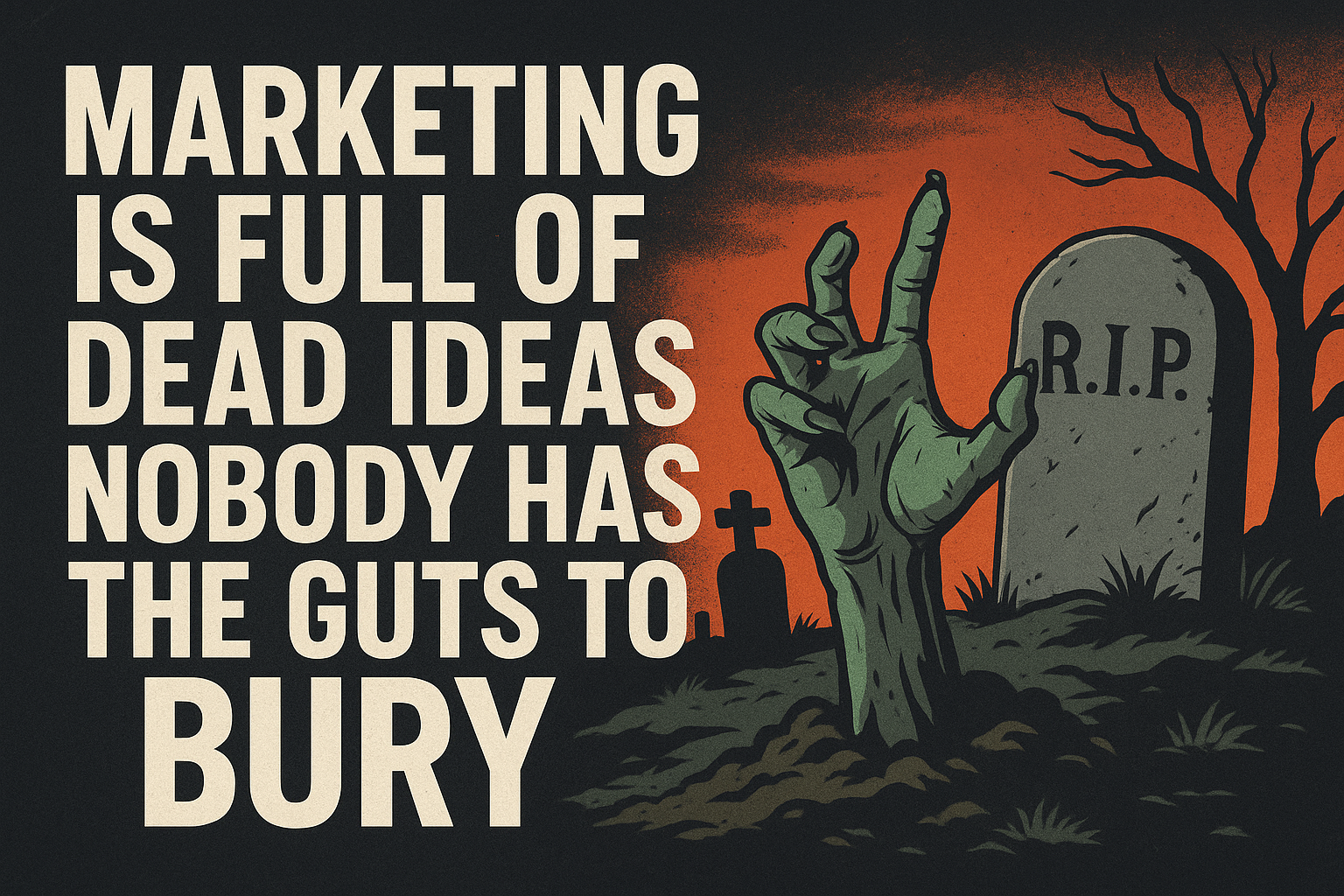
Marketing today isn’t an industry, it’s a cemetery.
A field of decaying ideas that everyone keeps pretending are still alive. People walk around acting like the smell isn’t real, like the corpse in the middle of the room is just “going through a phase.”
Here’s the truth: half the strategies brands still use don’t work. The other half works only because the competition is running even dumber shit.
Influencer campaigns with zero attribution? Dead.
SEO without UX or intent? Dead.
Content created to “fill the calendar”? Buried years ago, someone just forgot to put up a headstone.
Brands chasing “awareness” as a goal? Fossils.
And the funniest part? Everyone knows it.
But nobody wants to be first to say it out loud, because the entire industry is built on pretending everything still works.
Marketing right now is full of zombies, tactics that walk, but no longer live. Meanwhile, budgets bleed, performance tanks, and audiences ignore brands clinging to tactics that should’ve been cremated a long time ago.
If you want to survive 2025, learn this fast:
Stop resuscitating tactics that are already dead.
Because the moment you drop the dead weight, you outrun the entire market.
The 7 dead marketing ideas everyone pretends still work
1. “Awareness campaigns” with no path to revenue
This is the biggest zombie of them all.
Brands pour thousands into “visibility”, like visibility pays rent. It doesn’t. Unless you can draw a straight line from eyeballs → action → money, your awareness campaign is just a very expensive vanity mirror.
If you don’t know the next step after someone sees the ad, you’re not doing marketing, you’re burning cash.
And if you’re still clinging to management-speak, fuzzy value-statements and hollow promises, it’s time to cut that crap. I already tore down the most dangerous word that kills business in my post The most dangerous word in business. Read it, take notes, then burn the slides.
2. Influencer marketing without attribution
Don’t you know who drove sales?
Then you didn’t run influencer marketing, you ran a popularity contest.
This tactic died the moment audiences learned to skip sponsored content with the same reflex they use to skip ads. If you’re still guessing ROI, you’re not a strategist, you’re a gambler.
3. Posting daily “Because the algorithm likes it”
Algorithms don’t like your content.
People don’t like your content.
Nobody wants your 23rd identical carousel this month.
This idea died when platforms shifted from volume → relevance. Yet brands still push quantity like it’s 2016.
If your content calendar is “we must fill the slots,” congratulations, you’re embalming a corpse.
4. Chasing virality as a strategy
Virality is not a strategy. It’s a lottery where everyone thinks they have the winning ticket.
You can’t build systems on randomness.
Brands obsessed with “going viral” end up creating cringe videos, diluted messaging, and confusion. Virality is dead as a predictable lever, the only real lever left is consistency that compounds.
5. SEO built on keywords instead of intent
Keyword stuffing died.
Shallow listicles died.
Ranking for something nobody converts on died.
Modern SEO is user psychology, architecture, UX, and depth, but too many marketers are still stuck in 2013, chasing volume instead of solving a problem.
If your SEO strategy starts with “find keywords,” it’s already a corpse.
6. “Brand values” nobody in the company actually lives
Stop printing posters of values nobody follows.
Stop writing manifestos that your own employees roll their eyes at.
The market can smell fake from orbit.
If your brand values don’t show up in product, support, hiring, or behaviour, they’re not values, they’re décor. Dead décor.
7. Overproduced ads for an audience that wants reality
The high-polish, agency-perfect, cinematic ad is dead for 90% of brands.
People don’t trust perfection anymore.
They want proof, not polish.
But brands still pay fortunes for ads that look amazing and convert like wet cardboard.
The winners are raw, fast, human, and proof-driven. Everyone else is stuck embalming the old world.