
Amrudin Ćatić
Strategy, creativity, and technology are combined to craft digital experiences that perform. Smart marketing meets creative execution, always focused on growth, problem-solving, and real impact.
CHATA vs AIDA: Why modern marketers need a more adaptive model
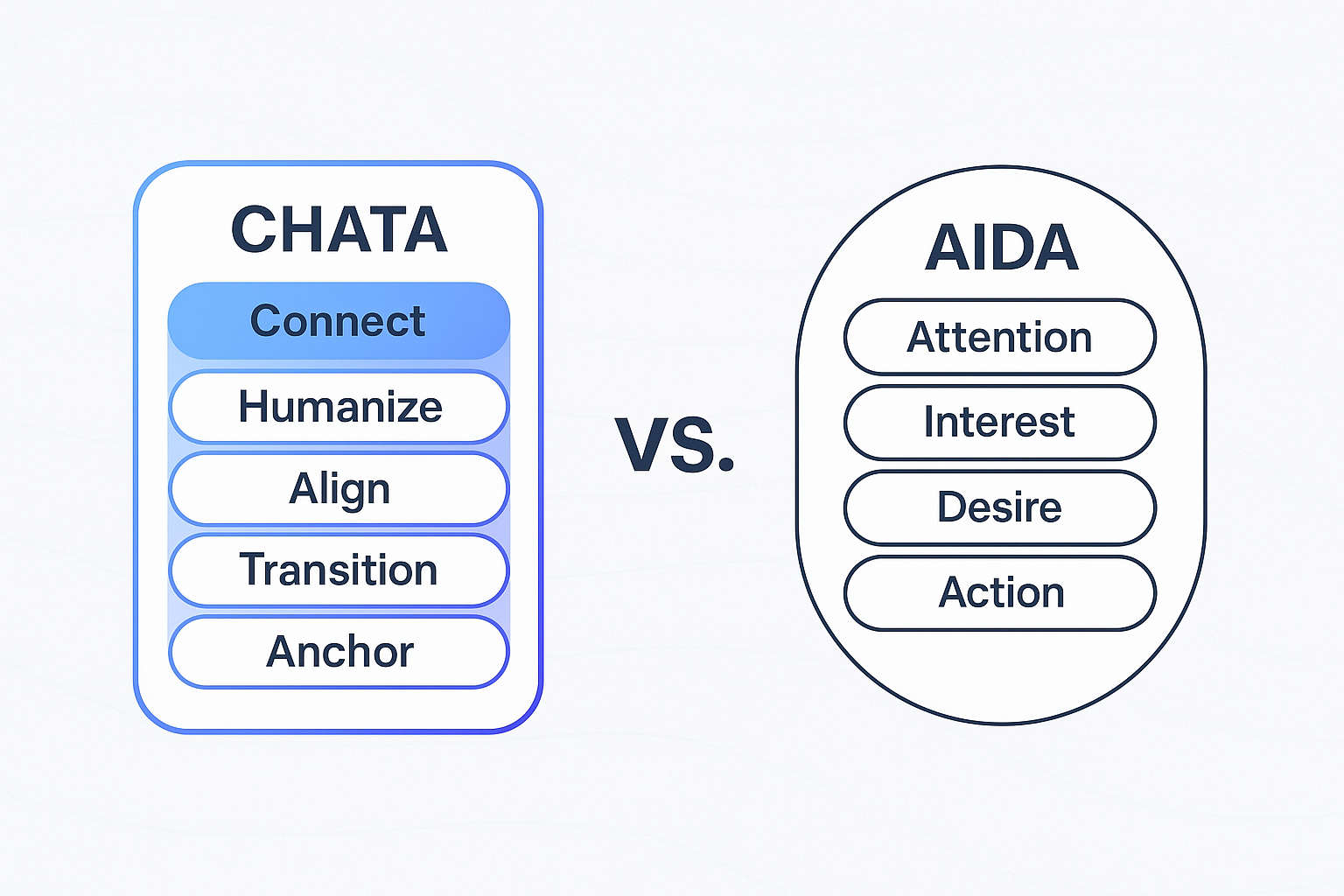
This article breaks down the real differences, the limitations of AIDA, and why CHATA is a more adaptive model for today’s marketing landscape.
For decades, AIDA (Attention → Interest → Desire → Action) has shaped the way marketers write, persuade, and build communication.
It became a universal template, simple, memorable, and easy to teach.
But simplicity can become a limitation.
Today’s digital environment is shaped by SGE (Search Generative Experience), AI-assisted content, fragmented user journeys, semantic search, and multi-touch buying behaviour.
Users don’t move through linear stages anymore, and that’s precisely where AIDA shows its age.
This is where the CHATA model enters the conversation:
a modern, human-centric alternative designed to reflect how people actually think, feel, navigate, and decide.
If you want the full breakdown of the CHATA model and its five core components (Connect → Humanize → Align → Transition → Anchor), you can read the foundational article here.
What AIDA gets right, and where it fails now
To understand CHATA, we need to examine why AIDA dominated for so long, and why it’s no longer enough.
AIDA’s strengths:
- It forces structure.
- It teaches progression.
- It works for simple ads, sales letters, and isolated funnels.
- It gives beginners a clear starting point.
But modern marketing is not linear, isolated, or predictable.
AIDA breaks in for four reasons:
1. Users don’t consume content linearly
People jump between tabs, channels, formats, and devices.
You can’t count on a clean “attention → interest → desire → action” flow.
Research also confirms that real-world decision-making rarely follows a clean sequence. Harvard Business Review outlines how people move in loops, not steps.
2. SGE and semantic search compress the early stages
Users skip straight to context and insight.
“Attention” is not the problem anymore, relevance is.
3. AI has commoditised copywriting
Anyone can generate AIDA-based content.
It all sounds the same.
A model that produces “generic” outputs is deadly in an AI-saturated world.
4. AIDA has no retention layer
In the real world, conversion is not the end.
You need continuity, loops, and relationship-building.
AIDA ends where modern marketing begins.
This is the gap CHATA was built to fill.
Meet the CHATA model (Connect → Humanize → Align → Transition → Anchor)
CHATA was developed to solve the flaws of legacy models like AIDA by introducing modern behavioural logic, continuity, and human-centric nuance.
Here’s a quick breakdown:
- Connect – establish immediate contextual relevance
- Humanize – add lived experience, trust, credibility, E-E-A-T
- Align – match intent, desire, and offer
- Transition – guide naturally to the next step
- Anchor – build continuity and retention
Unlike AIDA, CHATA reflects the way people actually move through content today.
Now, let’s compare them directly.
CHATA vs AIDA: The full breakdown
1. Connect vs Attention
AIDA: “Get attention.”
This leads marketers to chase hooks, shock value, clickbait, and noise.
CHATA: “Connect with the user’s reality.”
Connection is relevance.
Relevance wins SGE, improves UX, reduces bounce rate, and increases engagement.
Why it matters in 2025:
SGE rankings are heavily influenced by contextual alignment, not flashy intro lines. Humans scroll past “clever”, they stop for “this is about me.”
Example:
AIDA intro → “Struggling with low conversions?” (generic)
CHATA intro → “Your landing pages fail because users don’t see themselves in your message.”
CHATA mirrors inner dialogue → deeper engagement.
2. Humanize vs Interest
AIDA: “Build interest.”
This often creates generic benefit statements.
CHATA: “Humanize the message.”
Humanization =
- lived insights
- specific details
- experience
- credibility
- story structure
- expert view
This aligns perfectly with E-E-A-T guidelines and SGE’s trust filters.
Why it matters:
AI makes interest easy.
Human nuance is the new advantage.
3. Align vs Desire
AIDA: “Create desire.”
Simple, but outdated, desire doesn’t convert without relevance.
CHATA: “Align the user’s intent with your value.”
Alignment is not manipulation.
It’s clarity.
Users convert when:
- the problem is clear
- the offer matches their stage
- the value matches their need
- the solution fits their context
CHATA forces strategic alignment instead of emotional teasing.
4. Transition vs Action
AIDA: “Push the user to act.”
This can feel abrupt and salesy.
CHATA: “Create a natural next step.”
Transitions are frictionless pathways, not orders.
Examples CHATA prefers:
- “See the examples.”
- “Try the diagnostic.”
- “Here’s the method we used internally.”
- “Watch the breakdown.”
These feel like a continuation, not an interruption.
Conversion is earned, not forced.
5. (nothing) vs Anchor
AIDA ends with conversion.
But conversion is now the midpoint, not the finish line.
CHATA: “Anchor relationship, familiarity, and trust.”
This includes:
- lifecycle content
- retention
- long-term story arcs
- consistency
- community
- repeat value
- reminders
- frameworks
- follow-up loops
This is the biggest upgrade over AIDA.
Brands grow through memory, not one-time actions.
Why CHATA works better than AIDA in this AI digital era (Backed by Behaviour & SEO)
1. CHATA aligns with SGE and semantic search
SGE rewards:
- relevance
- human expertise
- clarity
- continuity
CHATA combines all four in the very first two steps.
2. CHATA is built for AI + human content workflows
AIDA outputs sound robotic when AI generates them.
CHATA forces human layers (Humanize + Align).
3. CHATA supports multi-touch journeys
Users don’t convert in one shot.
CHATA acknowledges loops, not funnels.
4. CHATA improves topical authority
Models that introduce structure → create topic clusters → create authority.
By publishing a CHATA series, you dominate your own niche.
5. CHATA reflects real human decision-making
We decide through:
- recognition
- emotional validation
- logical alignment
- contextual progression
- familiarity over time
CHATA maps exactly to these behaviours.
AIDA oversimplifies them.
How to apply CHATA (with a real example)
Let’s take a basic AIDA-style message:
“Get more leads with our landing page builder.
Start your free trial now.”
Problem:
– generic
– no proof
– no alignment
– no human relevance
– too abrupt
Now rewrite using CHATA:
Connect
“Most landing pages fail because they speak to everyone, and resonate with no one.”
Humanize
“I spent the last 3 months analysing 140+ landing pages, and only 12 got it right.”
Align
“Your problem isn’t design. It’s message alignment. You need a structure that matches user intent.”
Transition
“Here’s a breakdown template we use to fix underperforming pages.”
Anchor
“If you want more examples like this, I publish weekly breakdowns.”
CHATA transforms flat copy into insight-driven communication.
When should you use AIDA instead of CHATA?
To be brutally honest, AIDA still has its place.
Use it when:
- ultra-simple ad
- billboard
- SMS campaign
- low-effort awareness ad
- single CTA
- no need for depth
AIDA is good for short-form push messaging.
CHATA is a model for modern strategy, content, funnel, retention, and SEO.
FAQ (Based on real search intent)
Is AIDA outdated?
Not outdated, just limited.
It works for simple ads, but not for complex digital journeys.
Is CHATA better than AIDA?
For modern content, SEO, funnels, and multi-touch marketing, yes.
CHATA solves gaps AIDA never covered.
Can CHATA replace AIDA completely?
It can, but you don’t have to.
Think of CHATA as the evolution, not the replacement.
Is the CHATA model hard to learn?
No. It follows natural conversation logic instead of mechanical steps.
Is CHATA good for AI-generated content?
Perfect.
It fixes the biggest problem AI has, the lack of human nuance.
Conclusion: CHATA is the modern alternative to AIDA, because it reflects reality, not Theory
AIDA had a historic run.
But today’s marketing reality is different: it’s dynamic, fragmented, AI-driven, and deeply human.
A model built in 1898 cannot solve the complexities of 2026.
CHATA does.
It brings:
- relevance
- humanity
- alignment
- frictionless flow
- continuity
to every touchpoint.
This is why CHATA is not a trend,
It’s the next logical step in how modern marketers structure communication and strategy.