
Amrudin Ćatić
Strategy, creativity, and technology are combined to craft digital experiences that perform. Smart marketing meets creative execution, always focused on growth, problem-solving, and real impact.
Retention through the CHATA model: The missing layer in most marketing
Most marketing strategies are built to win attention.
Very few are built to deserve continuity.
Companies obsess over:
- traffic
- clicks
- sign-ups
- demos
- first conversions
And then they’re surprised when users leave.
The truth is simple and uncomfortable:
Retention is not a product problem.
It’s a narrative problem.
This is where the CHATA model exposes a massive blind spot in modern marketing.
Not because retention is ignored, but because it’s misunderstood.
Why retention is the most underdeveloped layer in marketing
Ask most teams how they handle retention, and you’ll hear:
- onboarding emails
- feature announcements
- discounts
- “check-in” messages
All tactics. No system.
Retention fails because:
- the story ends at conversion
- communication becomes transactional
- users stop feeling seen
- value becomes assumed instead of reinforced
Retention doesn’t collapse suddenly.
It erodes quietly.
CHATA exists precisely to prevent that erosion.
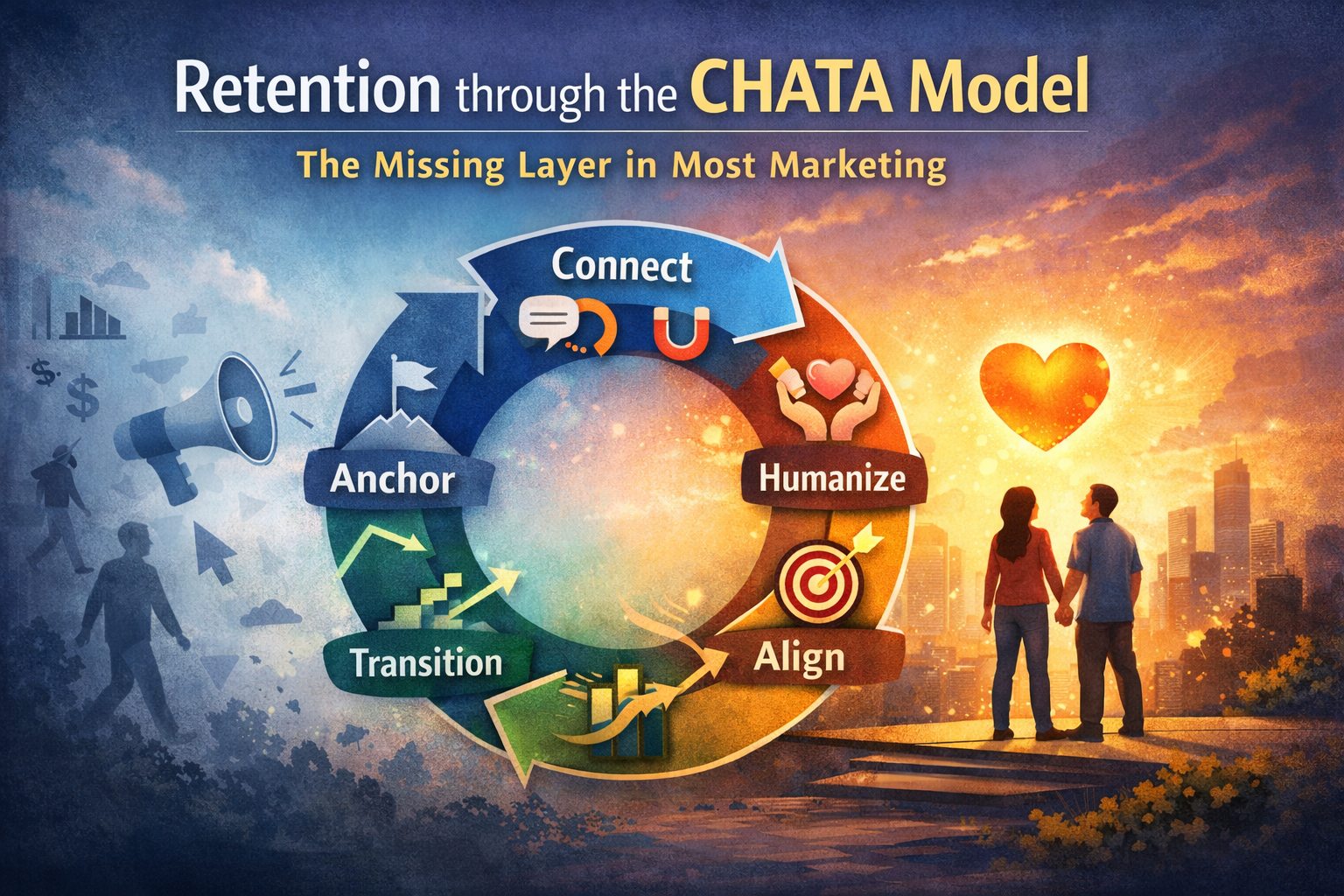
CHATA reframed: From conversion framework to continuity system
Most people think CHATA ends when someone takes action.
That’s wrong.
CHATA is cyclical, not linear.
After conversion:
- Connect becomes relevance in daily use
- Humanize becomes empathy over time
- Align becomes ongoing job validation
- Transition becomes habit progression
- Anchor becomes identity attachment
This is where retention actually lives.
1. Connect (post-conversion): Staying relevant after the excitement fades
After onboarding, attention drops.
This is the danger zone.
Users don’t churn because they hate your product. They churn because it stops feeling relevant.
Post-conversion connect means:
- reminding users why they chose you
- reconnecting them to the original tension
- surfacing relevance at the right moment
Examples:
- “This is where teams usually get stuck after week two.”
- “Most users ignore this feature, and regret it later.”
You’re not re-selling.
You’re reconnecting.
2. Humanize: Retention is about emotional safety
Retention messaging usually sounds robotic.
“Here’s what’s new.”
“Here’s what you missed.”
“Here’s a feature update.”
Humans don’t stay because of updates.
They stay because of emotional safety.
Humanized retention:
- acknowledges learning curves
- normalizes frustration
- removes shame from slow adoption
Example:
“If you haven’t touched this feature yet, that’s normal. Most teams wait until X happens.”
That single sentence can reduce churn more than any discount.
This layer of humanization doesn’t live only in onboarding emails or in-product messages.
For many users, ongoing emotional safety is reinforced through social touchpoints, the way a brand shows up consistently, speaks like a human, and reflects real struggles outside the product itself.
This is where CHATA becomes especially powerful on social platforms. I break this down in detail.
3. Align: Reinforcing jobs to be done over time
Jobs To Be Done don’t disappear after purchase.
They evolve.
Early JTBD:
- “Help me decide”
- “Help me justify this choice”
Later JTBD:
- “Help me look competent”
- “Help me prove this was the right call”
- “Help me avoid regret”
Alignment in retention means:
- reframing value based on stage
- showing progress, not just usage
- reconnecting outcomes to the user’s identity
This is where CHATA integrates naturally with long-term positioning.
If you want to see how this alignment works at a strategic level (not just retention messaging), this article breaks it down clearly about positioning & JTBD alignment.
4. Transition: Designing progression, not just usage
Most products track activity.
Retention depends on progression.
Transition after conversion is about:
- moving users from basic use → confident use
- from exploration → reliance
- from “trying” → “depending”
CHATA treats transitions as psychological milestones, not feature unlocks.
Examples:
- “You’ve completed X, here’s what teams usually do next.”
- “This is the moment where most users start seeing compound value.”
Retention grows when users feel a sense of movement, not just access.
5. Anchor: Turning retention into identity
This is the layer most teams never reach.
Anchor is where users stop thinking:
“I use this tool”
and start thinking:
“This is how I work”
Anchoring happens through:
- consistent language
- repeatable success patterns
- shared mental models
Over time, your product becomes:
- harder to replace
- harder to question
- easier to defend internally
This is retention as identity lock-in, not manipulation.
Why most retention marketing fails without CHATA
Without CHATA:
- onboarding feels disconnected from acquisition
- emails feel random
- product updates feel self-serving
- churn feels “mysterious”
With CHATA:
- every touchpoint reinforces meaning
- users feel accompanied, not managed
- value compounds psychologically
Retention stops being reactive.
It becomes designed.
Retention ≠ Loyalty programs or Discounts
Discounts don’t create loyalty.
They create a delay.
True retention is built on:
- relevance
- trust
- progression
- identity
CHATA addresses all four – systematically.
External perspective: Why continuity beats persuasion
Research consistently shows that long-term customer relationships are driven more by emotional continuity than rational persuasion, so Harvard Business Review highlights this shift clearly in its work on customer emotions and loyalty.
Retention grows when customers feel understood over time, not convinced once.
This aligns directly with CHATA’s cyclical nature.
Final thought: Retention is the story after the sale
Most marketing stops talking once the deal is done.
CHATA starts doing its best work there.
If your retention strategy is just:
- emails
- updates
- incentives
You’re missing the most powerful lever you have: meaning.
Retention through CHATA is not about keeping users.
It’s about making the relationship make sense, again and again.