
Amrudin Ćatić
Strategy, creativity, and technology are combined to craft digital experiences that perform. Smart marketing meets creative execution, always focused on growth, problem-solving, and real impact.
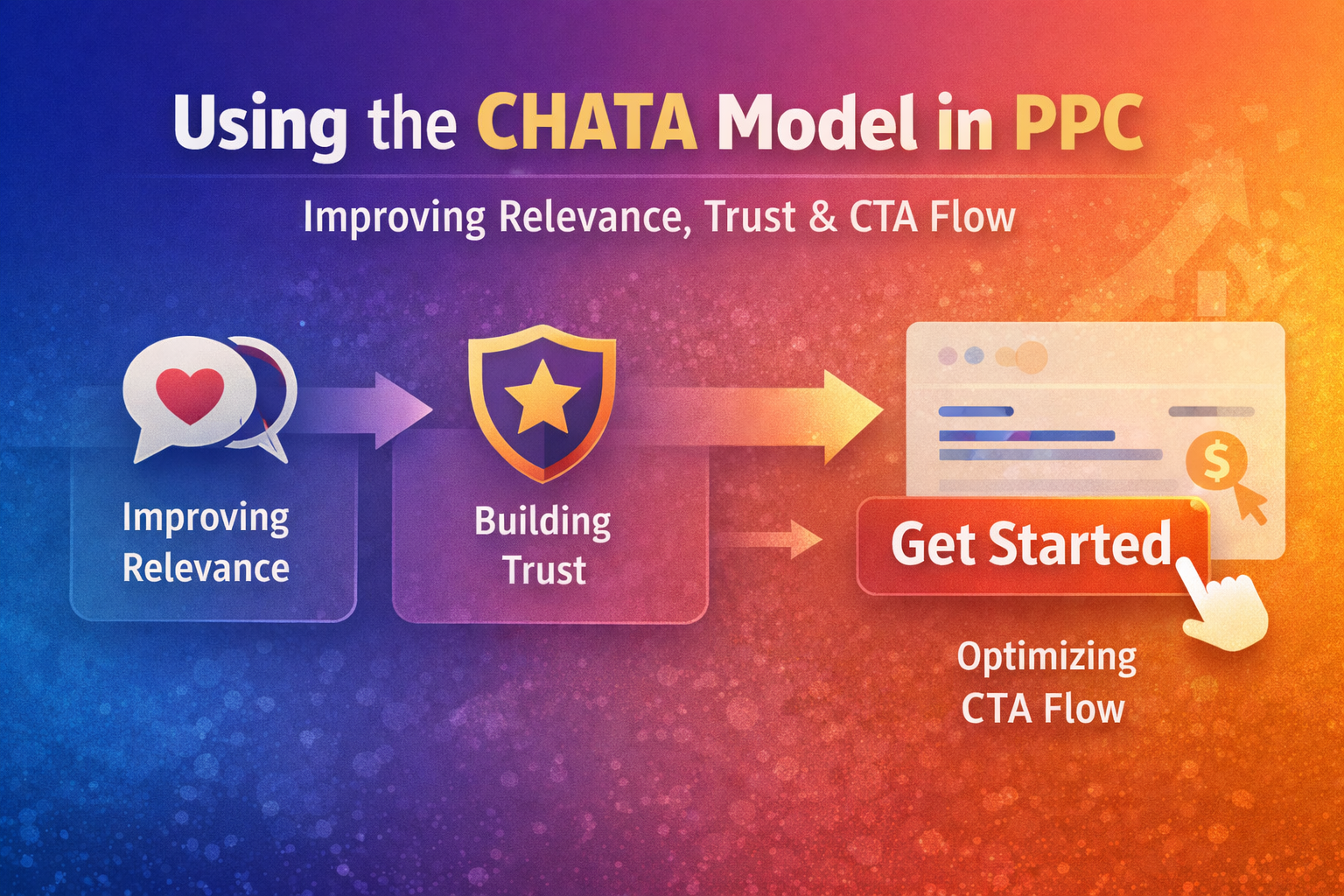
Using CHATA model in PPC: Improving relevance, trust & CTA flow
Most PPC campaigns don’t fail because of bidding strategies or budgets. They fail because they try to convert before they make sense.
Ads interrupt. Landing pages rush. CTAs push. And users, especially today, resist all three. What PPC really suffers from isn’t inefficiency. It’s psychological misalignment.
This is where the CHATA model (Connect → Humanize → Align → Transition → Anchor) becomes a powerful lens for paid media, not as a copywriting trick, but as a relevance and trust system.
In this article, we’ll break down how to apply CHATA across PPC ads and landing pages to improve:
- message relevance
- perceived trust
- CTA flow
- and post-click performance
Without sounding like marketing. Without burning the budget.
Why PPC optimization is incomplete without psychology
Traditional PPC optimization focuses on:
- keywords
- match types
- Quality Score
- CTR
- CPA
All important, but insufficient.
What most PPC frameworks ignore:
- the emotional state of the user when the ad appears
- the cognitive jump between ad → landing page
- the friction created by premature CTAs
- the lack of narrative continuity post-click
In other words: the human sequence is broken.
CHATA fixes this by forcing every PPC element to answer one question:
Where is the user psychologically and what do they need next?
CHATA reframed for paid media
In PPC, CHATA doesn’t apply to “content” in the abstract.
It applies to micro-moments.
Each stage maps cleanly to paid media execution:
- Connect → Ad relevance & pattern interrupt
- Humanize → Trust signals & tone
- Align → Landing page clarity & intent match
- Transition → CTA logic & friction control
- Anchor → Brand memory & post-click continuity
Let’s break this down stage by stage.
1. Connect: Winning the click without manipulation
In PPC, Connect happens in milliseconds.
Users don’t click ads because they’re persuasive.
They click because something feels immediately relevant.
Weak PPC messaging:
- generic benefit claims
- keyword-stuffed headlines
- empty urgency
Strong CHATA-driven Connect:
- reflects the user’s current problem state
- mirrors search intent language
- frames tension before solution
Example (Search Ad)
❌ Generic:
Best Project Management Software – Start Free Trial
✅ CHATA-driven:
Projects Moving Fast, but Visibility Isn’t?
Same keyword intent.
Radically different relevance signal.
Connect isn’t about cleverness.
It’s about recognition.
2. Humanize: Building trust in a hostile environment
Users distrust ads by default.
Humanize in PPC doesn’t mean “friendly copy.”
It means reducing perceived risk.
Humanized PPC elements include:
- calm, confident tone (not hype)
- acknowledgement of effort or uncertainty
- language that sounds like a peer, not a pitch
Example (Ad Description)
❌:
Boost productivity by 40% with our all-in-one platform.
✅:
Built for teams who’ve already tried too many tools.
That sentence does more trust work than any badge.
3. Align: Fixing the ad → Landing page disconnect
This is where most PPC money is wasted.
The ad promises one thing.
The landing page talks about ten others.
Alignment means:
- one dominant intent per page
- language continuity from keyword → ad → headline
- removing secondary narratives
CHATA forces a hard question:
Does this page continue the same conversation the ad started?
If not, bounce is inevitable.
4. Transition: Designing CTAs that feel earned
Most PPC CTAs fail because they arrive too early.
“Book a demo.”
“Start free trial.”
“Buy now.”
These are not transitions.
They are demands.
CHATA treats CTAs as psychological bridges, not buttons.
Effective PPC transitions:
- lower commitment
- match intent depth
- feel like the next logical step
Examples:
- “See how this works for your use case”
- “Explore a real example”
- “Understand if this fits your workflow”
When transition logic is right:
- conversion rate rises
- CPL drops
- lead quality improves
Because users don’t feel pushed.
5. Anchor: PPC’s most ignored advantage
Most PPC teams stop optimizing after conversion.
That’s a mistake.
Anchor is about:
- what users remember after clicking
- how they recall your brand later
- whether retargeting feels familiar or intrusive
Anchoring in PPC happens through:
- consistent language across ads and pages
- repeated mental models
- stable tone across campaigns
This is how PPC stops being transactional and starts compounding.
Why CHATA improves quality score without gaming it
Google rewards relevance.
CHATA improves:
- expected CTR (Connect)
- landing page experience (Align)
- engagement and time on page (Humanize + Transition)
Not by hacks but by making sense to humans.
Quality Score follows clarity.
If you want to see how CHATA continues working after conversion, this breakdown of retention through the CHATA model explains how relevance, trust, and continuity are maintained long after the first click.
External Perspective: Why relevance beats persuasion in ads
Behavioural research consistently shows that users respond better to relevance and familiarity thanto persuasion pressure.
Google itself emphasises this in its guidance on ad relevance and landing page experience.
CHATA operationalizes that principle across every PPC touchpoint.
Final thought: PPC isn’t about forcing action
PPC doesn’t fail because ads are expensive.
It fails because:
- relevance is shallow
- trust is rushed
- CTAs are premature
The CHATA model gives PPC something it’s been missing for years:
a human sequence that survives the click.
When relevance, trust, and transition flow together, performance follows without shouting.