
Amrudin Ćatić
Strategy, creativity, and technology are combined to craft digital experiences that perform. Smart marketing meets creative execution, always focused on growth, problem-solving, and real impact.
How teams can use CHATA model: A unified approach to communication
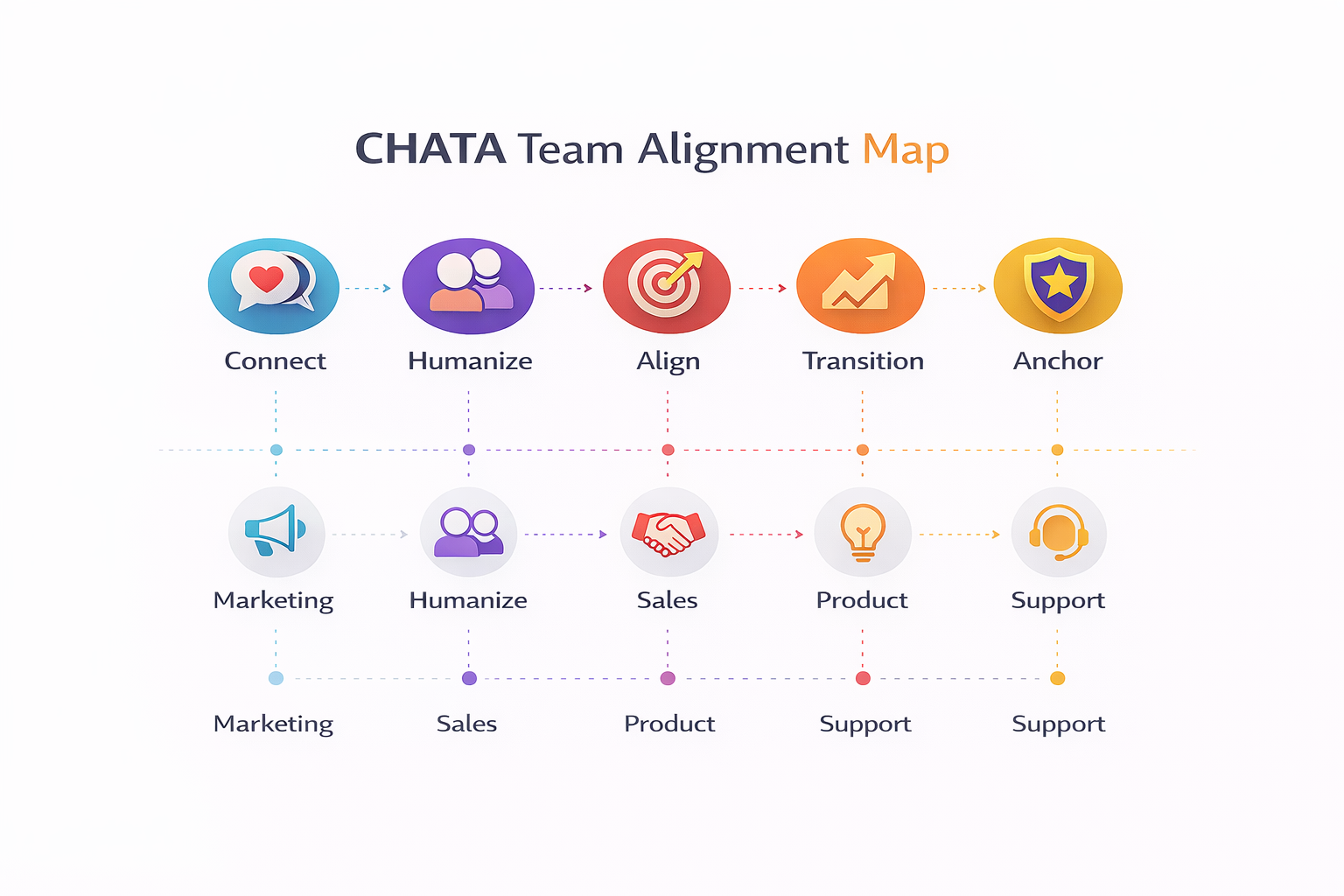
Most teams don’t struggle because of a lack of talent. They struggle because of misalignment in communication.
Marketing says one thing.
Product says another.
Sales simplifies it differently.
Support explains it in its own way.
Individually, everyone makes sense.
Collectively, the message fractures.
That fracture creates:
- confused customers
- inconsistent messaging
- slow decision cycles
- internal friction
- brand dilution
This is where the CHATA model (Connect → Humanize → Align → Transition → Anchor) becomes more than a content structure.
It becomes a unified communication system across teams.
Why most teams communicate in silos
Communication breakdown usually happens in predictable patterns:
- Marketing focuses on awareness.
- Sales focuses on objection handling.
- Product focuses on feature clarity.
- Support focuses on problem resolution.
Each team optimizes for its stage.
Nobody optimizes for continuity.
The result?
The customer experiences multiple voices, not one narrative.
CHATA fixes that by creating a shared progression logic.
CHATA as a cross-team communication framework
Instead of organizing communication by department, CHATA organizes it by human state progression.
Every team, at any touchpoint, can ask:
- Are we connecting?
- Are we humanizing?
- Are we aligned?
- Are we transitioning properly?
- Are we reinforcing identity?
When everyone uses the same lens, silos weaken.
1. Connect: Shared entry points across teams
Connection is not just marketing’s job.
Product onboarding connects.
Support replies connect.
Sales discovery connects.
A unified team approach means:
- Shared language about user tension
- Consistent problem framing
- Stable vocabulary across channels
If marketing says:
“We simplify complex workflows”
But support says:
“Use advanced configuration settings”
You’ve broken the connection.
Teams should define:
- Core tension
- Core vocabulary
- Core user state
And use it everywhere.
2. Humanize: Internal culture reflects external tone
You cannot humanize externally if internal communication is robotic.
Humanization across teams means:
- Empathy in sales calls
- Calm tone in support tickets
- Honest trade-offs in product documentation
When teams adopt CHATA internally, communication shifts from:
“Process enforcement”
To:
“Shared understanding.”
This consistency compounds trust.
3. Align: Strategic clarity across departments
Alignment is where most teams quietly drift apart.
Marketing chases growth.
Product chases roadmap milestones.
Sales chases quotas.
CHATA alignment forces a shared question:
What job is the user trying to get done, right now?
When all departments align around the same JTBD logic:
- Messaging sharpens
- Feature priorities clarify
- Sales objections reduce
- Support conversations shorten
Alignment is not agreement. It’s coherence.
If you want to understand how AI-generated interfaces actually shape perception, clarity, and conversion, read my deep dive on ChatGPT model UX writing and conversational interface strategy. I break down how model behavior, prompt structure, and microcopy decisions directly influence user trust, engagement, and product experience, and why most teams underestimate the strategic weight of UX writing in AI-driven products
4. Transition: Removing friction between teams
Most customer friction isn’t external. It’s internal handoff friction.
Example:
- Marketing promises simplicity.
- Sales promises speed.
- Onboarding introduces complexity.
That gap is not a feature problem. It’s a transition failure.
CHATA-based teams design transitions intentionally:
- Marketing → Sales
- Sales → Onboarding
- Onboarding → Retention
- Retention → Advocacy
Every handoff must feel like a continuation, not a reset.
5. Anchor: Building a shared identity inside the organization
Anchor isn’t just for customers. It’s for teams.
When teams consistently:
- use the same metaphors
- repeat the same mental models
- reinforce the same vocabulary
Communication becomes faster.
Decision-making becomes clearer.
Brand identity becomes stable.
CHATA becomes an internal shorthand.
Instead of debating tone or structure, teams ask:
Which stage are we in?
That clarity reduces internal noise dramatically.
Why CHATA works better than departmental frameworks
Most frameworks are siloed:
- Sales scripts
- Brand guidelines
- UX patterns
- Customer journey maps
CHATA cuts horizontally across all of them.
It doesn’t replace tools. It unifies them.
This is similar to how modern organizational research emphasises alignment and shared narrative as drivers of performance. Harvard Business Review often highlights that teams with coherent internal narratives outperform fragmented ones.
Communication clarity scales performance.
Practical implementation: How teams start using CHATA
- Define your core user tension.
- Agree on shared vocabulary.
- Audit messaging across departments.
- Identify broken transitions.
- Create an anchor language that repeats consistently.
You don’t need new tools.
You need shared progression logic.
Final thought: One model, many voices
A brand does not speak once.
It speaks across:
- ads
- landing pages
- sales calls
- onboarding
- support replies
- feature updates
Without structure, those voices diverge.
With CHATA, they converge.
And convergence builds trust, internally and externally.