
Amrudin Ćatić
Strategy, creativity, and technology are combined to craft digital experiences that perform. Smart marketing meets creative execution, always focused on growth, problem-solving, and real impact.
CHATA model for SEO: Aligning with SGE, entities & topical authority
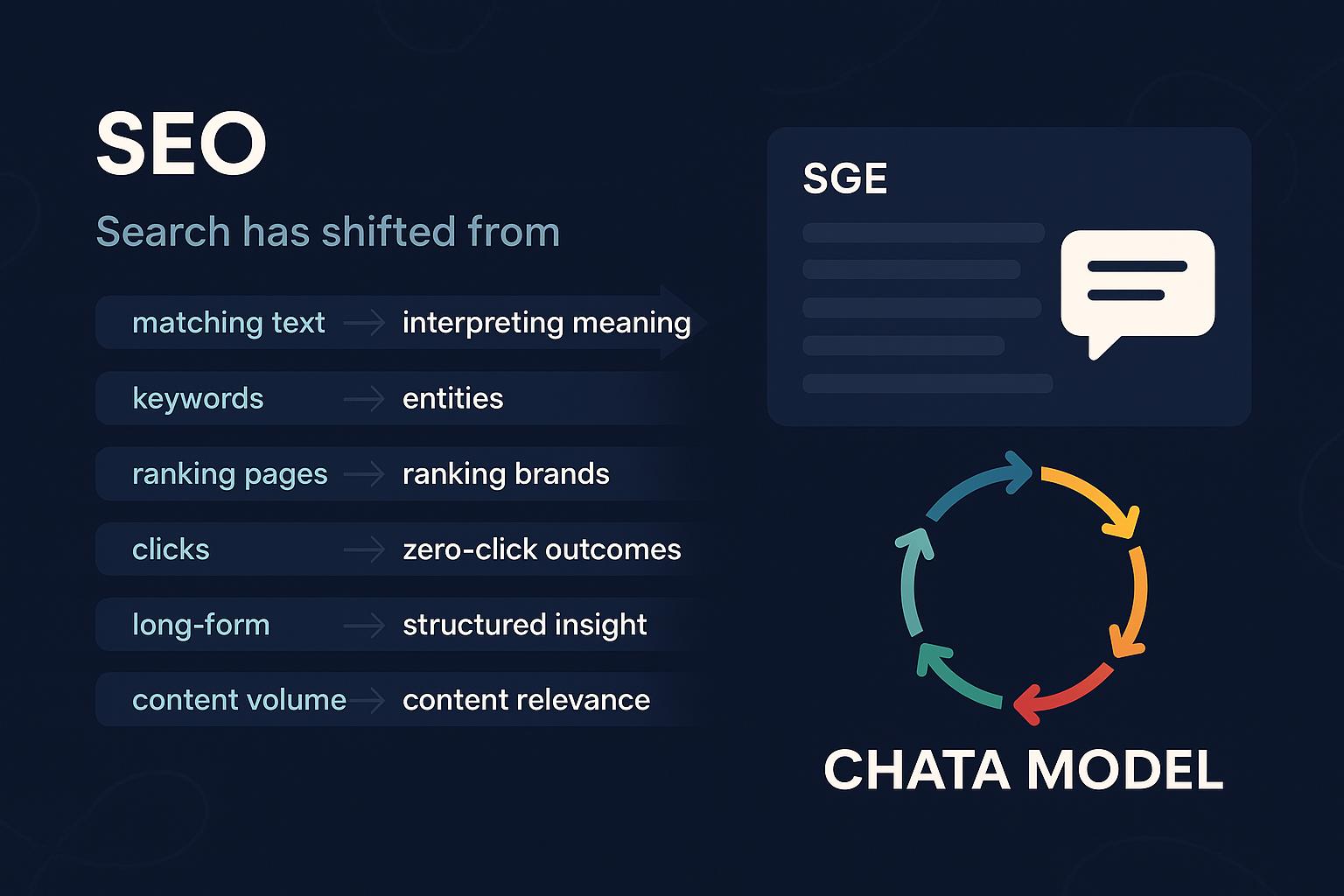
SEO is no longer keyword-driven, linear, or static. It’s shaped by Search Generative Experience (SGE), entity-based understanding, AI summarisation layers, topical authority, and user behaviour that moves in loops instead of funnels.
Most SEO frameworks still focus on traditional mechanics: keyword research, on-page structure, link building, and technical health. These still matter, but they no longer explain why some pages rank better than technically perfect competitors, or why certain brands dominate SGE even with fewer backlinks.
What drives visibility today is not only optimisation.
It’s communication logic, how you structure meaning, relevance, and value across an entire content ecosystem.
This is where the CHATA model becomes a powerful SEO tool.
Built around Connect → Humanize → Align → Transition → Anchor, CHATA maps perfectly to the ranking factors, behavioural patterns, and content-format expectations Google now prioritises.
This article breaks down exactly how CHATA strengthens SEO performance, earns SGE visibility, and builds durable topical authority, not through hacks, but through structured, human-centric communication.
Many marketers still rely on legacy models built for linear communication, which is exactly why their SEO content sounds generic. If you want a deeper breakdown of how CHATA compares to older structures like AIDA.
Why SEO needs CHATA (Not another checklist)
Search has shifted from:
- matching text → interpreting meaning
- keywords → entities
- ranking pages → ranking brands
- clicks → zero-click outcomes
- long-form → structured insight
- content volume → content relevance
And most SEO content still sounds like it’s written for 2016.
The problem?
Traditional SEO frameworks can’t explain:
- why SGE chooses one brand over another
- why pages with fewer backlinks outrank big sites
- why average content dies in generative search
- why user behaviour rejects linear structures
- why trust signals outperform keyword density
SGE fundamentally changed how search works. Instead of ranking pages mechanically, Google now interprets intent, entities and topical depth through generative summaries. Google’s own breakdown of SGE makes this clear:
CHATA solves this by reframing SEO as communication.
SEO is no longer “optimising pages”.
It is “aligning meaning, relevance, expertise and continuity across every page and touchpoint.”
CHATA gives you a model for that.
How the CHATA model fits into modern SEO
CHATA’s structure maps directly onto Google’s ranking logic:
| CHATA Step | SEO Equivalent | Why It Matters |
|---|---|---|
| Connect | Search intent + entity matching | Drives relevance & SGE accuracy |
| Humanize | E-E-A-T, trust, expertise | Required for SGE surfaceability |
| Align | Semantic structure + internal linking | Builds topical authority |
| Transition | UX flow + engagement + CTR | Improves behavioural signals |
| Anchor | Retention + content ecosystem | Grows brand presence & revisit patterns |
This is exactly why CHATA works so well for SEO, it addresses ranking factors before they become checklists.
C – CONNECT: Search intent, entities & relevance
This is the foundation of modern SEO.
“Connect” ensures that your content:
- immediately reflects search intent
- aligns with entity relationships
- mirrors the user’s language
- enters the conversation at the right point
SGE doesn’t reward “attention-grabbing” intros.
It rewards contextual alignment.
How to apply Connect in SEO:
1. Start with immediate relevance
Your first 2–3 lines must answer:
“What is the user actually trying to solve?”
Examples:
AIDA-style intro → vague, broad
CHATA intro → specific, user-driven
2. Use entities early
Entities are not keywords, they’re concepts Google recognises.
Example entities for this post:
- CHATA model
- AIDA model
- SGE
- topical authority
- semantic search
- content clusters
- user intent
When entities appear early and clearly, SGE understands your context.
3. Match intent format, not just content
SGE evaluates whether your page is the right type of page for a query.
CHATA’s “Connect” naturally forces that.
H – HUMANIZE: E-E-A-T and trust signals
Humanization is now an SEO requirement.
Google’s quality guidelines explicitly reward:
- experience
- expertise
- author authority
- transparency
- real insights
- first-hand examples
CHATA treats this as a core part of communication, not an afterthought.
How to humanize effectively in SEO:
Add lived experience
Describe what you’ve tested, observed, and analysed.
Use specific details
Generic content dies in SGE.
Specificity builds authority.
Bring an expert perspective
“Here’s what we saw when testing 50 onboarding flows”
That beats any AI text.
Show your reasoning
Explain why something works, not only what to do.
Humanized content → Better E-E-A-T → Better ranking & better SGE surfaceability.
A – ALIGN: Semantic search & topical architecture
Alignment is where CHATA becomes a powerhouse for SEO.
Alignment in SEO means:
- matching content structure to user journey
- linking topics through semantic relationships
- showing Google you understand the subject deeply
- using internal linking to guide meaning
- placing your content inside a larger, logical ecosystem
How CHATA improves semantic SEO:
Build topical clusters
Every CHATA-related post boosts all others.
Align subtopics with natural user questions
H3 sekcije = search intent questions.
Use semantic signals intentionally
Synonyms, related topics, entities, and contextual phrases deepen content.
Align content depth with query complexity
SGE hates shallow answers.
This is how CHATA automatically builds topical authority.
T – TRANSITION: UX flow, behavioural signals & engagement
Transition is where AIDA breaks, it forces a CTA.
CHATA instead improves flow, which is crucial for:
- time on page
- scroll depth
- click-through
- internal link CTR
- pogo-sticking avoidance
- engagement patterns (SGE metric!)
How to apply Transition in SEO:
Natural CTA (contextual, not pushy)
“See examples”
“View breakdowns”
“Explore the full CHATA model”
Smooth section-to-section flow
Logical transitions reduce drop-off.
Clear internal link positioning
Internal links placed at the right moment increase engagement → boost authority.
Multi-step engagement design
Users should always have “what’s next?” clarity.
A – ANCHOR: Content ecosystems & SEO density
Anchor is what AIDA never had, and what SEO absolutely needs.
Anchor builds:
- return visits
- content pathways
- memorability
- branded search queries
- behaviour loops
- category ownership
How CHATA creates SEO power through anchoring:
Anchor posts to a main hub
Your CHATA hub page becomes the “pillar”.
Anchor long-term readers
Recurring patterns → users stay longer across multiple posts.
Anchor brand identity into the model
“CHATA model” becomes associated with your name → branded searches → huge SEO impact.
Anchor through internal linking
Every CHATA post boosts the rest of them.
Why the CHATA model outperforms classic SEO methodologies
- Works with entity-based search, not keyword lists
- Matches SGE behaviour, not outdated ranking logic
- Forces E-E-A-T naturally without forcing it
- Builds topic authority systematically
- Creates a UX flow that Google can measure
- Improves retention – a hidden SEO advantage
- Reflects human cognitive behaviour
Simply put:
CHATA is modern SEO logic disguised as communication logic.
And that’s why it works.
Real example: Rewriting SEO content using CHATA
AIDA-style SEO intro:
“SEO is more important than ever. Businesses need to optimise their content to stay competitive.”
Flat. Generic. Lifeless.
CHATA intro:
“Most brands aren’t struggling with SEO, they’re struggling with relevance. Search engines now prioritise meaning over keywords, and most content isn’t built for that shift.”
This hits:
- Connect → relevance
- Humanize → insight
- Align → logical clarity
- Transition → invites the next section
- Anchor → opens room for deeper exploration
This is how CHATA rewrites ranking content.
How to use the CHATA model in your SEO workflow
1. Start with a CHATA audit
- Does your intro connect to real intent?
- Does your content contain lived insight?
- Is the structure aligned with user questions?
- Do your CTAs feel natural?
- Does the article link into an ecosystem?
2. Structure articles using CHATA sections
Each major section maps to an SEO factor.
3. Build CHATA-based content clusters
Example cluster:
- CHATA model
- CHATA vs AIDA
- CHATA for SEO
- CHATA for CRO
- CHATA for email
- CHATA for UX writing
- CHATA case studies
This creates a topic monopoly.
4. Feed SGE with clarity, expertise, and connected meaning
SGE needs structure, CHATA gives it.
FAQ (Search-intent based)
How does the CHATA model improve SEO?
By aligning content relevance, expertise, semantic structure, user engagement, and long-term retention.
Is CHATA better than AIDA for SEO?
Yes, AIDA doesn’t support SGE, semantic search, or entity-driven content.
Does CHATA help with topical authority?
Yes. It naturally creates content clusters and internal linking pathways.
Can CHATA be used for keyword research?
Indirectly, it improves how you structure meaning around keywords.
Does CHATA work with AI-generated content?
Perfectly. It fixes AI’s lack of nuance and human insight.
Conclusion: CHATA is not a tactic – it’s modern SEO logic
SGE, semantic search, behavioural signals, and E-E-A-T have reshaped how ranking works.
Most marketers still optimise content, but ignore communication.
CHATA merges both worlds:
- relevance
- expertise
- alignment
- flow
- continuity
This makes it one of the most adaptive models for modern SEO teams, creators, strategists, and brand builders.