
Amrudin Ćatić
Strategy, creativity, and technology are combined to craft digital experiences that perform. Smart marketing meets creative execution, always focused on growth, problem-solving, and real impact.
CHATA: A scalable marketing model for modern brands
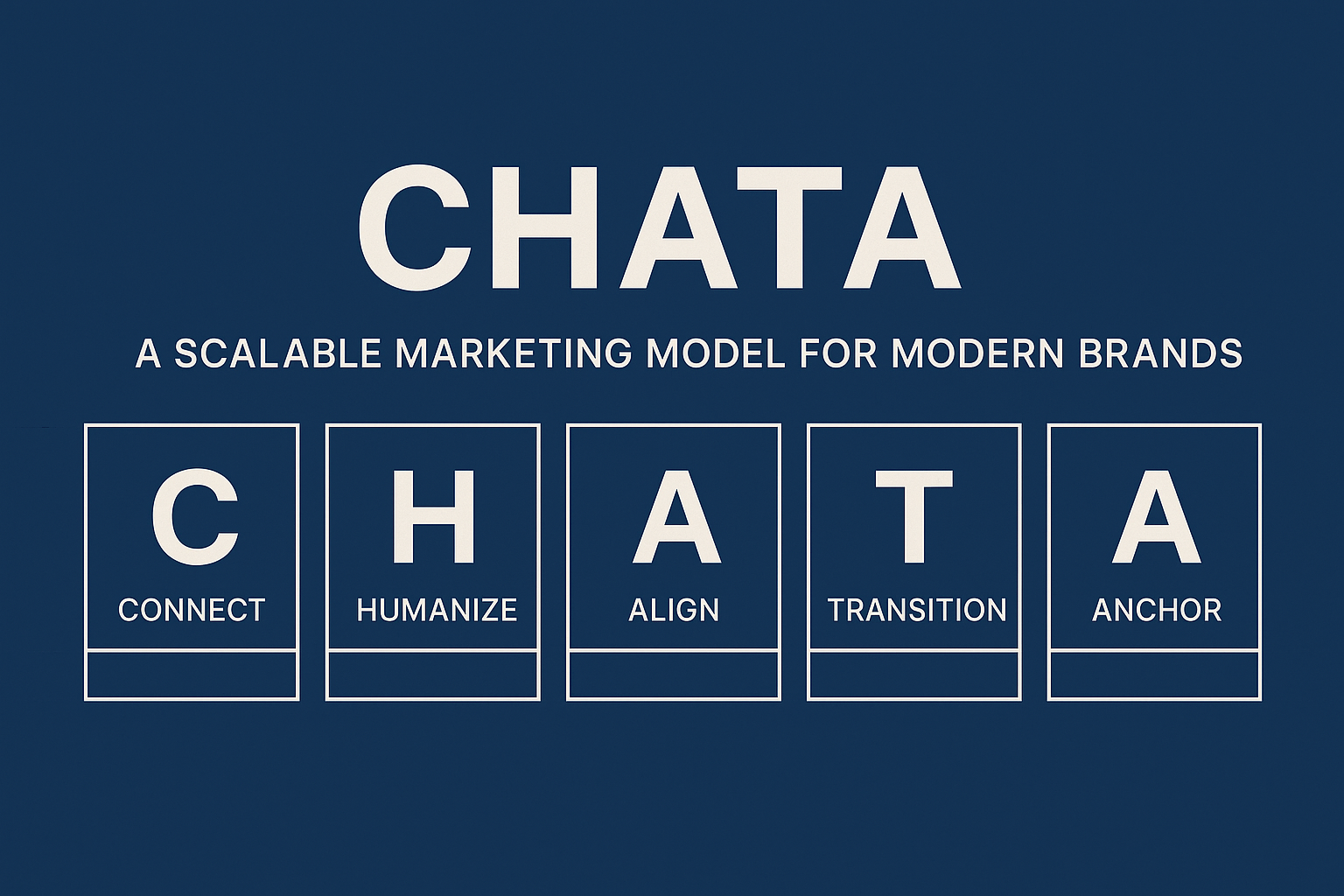
Most marketing frameworks explain how to write better messages. Very few explain how to build a communication system that scales across content, funnels, SEO, brand, product, and retention.
That gap became obvious after working with dozens of brands and analysing thousands of assets across the last decade. Clear messaging was rarely the real problem. The real bottleneck was fragmentation: the email team said one thing, the content team another, ads used a third angle, and product pages lived in a completely different universe.
The result?
A brand that sounds inconsistent, communicates reactively, and loses trust at every touchpoint.
This is why the CHATA model needed to evolve beyond only communication.
CHATA is not just a framework for writing, it’s a marketing operating system designed to unify positioning, messaging, content, conversion, and retention into one coherent structure.
In a world defined by SGE, semantic search, AI-assisted content, and zero-click SERPs, brands need more than tactics. They need alignment, need continuity, need a communication architecture.
CHATA is built for that!
Why CHATA needed to scale beyond conversation
Traditional linear frameworks like AIDA still describe how attention moves through a message (as outlined by HubSpot), but they don’t explain how modern brands maintain relevance, trust, and alignment across entire ecosystems.
CHATA model (Connect → Humanise → Align → Transition → Anchor) solved a big problem: how to communicate in a way that feels natural, human, and conversion-driven.
But when applied to broader marketing systems, something became clear:
- “Connect” is also positioning
- “Humanise” is also brand trust and E-E-A-T
- “Align” is also an offer-market fit
- “Transition” is also a funnel design
- “Anchor” is also retention and lifecycle marketing
Introducing CHATA – The scalable model
CHATA expands each letter into three layers:
1. Micro layer – Messaging (copy, content, communication)
What people read.
2. Mezo layer – Strategy (brand, offer, funnel, intent)
How everything fits together.
3. Macro layer – Growth (lifecycle, retention, loyalty, community)
How the brand sustains a relationship over time.
This structure lets CHATA work across:
- SEO + topical authority
- email sequences
- CRO and UX
- landing pages
- PPC campaigns
- sales enablement
- brand identity
- product messaging
- retention systems
- onboarding
- community building
It becomes a complete marketing ecosystem model.
Let’s break down each layer.
C – CONNECT (Positioning, Relevance, Discovery)
1. Micro (Messaging): Immediate contextual relevance
Connect = the first moment where a user recognises you understand their world.
Examples:
- A headline that mirrors a real frustration
- A landing page hook that reflects the user’s intent level
- A content intro aligned with SGE snapshots
2. Mezo (Strategy): Market fit + positioning clarity
Here, Connect becomes structural:
- who you serve
- what problem do you solve
- why now
- what category do you operate in
- how your brand enters the user’s mental model
Brands fail because they “connect” emotionally but fail to connect strategically.
3. Macro (Growth): Discoverability + intent pathways
At the macro level, Connect becomes:
- SEO topic clusters
- entity-driven content maps
- search intent journeys
- SGE-friendly structures
- multi-channel entry points
This is how CHATA aligns with topical authority and semantic search.
H – HUMANIZE (Trust, Proof, Differentiation)
1. Micro (Messaging): Human voice + insights
Humanisation is the antidote to AI sameness.
Practical applications:
- specific detail
- lived experience
- behind-the-scenes context
- founder voice
- case anecdotes
2. Mezo (Strategy): E-E-A-T architecture
Humanisation at the strategic level means:
- transparent proof
- credibility layers
- consistent brand voice guidelines
- expert insights baked into content
- cross-channel authority alignment
This is where SGE evaluates trustworthiness.
3. Macro (Growth): Brand character + long-term recognition
At the operating system level, Humanise becomes:
- narrative arcs
- brand memory triggers
- community voice
- founder-as-media presence
- human-centric onboarding
This is the layer AI can’t replicate.
A – ALIGN (Intent, Offers, Fit, JTBD)
1. Micro (Messaging): Aligning problem → solution
Misalignment kills conversion faster than bad copy.
Examples:
- wrong offer for wrong intent
- mismatched promise
- CTA that doesn’t follow the narrative
2. Mezo (Strategy): Offer-Market Fit
Alignment becomes:
- mapping Jobs-To-Be-Done
- matching offer ladders to user awareness
- funnel → messaging → intent consistency
- pricing psychology
- value proposition clarity
This is where CRO and PM meet marketing.
3. Macro (Growth): Systems-level alignment
At scale, alignment becomes:
- orchestrated content ecosystem
- multi-touch, multi-channel logic
- consistent journey architecture
- lifecycle syncing with behavioural triggers
This unlocks smooth acquisition → activation → retention flow.
T – TRANSITION (Journey Flow, UX, Micro-Commitments)
1. Micro (Messaging): Natural CTA progression
A transition is not “sign up now”.
It’s the next logical step that reduces friction.
Examples:
- “See the examples”
- “Try the diagnostic”
- “Check the breakdown we used internally”
2. Mezo (Strategy): Funnel + UX flow
Transition expands into:
- funnel path architecture
- UX writing
- onboarding logic
- micro-commitment sequencing
- behavioral nudges
This is where CHATA becomes a CRO framework.
3. Macro (Growth): Holistic journey design
At the OS level, Transition means:
- cross-channel continuity
- retargeting logic
- multi-step nurturing flows
- omnichannel progression
This ensures users never feel like the brand “resets” every time.
A – ANCHOR (Retention, Continuity, Loyalty, Memory)
1. Micro (Messaging): Stay present
Anchoring in communication:
- follow-up content
- recurring themes
- referencable frameworks
- reminders that reinforce the narrative
2. Mezo (Strategy): Relationship-building systems
At the strategic layer:
- lifecycle sequences
- segmentation
- trust loops
- case study nurturing
- problem-update broadcasts
3. Macro (Growth): Retention engine
At the OS level, Anchoring becomes:
- customer communities
- loyalty loops
- habit creation
- long-term content sequences
- proprietary methodologies
- recurring value cycles
This is where a brand stops being “a touchpoint” and becomes an ecosystem.
Why CHATA outperforms legacy models
1. Compatible with SGE and Zero-Click search
CHATA forces contextual clarity early, humanises content, and anchors expertise, exactly what SGE rewards.
2. Built for AI + human collaboration
The “H” and “A” stages ensure original insight is baked into AI-assisted content.
3. Works across every marketing discipline
Unlike AIDA or PAS, which are narrow, CHATA is holistic.
4. Strengthens topical authority
CHATA structures entire ecosystems, not isolated articles.
5. Mirrors real buyer behaviour
Users don’t move linearly, something CXL has broken down extensively when analysing why classic funnel sequences fail in real-world behaviour, can check about this here.
CHATA adapts to these non-linear patterns instead of forcing users into artificial steps.
How to implement CHATA (Practical steps)
1. Run a CHATA audit
Use this checklist:
- Is your positioning immediately clear? (Connect)
- Are you using real insight, expertise, and narrative? (Humanise)
- Does your offer match your audience? (Align)
- Is the next step frictionless? (Transition)
- Are you building relationship continuity? (Anchor)
This audit alone will expose 70% of inconsistencies.
2. Build CHATA into your content ecosystem
Example cluster:
- CHATA overview
- CHATA for SEO
- CHATA for CRO
- CHATA for email sequences
- CHATA vs AIDA
- CHATA onboarding framework
- CHATA for B2B SaaS positioning
This builds depth → depth builds authority → authority builds rankings.
3. Apply CHATA to funnel architecture
- Connect → Top-of-funnel messaging
- Humanize → Middle-of-funnel trust
- Align → Offer mapping
- Transition → UX/CRO layers
- Anchor → retention workflows
This makes funnels feel natural, not forced.
4. Build a CHATA-aligned brand narrative
Create 3–5 recurring narrative pillars that reinforce:
- expertise
- mission
- value
- transformation narrative
This makes the brand recognisable across touchpoints.
FAQ (Search-intent based)
What is CHATA?
A marketing operating system built on Connect, Humanise, Align, Transition, and Anchor, expanded across messaging, strategy, and long-term growth.
Is CHATA better than AIDA?
For modern digital behaviour, yes. It accounts for trust, alignment, continuity, and user behaviour beyond a single interaction.
Where can CHATA be applied?
SEO, branding, UX writing, CRO, product marketing, funnels, email sequences, and retention systems.
Can CHATA work with AI-based content workflows?
Yes, the humanise and Align stages specifically strengthen AI-assisted content so it doesn’t sound generic.
Conclusion: CHATA is a true marketing model – not just a framework
CHATA began as a communication model but naturally evolved into something more powerful: a system for structuring relevance, trust, alignment, progression, and continuity across the entire marketing ecosystem.
In an era defined by AI saturation, semantic search, zero-click content, and non-linear buyer journeys, brands need models that reflect reality, not legacy.
CHATA gives you the architecture to unify:
- messaging
- funnels
- SEO
- brand
- retention
into one coherent, scalable structure.
If you want help applying CHATA to your brand
CHATA works best when it’s implemented through real marketing systems, positioning, SEO architecture, funnel flows, content ecosystems, and retention loops.
If you want support adapting the model to your brand or building a scalable marketing operating system:
See what I do and how I work.