
Amrudin Ćatić
Strategy, creativity, and technology are combined to craft digital experiences that perform. Smart marketing meets creative execution, always focused on growth, problem-solving, and real impact.
CHATA for B2B SaaS: A modern model for clear positioning & JTBD alignment
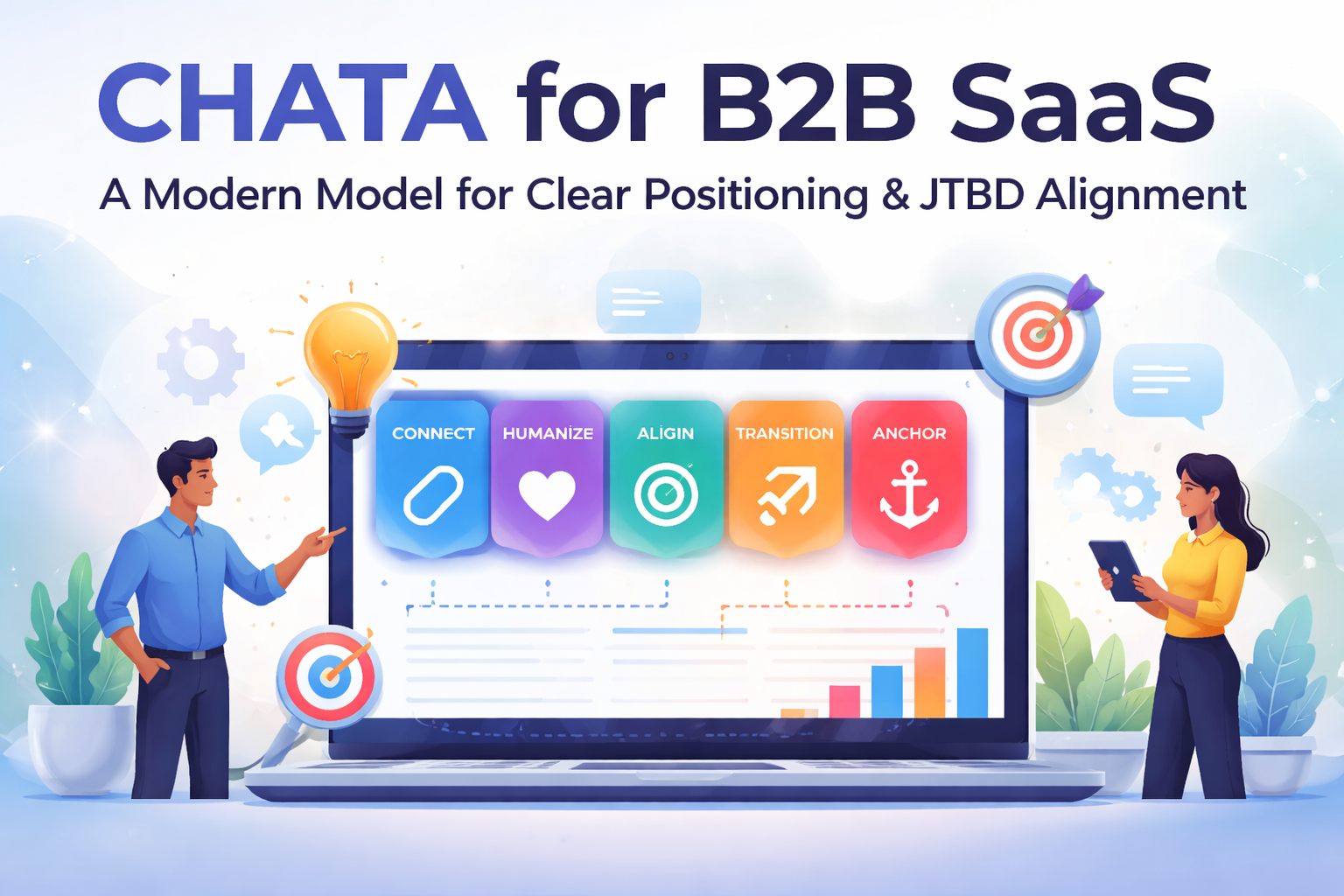
Learn how the CHATA model helps B2B SaaS companies clarify positioning, align with Jobs To Be Done, and drive sustainable growth.
B2B SaaS marketing is broken in a very specific way.
Products are powerful.
Teams are smart.
Features are impressive.
And yet, most SaaS websites, email sequences, onboarding flows, and sales decks sound the same.
The problem is not demand.
The problem is misalignment.
Misalignment between:
- what the product does
- what the customer is trying to achieve
- and how the company communicates value
This is where the CHATA model becomes relevant, not as a content framework, but as a positioning and execution system.
CHATA stands for:
Connect → Humanize → Align → Transition → Anchor
In this article, we’ll break down how CHATA applies specifically to B2B SaaS, and how it helps teams achieve clear positioning, stronger JTBD alignment, and higher-quality conversions across the entire lifecycle.
Why B2B SaaS positioning fails (even with great products)
Most B2B SaaS companies don’t lose because the product is bad.
They lose because:
- they talk about features instead of outcomes
- they assume users understand why the product matters
- they jump to conversion before earning psychological buy-in
This creates a dangerous gap:
The customer understands what the product is, but not why it exists for them.
That gap kills:
- homepage clarity
- demo requests
- email engagement
- onboarding completion
- long-term retention
JTBD theory explains what users are trying to get done, but most SaaS teams struggle to translate JTBD insights into clear messaging and user journeys.
CHATA is the missing execution layer.
CHATA as a B2B SaaS positioning system
CHATA is not linear marketing fluff.
It is a behavioural sequence that mirrors how people actually evaluate B2B software.
Let’s break it down, step by step.
1. Connect: Earn relevance before you earn attention
In B2B SaaS, attention without relevance is useless.
“AI-powered.”
“End-to-end platform.”
“Scalable solution.”
That language doesn’t connect, it blends in.
Connect means:
- signalling situational awareness
- entering the user’s reality at the right moment
- reflecting the problem before naming the solution
In JTBD terms:
You’re not selling the product.
You’re recognizing the job the user is already struggling with.
Example (weak):
“Our SaaS helps teams automate workflows.”
Example (CHATA-style Connect):
“If your team spends more time maintaining tools than doing actual work, the problem isn’t productivity, it’s tool overload.”
Connection is achieved when the user thinks:
“They understand my situation.”
No CTA yet. No demo pitch.
Just relevance.
2. Humanize: Reduce cognitive and emotional friction
B2B buyers are not robots.
They are:
- under pressure
- afraid of making the wrong decision
- accountable to managers, teams, and budgets
Humanize is not about being “friendly.”
It’s about reducing psychological resistance.
This means:
- acknowledging trade-offs
- naming fears (complexity, migration risk, adoption failure)
- speaking like a competent peer, not a vendor
Humanization builds trust velocity.
This is where CHATA overlaps with behavioural psychology, explored deeper in The Psychology Behind the CHATA Model.
Without humanization, even strong JTBD messaging feels manipulative or shallow.
3. Align: Turn JTBD insights into clear positioning
This is the most critical and most misunderstood step.
Align is where CHATA locks directly into Jobs To Be Done.
But here’s the hard truth:
Knowing the job is useless if your positioning doesn’t mirror it.
Alignment means:
- mapping product capabilities to job success
- showing what changes after adoption
- clarifying what the product is not for
Strong alignment answers three questions instantly:
- Who is this for?
- What job does it help me complete?
- Why is this approach better than alternatives?
This is where positioning lives, not in taglines, but in narrative clarity.
If your SaaS can’t explain its value without screenshots or feature lists, alignment is broken.
4. Transition: Move from understanding to action (without pressure)
Most B2B SaaS teams rush this step.
They go from:
“Here’s what we do” straight to “Book a demo.”
CHATA treats Transition as a designed behaviour shift, not a CTA button.
Effective transitions:
- feel like the next logical step
- match the user’s stage of awareness
- lower perceived commitment
Examples of CHATA-aligned transitions:
- “See how this applies to your use case”
- “Explore a real workflow”
- “Compare this to your current setup”
The goal is not conversion, it’s momentum.
Momentum compounds.
5. Anchor: Turn usage into identity and retention
Most SaaS companies stop at activation.
CHATA doesn’t.
Anchor is about:
- memory
- habit
- identity reinforcement
Anchoring answers:
“Why do I keep coming back to this product?”
In B2B SaaS, anchoring happens through:
- consistent mental models
- repeatable value moments
- language users adopt internally (“We do it this way now”)
This is where:
- churn drops
- advocacy grows
- product becomes infrastructure, not a tool
Anchoring is the difference between usage and dependence.
CHATA vs Traditional SaaS funnels
| Traditional funnel | CHATA Model |
|---|---|
| Awareness | Connect |
| Interest | Humanize |
| Consideration | Align |
| Conversion | Transition |
| Retention | Anchor |
The difference?
CHATA is psychologically coherent.
Funnels describe stages.
CHATA engineers behaviour.
Where CHATA fits in a modern B2B SaaS stack
CHATA is not a replacement for:
- JTBD research
- product marketing
- lifecycle emails
- onboarding UX
It’s the unifying logic across all of them.
You can apply CHATA to:
- homepage messaging
- email sequences
- sales enablement
- onboarding flows
- feature announcements
- churn prevention
Think of it as a messaging system, not a campaign tactic.
External references (credibility & context)
To ground CHATA in proven thinking:
- Clayton Christensen’s Jobs To Be Done framework
https://hbr.org/2016/09/know-your-customers-jobs-to-be-done - Intercom on JTBD-driven product messaging
https://www.intercom.com/blog/jobs-to-be-done/
CHATA doesn’t contradict these ideas, it operationalises them.
FAQ: CHATA for B2B SaaS
Is CHATA a replacement for JTBD?
No. JTBD explains why users buy.
CHATA explains how to communicate, guide, and retain them across time.
Can CHATA be used by early-stage SaaS?
Yes, but especially early-stage.
Clear positioning matters more before product-market fit than after.
Is CHATA only for content marketing?
No. Content is just one surface.
CHATA applies to email, UX, sales, onboarding, and retention.
How long does it take to implement CHATA?
You don’t “implement” it, you adopt the logic.
Results appear as soon as messaging becomes clearer and transitions feel natural.
What’s the biggest mistake teams make with CHATA?
Treating it like a checklist instead of a behavioural system.
Final thought
B2B SaaS doesn’t fail because teams lack tools.
It fails because:
- positioning is vague
- messaging is feature-driven
- and user psychology is ignored
CHATA exists to fix that.
Not by adding more tactics, but by restoring clarity, alignment, and intent across the entire journey.
If your SaaS sounds smart but feels forgettable,
the problem isn’t your product.
It’s your sequence.