
Amrudin Ćatić
Strategy, creativity, and technology are combined to craft digital experiences that perform. Smart marketing meets creative execution, always focused on growth, problem-solving, and real impact.
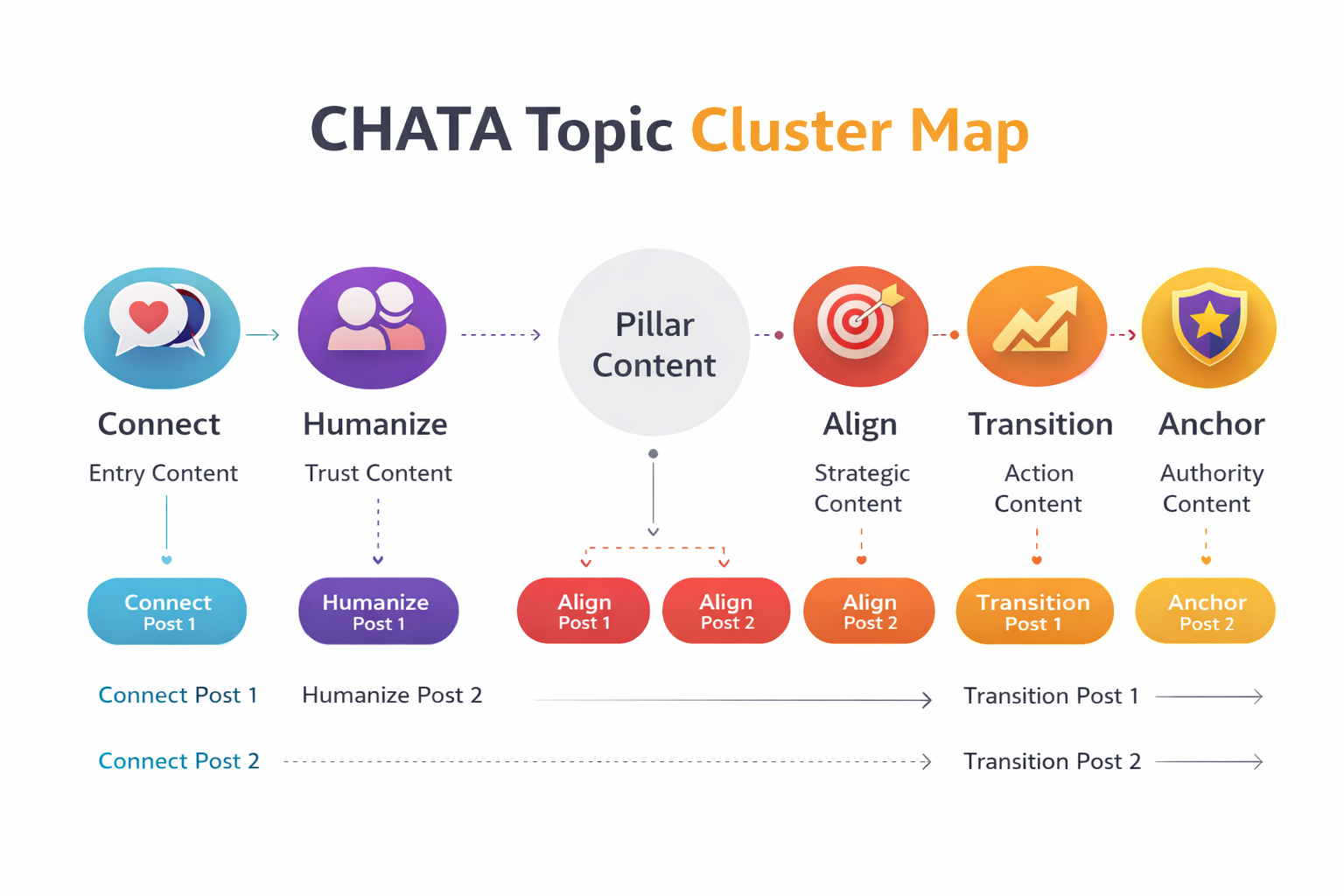
The CHATA content structure: Building a topic cluster with a single model
Most content strategies collapse under their own weight.
Not because they lack ideas. But because they lack structure.
You publish:
- blog posts
- LinkedIn articles
- newsletters
- PPC landing pages
- retention flows
And after six months, nothing connects.
Traffic is fragmented.
Authority is diluted.
Messaging drifts.
This is where the CHATA model (Connect → Humanize → Align → Transition → Anchor) becomes more than a messaging framework.
It becomes a content architecture system.
Why most topic clusters fail
Topic clusters are not new.
The classic model:
- Pillar page
- Supporting articles
- Internal links
- Semantic coverage
Sounds clean. In practice?
Clusters fail because:
- Articles don’t share narrative logic
- Messaging tone shifts between pieces
- Each post solves a problem in isolation
- Internal linking is mechanical, not meaningful
You don’t need more posts.
You need a unifying cognitive spine.
That’s what CHATA provides.
Reframing topic clusters through CHATA
Instead of organizing content only by keyword, CHATA organizes it by human progression.
Here’s the shift:
Traditional cluster logic:
Keyword → subtopic → related keyword → backlink
CHATA-driven cluster logic:
Human state → tension → alignment → progression → identity
This difference is subtle, but powerful.
The CHATA-based content ecosystem
Let’s break this down practically.
1️⃣ Connect-level content (attention & entry)
These are articles that:
- surface tension
- challenge assumptions
- interrupt default thinking
Examples:
- “Why most marketing stops too early”
- “Why your PPC doesn’t convert despite high CTR”
Goal:
👉 Attract and filter the right audience.
These posts create entry points into your ecosystem.
2️⃣ Humanize-level content (trust & relatability)
These deepen the relationship.
They:
- expose friction
- normalize struggle
- show thinking process
Example:
- Social media breakdowns
- Copy rewrite examples
- Behind-the-scenes case logic
This is where you build emotional credibility. That’s Humanize in action.
3️⃣ Align-level content (strategic depth)
This is where positioning and JTBD live.
These pieces:
- connect CHATA to business logic
- explain how it integrates with systems
- reduce abstraction
Alignment articles anchor the framework in real-world complexity.
4️⃣ Transition-level content (action & application)
These pieces:
- translate theory into process
- show execution in PPC, retention, and onboarding
- move readers toward operational thinking
Example:
👉 https://www.amrudincatic.com/chata-model-in-ppc/
Transition content doesn’t just educate. It changes behaviour.
5️⃣ Anchor-level content (authority & identity)
Anchor content is your “pillar clarity.”
These are cornerstone pieces that:
- define the philosophy
- consolidate ideas
- create conceptual gravity
Anchor posts prevent content drift.
They give Google and your audience a stable reference point.
How this improves SEO (without chasing algorithms)
When CHATA structures your topic cluster:
- Internal links become contextual, not forced
- Semantic coverage becomes natural
- Keyword cannibalisation decreases
- Bounce rates drop (narrative continuity)
- Dwell time increases
Google doesn’t reward random volume. It rewards topical coherence.
CHATA builds that coherence.
External perspective: Why structured clusters win
HubSpot’s research on topic clusters shows that structured, interconnected content improves search visibility by strengthening semantic relationships across pages.
What most people miss is this:
Structure alone isn’t enough. The content must share psychological continuity.
That’s where CHATA outperforms generic cluster strategies.
The real advantage: Narrative compounding
Here’s what happens after 10–15 CHATA-structured articles:
- Readers recognize your thinking pattern
- Posts feel interconnected
- Authority compounds
- Internal linking becomes intuitive
Your blog stops being:
“a collection of posts”
And becomes:
a coherent body of work.
That’s when you move from content creator to category builder.
Final thought: One model, many surfaces
You don’t need:
- 12 frameworks
- 5 messaging systems
- 3 brand philosophies
You need one model that:
- structures thinking
- guides content
- reinforces identity
CHATA does that.
It turns topic clusters into narrative ecosystems. And ecosystems scale better than posts.