
Amrudin Ćatić
Strategy, creativity, and technology are combined to craft digital experiences that perform. Smart marketing meets creative execution, always focused on growth, problem-solving, and real impact.
Your business is not scaling – Your processes are clinging to 2018
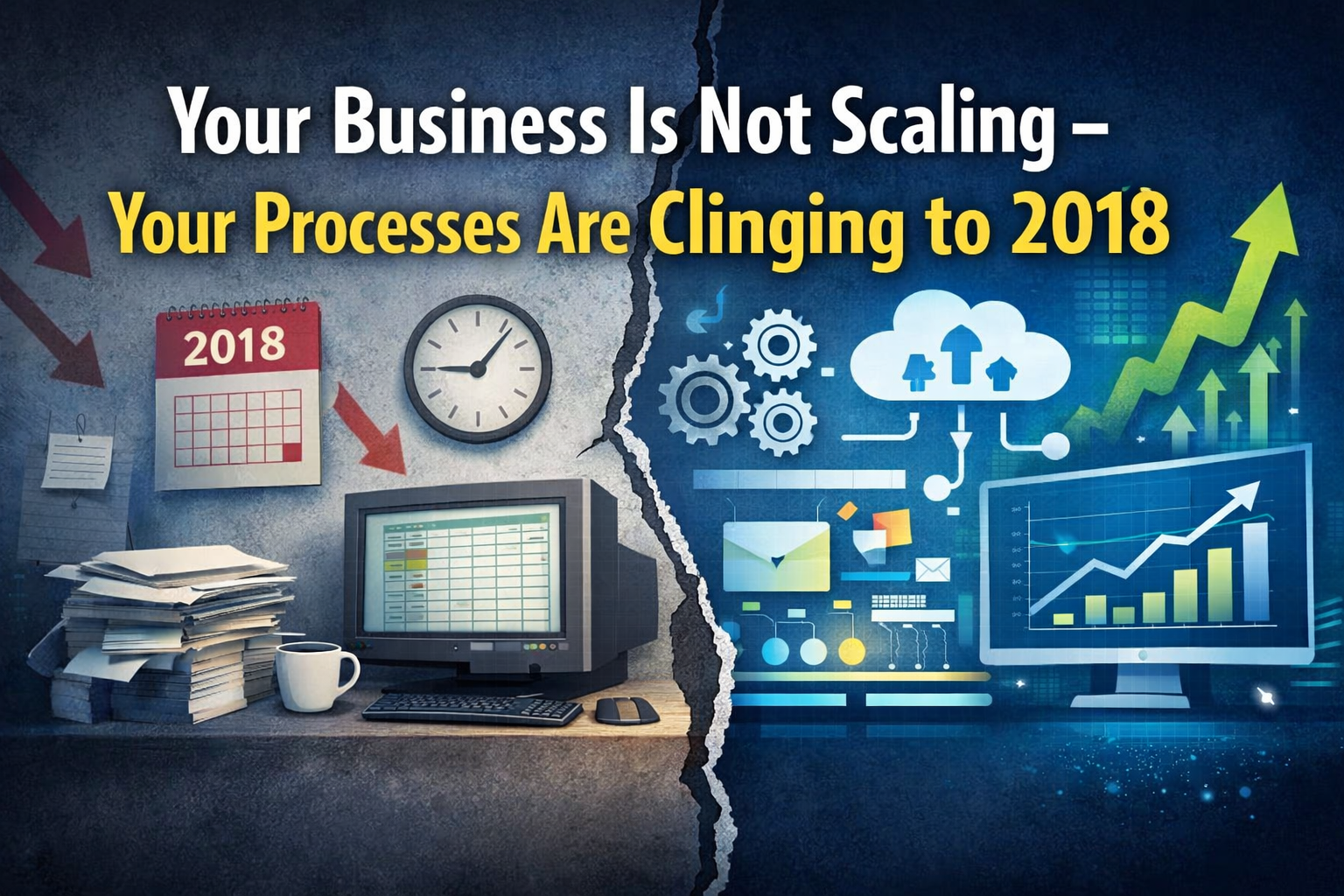
Your business is not scaling because your processes are clinging to 2018. Discover why outdated systems slow growth and how modern workflows unlock speed, clarity, and scalability.
Introduction: Your business is not scaling for a reason
If your business is not scaling – your processes are clinging to 2018, you are not alone. Many companies believe growth problems come from marketing, sales, or funding. In reality, the real bottleneck is often hidden deep inside daily operations.
Processes that once worked fine, manual approvals, spreadsheets, email chains, and disconnected tools, now quietly block progress. As your business grows, these outdated systems create friction, confusion, and burnout.
The good news? Scaling problems caused by old processes are fixable. Once you modernise how work flows, growth becomes faster, smoother, and more predictable.
Why outdated processes kill business growth
Manual work is stealing your time
In 2018, manual workflows were normal. Today, they are costly. When employees spend hours copying data, chasing approvals, or fixing errors, they are not creating value.
Manual processes:
- Slow decision-making
- Increase mistakes
- Reduce team morale
As volume increases, these problems multiply instead of staying manageable.
Disconnected tools create chaos
Many businesses use one tool for sales, another for finance, and another for operations, with no real connection between them. This creates:
- Data silos
- Conflicting reports
- Poor visibility for leadership
When leaders cannot see what is happening in real time, scaling becomes guesswork instead of strategy.
Signs your processes are stuck in 2018
You rely on spreadsheets for core operations
Spreadsheets are useful, but not as the backbone of a growing business. If critical workflows depend on Excel files shared by email, scaling will be painful.
Approvals take days instead of minutes
When approvals require multiple emails or meetings, work stalls. Modern businesses automate approvals with rules and triggers that move work forward instantly.
Your team is always “Busy” but progress is slow
Busyness without results is a red flag. It usually means systems are inefficient, not that people are lazy.
How modern processes enable scaling
Automation removes bottlenecks
Automation handles repetitive tasks consistently and instantly. Examples include:
- Automated invoicing
- Customer onboarding workflows
- Inventory updates
This allows teams to focus on strategy, creativity, and customer experience.
Global consulting leader with deep research on automation and scaling: How automation is shaping the future of work.
Standardisation creates predictability
Scaling requires repeatable success. Standardised processes ensure that tasks are done the same way every time, regardless of who is working on them.
Real-time data improves decisions
Modern systems provide dashboards and analytics that update instantly. Leaders can spot issues early and act before small problems become big ones.
Technology is not the enemy – old habits are
Digital tools have evolved
Cloud platforms, AI-driven tools, and no-code automation did not exist in practical form in 2018. Businesses that adopt them gain:
- Speed
- Accuracy
- Flexibility
Avoiding new tools often feels safe, but it is risky.
Change feels hard, but stagnation is worse
Many leaders avoid process change because it feels disruptive. However, outdated processes disrupt growth every single day. Small, gradual improvements are often enough to unlock big gains.
How to modernise your processes step by step
Step 1: Audit your current workflows
Document how work actually gets done, not how you think it gets done. Look for:
- Repeated steps
- Manual data entry
- Delays
Step 2: Identify high-impact automations
Start with processes that:
- Happen frequently
- Affect customers
- Consume the most time
Step 3: Train your team
Technology alone does not scale businesses; people do. Make sure your team understands and trusts the new systems.
If you’re serious about using AI in your workflow, you need signal, not hype. I personally tested 17 AI assistants, pushed them beyond surface-level prompts, and evaluated real output quality, usability, and ROI. Only three made the cut. You can read the full breakdown here: Tested 17 AI Assistants – Only 3 Worth It.
Frequently asked questions (FAQs)
Why is my business growing but not scaling?
Growth increases revenue, while scaling increases efficiency. If processes do not improve, costs and complexity rise faster than profits.
How do I know if my processes are outdated?
If your team relies heavily on emails, spreadsheets, and manual approvals, your processes are likely behind.
Is automation expensive to implement?
Not anymore. Many modern tools are affordable, scalable, and require little technical knowledge.
Can small businesses benefit from modern processes?
Yes. In fact, small businesses benefit the most because efficiency gives them a competitive edge.
How long does it take to see results?
Some improvements show results within weeks, especially automation and workflow optimization.
Do I need to replace all systems at once?
No. Gradual upgrades reduce risk and allow teams to adapt comfortably.
Conclusion: Scaling requires letting go of 2018
If your business is not scaling – your processes are clinging to 2018, the solution is not working harder. It is working smarter.
Modern processes create clarity, speed, and resilience. They allow your business to grow without chaos and give your team the freedom to focus on what truly matters.
The future of your business depends on the systems you build today. Let go of outdated habits and scale with confidence.