
Amrudin Ćatić
Strategy, creativity, and technology are combined to craft digital experiences that perform. Smart marketing meets creative execution, always focused on growth, problem-solving, and real impact.
If your idea survives only when nobody questions it, it is shit
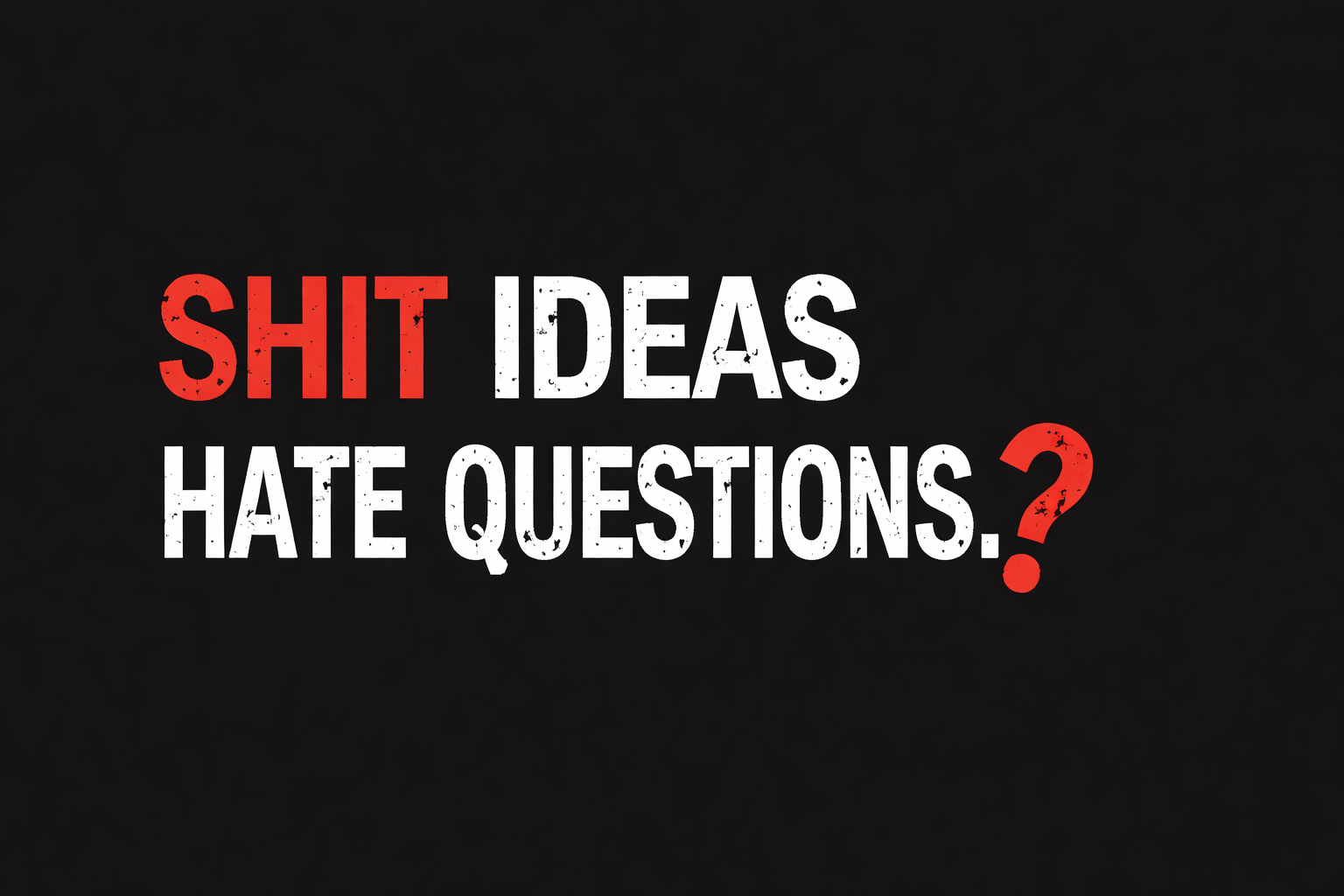
Good ideas don’t need protection.
They need pressure.
If your idea collapses the moment someone asks a hard question, the problem isn’t the question.
The problem is the idea.
Fragile ideas demand silence
Watch how bad ideas behave.
They don’t invite trust.
They create rules around it.
- “Let’s not derail the discussion”
- “We’ve already aligned on this”
- “This was decided earlier”
- “Now isn’t the time to question it”
That’s not the focus.
That’s fear of exposure.
Any idea that requires silence to survive already knows it can’t defend itself.
Questioning is not negativity – it’s stress testing
Strong ideas get better when attacked.
They sharpen.
They adapt.
They drop weak assumptions.
Weak ideas do the opposite.
They:
- rely on authority
- hide behind urgency
- weaponize politeness
When questioning is labelled as “being difficult,” what’s really happening is intellectual self-defence.
Ideas don’t just avoid questions on their own. They’re often protected by leaders who refuse to make clear calls. When no one is willing to decide, weak ideas get time, cover, and legitimacy they don’t deserve. That kind of paralysis isn’t caution; it’s fear pretending to be professionalism, which I break down in indecision in leadership.
“Alignment” is often just an enforced agreement
Let’s kill a popular lie.
Alignment does not mean agreement.
It means shared understanding after conflict.
If everyone agrees immediately, one of three things is true:
- The idea is trivial
- The room is scary
- The decision was already made
None of those signal qualities.
Ideas don’t become right because more people nodded.
They become right because they survived being challenged.
Authority doesn’t make ideas stronger – it makes them quieter
Bad ideas love hierarchy.
They sound better when:
- spoken by the highest-paid person
- presented in polished decks
- wrapped in confident language
But authority doesn’t replace logic.
It only delays failure.
The more an idea depends on who said it instead of why it works, the faster it rots.
The most dangerous ideas feel “obvious”
These are the worst.
They get waved through with:
- “It just makes sense”
- “Everyone knows this”
- “We don’t need to overthink it”
Obvious ideas are rarely examined.
And unexamined ideas are where the biggest mistakes hide.
If an idea can’t explain itself without shortcuts, it doesn’t deserve execution.
Teams that don’t question ideas don’t think – they comply
This is where culture dies.
When questioning is punished:
- curiosity disappears
- ownership erodes
- intelligence gets wasted
People stop contributing insight and start managing optics.
At that point, you don’t have a team.
You have a room full of adults cosplaying in agreement.
A simple rule that never fails
If your idea needs:
- protection from questions
- urgency to avoid scrutiny
- politeness to survive
It’s not misunderstood.
It’s weak.
Good ideas invite resistance.
Great ideas expect it.
Final truth
If your idea survives only when nobody questions it, it is shit.
And the faster you find that out, the cheaper the lesson will be.