
Amrudin Ćatić
Strategy, creativity, and technology are combined to craft digital experiences that perform. Smart marketing meets creative execution, always focused on growth, problem-solving, and real impact.
The automation gap: How companies lose millions by refusing to automate the boring stuff
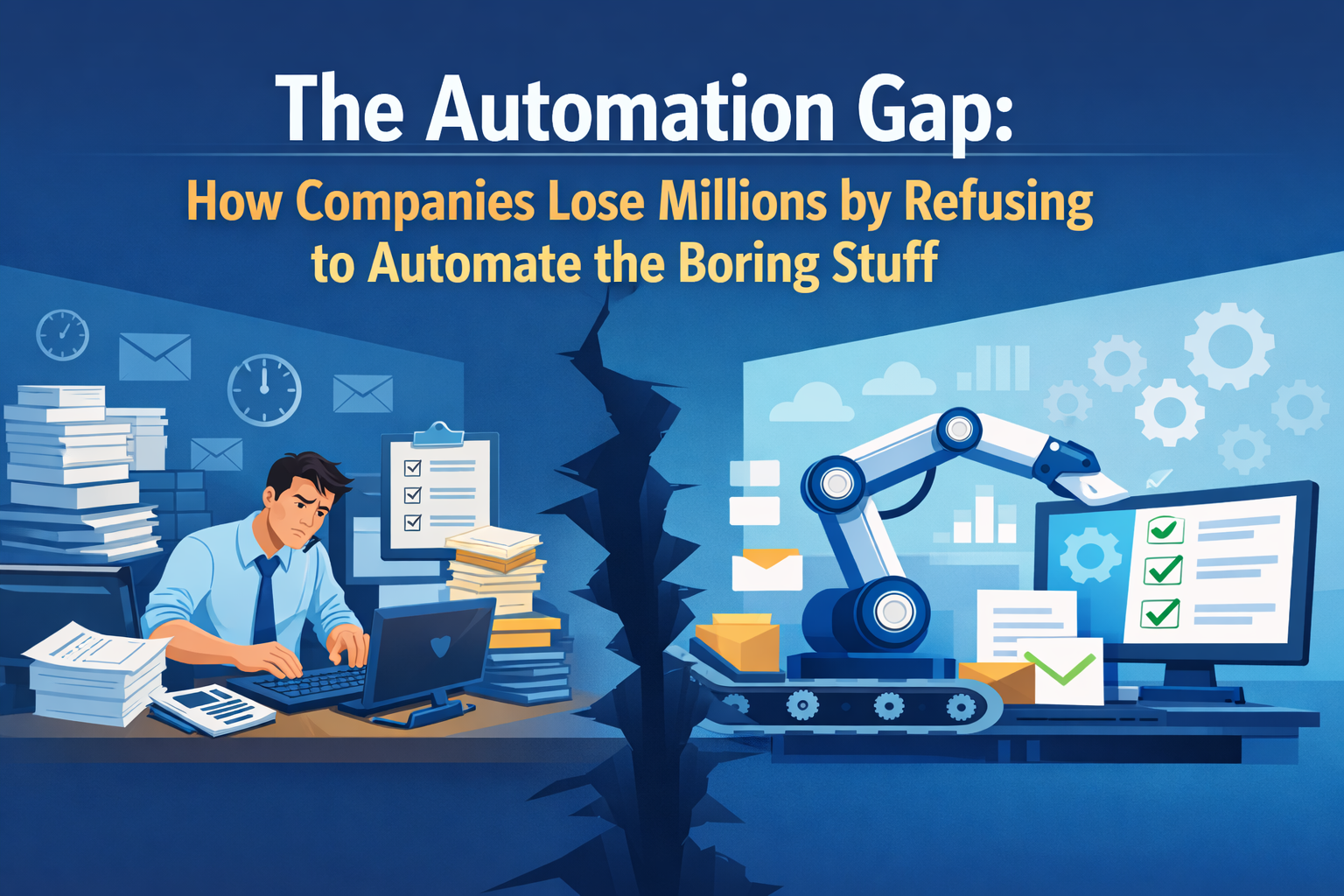
The automation gap explains how companies lose millions by refusing to automate repetitive work, what causes it, and how leaders can close it fast.
Introduction: Understanding the automation gap
The automation gap refers to the growing disconnect between what businesses could automate and what they actually automate. While technology has advanced rapidly, many organisations still rely on manual processes for routine, repetitive, and time-consuming tasks. This hesitation is costing companies millions each year in lost productivity, preventable errors, employee burnout, and missed growth opportunities.
In simple terms, the automation gap is not about a lack of technology. It’s about resistance, cultural, psychological, and organisational, to automating “boring” but essential work.
This article explores the automation gap: how companies lose millions by refusing to automate the boring stuff, why it exists, what it costs, and how businesses can close it before competitors do.
What is the automation gap?
A simple definition
The automation gap is the difference between:
- Tasks that can be automated using existing tools
- Tasks that companies continue to do manually
These tasks often include data entry, report generation, invoice processing, scheduling, customer follow-ups, inventory updates, and compliance documentation.
Why it’s growing
As software becomes more powerful and affordable, the gap widens because:
- Expectations rise faster than adoption
- Competitors automate while others stall
- Manual processes scale poorly with growth
The “Boring stuff” companies refuse to automate
Commonly ignored automation opportunities
Many leaders focus on flashy innovations while ignoring everyday inefficiencies, such as:
- Copying data between systems
- Approving routine requests
- Generating weekly or monthly reports
- Responding to standard customer emails
- Updating CRM records
These tasks are repetitive, rule-based, and predictable, perfect candidates for automation.
Why these tasks matter
Although “boring,” these processes:
- Consume thousands of employee hours
- Introduce human error
- Slow down decision-making
- Reduce morale and engagement
Individually small, collectively massive.
The real cost of refusing to automate
1. Direct financial losses
Manual processes cost more than salaries alone. They also lead to:
- Overtime expenses
- Rework due to errors
- Delayed billing and cash flow
- Lost customers from slow responses
Research frequently cited by consulting firms like McKinsey & Company shows that up to 30% of tasks in many roles are automatable today.
2. Hidden opportunity costs
When skilled employees spend time on repetitive work:
- Innovation stalls
- Strategic projects get delayed
- Leadership bandwidth shrinks
The automation gap silently steals growth.
3. Employee burnout and turnover
Repetitive manual work leads to:
- Lower job satisfaction
- Higher turnover
- Increased training and hiring costs
Talented workers want meaningful work, not endless spreadsheets.
Why companies resist automation
Fear of change
Automation often triggers fears of:
- Job loss
- Loss of control
- Complexity
Ironically, automation usually protects jobs by making teams more valuable.
Short-term thinking
Many leaders ask:
“Why invest now when the process still works?”
They overlook how quickly “working” turns into “failing” at scale.
Poor process visibility
You can’t automate what you don’t understand. Many companies:
- Lack of documented workflows
- Rely on tribal knowledge
- Underestimate how much time tasks take
The psychology behind the automation gap
Status quo bias
People prefer familiar routines, even inefficient ones. Manual work feels safe because it’s known.
Sunk cost fallacy
Organisations stick with old processes because they’ve already invested time and effort into them.
Misplaced pride
Some teams take pride in “handling complexity manually,” mistaking effort for value.
Industries hit hardest by the automation gap
Finance and accounting
- Invoice matching
- Expense approvals
- Financial reporting
Healthcare administration
- Scheduling
- Billing
- Compliance documentation
Logistics and supply chain
- Order tracking
- Inventory updates
- Vendor communication
Retail and E-commerce
- Stock management
- Customer support
- Pricing updates
How automation directly improves profitability
Speed
Automated processes run 24/7 without delays.
Accuracy
Rules-based automation eliminates common human errors.
Scalability
Growth no longer requires proportional hiring.
Consistency
Every task follows the same standard, every time.
If you’re hitting a plateau despite growth in revenue and team size, the real bottleneck might not be market-facing at all, it’s internal. Many businesses mistake growth for scalability, only to discover that manual approvals, scattered spreadsheets, and disconnected tools quietly cripple performance as volume rises. Modern workflows and automation aren’t gimmicks, they’re the foundation of real scale. That’s exactly why, in my post “Your business is not scaling – your processes are clinging to 2018”, I break down how outdated systems silently throttle expansion and what to do about it.
Small automations, massive impact
Low-risk, high-return examples
- Auto-generating invoices
- Automated email confirmations
- Scheduled report delivery
- CRM data synchronisation
These automations often pay for themselves within months.
How to identify your automation gap
Step 1: Track time
Ask teams to log repetitive tasks for one week.
Step 2: Look for patterns
Focus on tasks that are:
- Repetitive
- Rule-based
- Frequent
- Time-consuming
Step 3: Quantify the cost
Multiply the time spent by the hourly cost and error rates.
The numbers are often shocking.
Building an automation-first culture
Leadership buy-In
Automation must be framed as:
- A growth tool
- A productivity enabler
- A job enhancer, not a threat
Employee involvement
The best automation ideas come from people doing the work.
Continuous improvement
Automation is not a one-time project; it’s a mindset.
Common automation myths (Debunked)
- “Automation is expensive” → Manual work is more expensive
- “We’re too small” → Small teams benefit the most
- “It’s too complex” → Modern tools are user-friendly
The long-term risk of ignoring the automation gap
Companies that refuse to automate face:
- Slower growth
- Higher costs
- Lower employee retention
- Competitive disadvantage
Over time, the automation gap becomes a survival gap.
FAQs about the automation gap
1. What is the automation gap in simple terms?
It’s the difference between tasks that could be automated and those still done manually.
2. Why do companies avoid automating boring tasks?
Because of fear, habit, lack of awareness, and short-term thinking.
3. How much money can automation save?
Savings vary, but many companies reduce operational costs by 20–40%.
4. Does automation replace employees?
No. It reallocates human effort to higher-value work.
5. What tasks should be automated first?
Repetitive, rule-based, high-volume tasks with clear inputs and outputs.
6. Is automation only for large enterprises?
Not at all. Small and mid-sized businesses often see faster returns.
Conclusion: Closing the automation gap before it closes you
The automation gap is not a technology problem, it’s a leadership problem. Companies lose millions not because automation doesn’t work, but because they delay adopting it. By refusing to automate the boring stuff, organisations waste talent, money, and time.
Closing the automation gap starts small: one process, one workflow, one improvement at a time. But the impact compounds quickly. Businesses that act now gain efficiency, resilience, and a powerful competitive edge.
Those that don’t? They keep paying the hidden tax of manual work.
For further reading on automation strategy, explore insights from McKinsey’s digital operations research.