
Amrudin Ćatić
Strategy, creativity, and technology are combined to craft digital experiences that perform. Smart marketing meets creative execution, always focused on growth, problem-solving, and real impact.
Attribution is broken: How to measure real impact when every channel lies
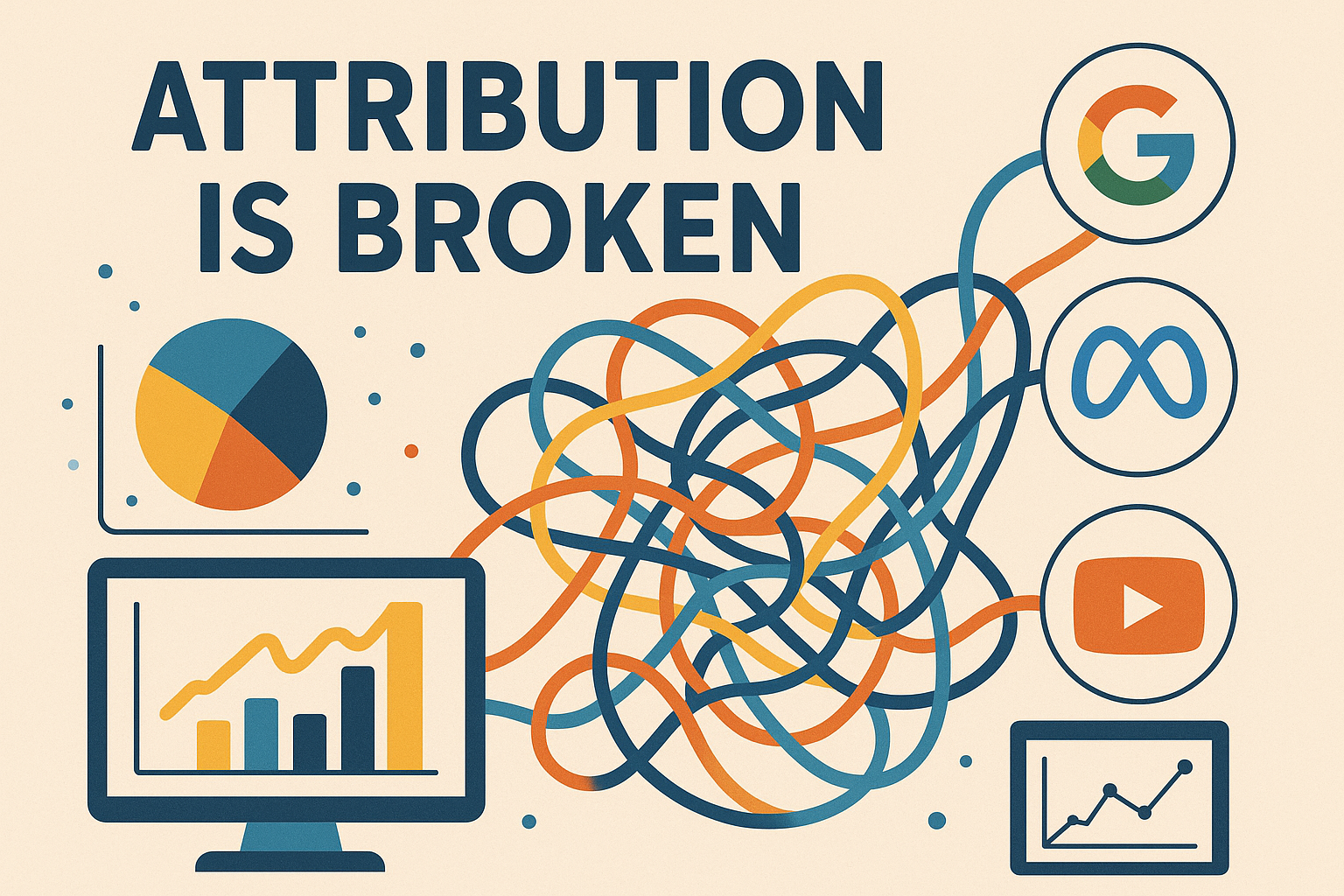
Learn why marketing attribution is broken and discover 7 proven ways to measure true impact across channels. Uncover how data distortion and algorithm bias mislead marketers, and what to do about it.
In the world of digital marketing, attribution is the holy grail, the mechanism that promises to reveal which ad, post, or channel truly drives conversions. But in 2025, that promise is broken.
Every platform tells a different story. Google Ads swears it’s driving 80% of conversions. Meta claims it’s 70%. Your CRM attributes the same sale to email. And analytics dashboards? They disagree with everyone.
So if every channel lies, how can marketers measure real impact?
Let’s uncover what’s really happening, why attribution is collapsing, and how the smartest brands are redefining success.
The illusion of perfect attribution
Once upon a time, marketers believed data was truth. Clicks were clear, pixels fired reliably, and UTM tags told a neat story. But as tracking evolved, so did the problems.
The rise of multi-channel chaos
Consumers no longer follow a straight line from ad to conversion. A single buyer might:
- See a TikTok ad,
- Search for the brand on Google,
- Read a blog post,
- Click an email,
- Then convert via an Instagram retargeting ad.
Who gets credit? Every platform will say “me.”
Why traditional attribution models fail in 2025
Models like last-click or first-touch are obsolete. Even multi-touch attribution (MTA) struggles as cookies vanish and devices multiply. With privacy updates from Apple and Google, tracking accuracy has plummeted.
Attribution, once a measurement tool, has become a marketing myth.
Understanding why “Every channel lies”
The data distortion problem: Tracking isn’t truth
Pixels and UTMs are only as reliable as the platforms that fire them. Ad blockers, iOS updates, and cross-device behavior all distort visibility. What’s worse, platforms optimize for their own metrics, not your truth.
Platform bias: Why algorithms inflate their own impact
Every ad network’s business model depends on proving ROI. Facebook’s attribution window might “capture” conversions influenced by another source. Google’s data-driven model credits itself based on probability, not proof.
The privacy revolution: How iOS and GDPR broke attribution
Between GDPR, CCPA, and Apple’s App Tracking Transparency (ATT), data granularity has vanished. That means marketers can’t link users across sessions or channels with the same precision.
The outcome? Incomplete data, inflated claims, and confused marketers.
The new reality: From attribution to contribution
The smartest marketers no longer chase perfect attribution. They measure contribution, the incremental value each channel adds to the whole.
Redefining success metrics beyond clicks and conversions
Metrics like Customer Lifetime Value (CLV), brand lift, and market share now paint a more accurate picture than last-click conversions.
Why “Incrementality” beats attribution models
Incrementality testing reveals causal impact: what actually changes when you run an ad versus when you don’t. It focuses on true lift, not credit assignment.
The role of data clean rooms and privacy-safe analytics
Tools like Google Ads Data Hub, Amazon Marketing Cloud, and Meta’s Clean Room allow marketers to analyze performance safely, respecting user privacy while improving accuracy.
7 Proven ways to measure real marketing impact
1. Use geo-testing and market-level experiments
Turn your marketing into a lab. Run A/B tests across geographic regions to isolate the real effect of campaigns.
2. Combine first-party data with MMM (Media Mix Modeling)
MMM uses aggregated data to model performance trends over time, a strong alternative in a cookie-less world.
3. Build a unified customer data layer
Integrate CRM, analytics, and ad data into a single source of truth. This helps eliminate duplicate conversions and improves accuracy.
4. Implement lift studies across major platforms
Lift studies measure the incremental effect of your marketing campaigns by comparing exposed groups with control groups who never saw your ads. Platforms like Meta, Google, and YouTube offer built-in lift testing tools that quantify how many conversions would nothave happened without exposure. Unlike attribution reports, lift studies focus on causality, not correlation, revealing whether your campaigns truly driveaction or just take credit.
5. Create cross-channel cohort analyses
Cohort analysis groups users by when or how they interacted with your brand. For instance, you can analyze:
- Customers who first engaged through organic content,
- Those introduced via paid social, and
- Those acquired via influencer campaigns.
Comparing lifetime value (LTV), retention, and repeat purchases across cohorts exposes which channels generate sustainable growth, not just cheap conversions.
6. Measure “Time to impact” instead of just ROI
Most marketers obsess over immediate ROI, but real influence unfolds over time. For example, upper-funnel channels like YouTube, podcasts, and influencers may show lower direct ROI yet significantly accelerate conversions weeks later.
Tracking “time to impact”, the lag between exposure and action, gives a more realistic view of how channels work together to nurture demand.
7. Adopt a continuous learning framework
The future of measurement isn’t about finding the model; it’s about constant learning.
Set up a framework to:
- Test one new hypothesis each quarter.
- Review what worked, what didn’t, and why.
- Adjust your strategy based on new data, not assumptions.
The best marketers treat measurement like a living experiment, always evolving, never finished.
The future of attribution: AI, causality, and probabilistic modeling
How AI is rebuilding trust in marketing measurement
Artificial Intelligence is reshaping how we interpret fragmented data. For a deeper breakdown of how AI changes marketing measurement, check out my guide on AI-driven marketing metrics, where machine learning replaces outdated attribution models.
But, machine learning models can now:
- Predict cross-channel influence with limited tracking,
- Identify hidden correlations between campaigns, and
- Estimate probabilistic credit for conversions.
In essence, AI helps marketers fill in the blanks responsibly, producing smarter, data-driven insights that aren’t tied to any single platform’s bias.
The shift from deterministic to probabilistic thinking
Deterministic attribution depends on perfect tracking, which no longer exists. Probabilistic models, however, accept uncertainty and use patterns to estimate contributions. This shift mirrors the broader trend toward causal inference, where data science techniques (like Bayesian modeling or uplift modeling) uncover what likely caused an outcome instead of merely recording it.
Building a culture of measurement maturity
True measurement transformation isn’t just about tools, it’s cultural.
Organizations that succeed at attribution 2.0 share these traits:
- Leadership values testing and patience.
- Teams collaborate across data, marketing, and product.
- Success is measured by impact, not by dashboards.
When marketing measurement matures, decision-making becomes less about politics and more about proof.
FAQs
1. What does it mean when marketers say “attribution is broken”?
It means that modern tracking systems can’t accurately credit the true source of conversions. With privacy restrictions, cross-device behavior, and data silos, no single model can tell the full story.
2. Can AI really fix marketing attribution?
AI won’t magically fix attribution, but it dramatically improves it. By analyzing massive datasets and applying causal inference, AI helps estimate the most probable sources of influence more accurately than rule-based models.
3. What is the best model for cross-channel attribution?
There’s no universal “best” model, it depends on your data maturity. However, Media Mix Modeling (MMM) combined with incrementality testing provides one of the most holistic and privacy-safe approaches available today.
4. How can small businesses measure impact without huge data teams?
Start simple:
- Use platform lift studies (Meta, Google).
- Compare “exposed vs. non-exposed” regions.
- Track long-term metrics like retention and lifetime value.
Small teams can still uncover meaningful insights using free or low-cost tools like Google Analytics 4 and HubSpot CRM.
5. What’s the difference between incrementality and attribution?
Attribution tells you who gets credit for conversions. Incrementality tells you what really caused the conversions.
Incrementality testing isolates the causal lift created by your marketing, the difference between what happened with your ads and what would have happened without them.
6. How do privacy laws affect marketing measurement?
Privacy laws like GDPR and CCPA restrict data collection and user tracking. As a result, marketers must rely on aggregated, anonymized data models (e.g., MMM or clean rooms) rather than user-level tracking to remain compliant.
Conclusion: From attribution illusion to true impact measurement
The era of perfect attribution is over. Between privacy shifts, platform biases, and data fragmentation, every channel now lies a little. But marketers who adapt, by focusing on incrementality, causality, and cross-channel contribution, can uncover deeper truths about how their marketing truly drives growth.
The goal isn’t to find perfect attribution anymore.
It’s to build a resilient measurement system that helps you make smarter, evidence-based decisions even in an imperfect data world.
Remember: when every channel lies, learning the truth becomes your biggest competitive advantage.
Recommended external resource
For further reading on incrementality testing and modern attribution, check out this guide from Google:
Google Marketing Measurement Playbook