
Amrudin Ćatić
Strategy, creativity, and technology are combined to craft digital experiences that perform. Smart marketing meets creative execution, always focused on growth, problem-solving, and real impact.
The new AI tools stack for 2026: The brutally honest guide to what’s worth paying for (and what’s pure vaporware)
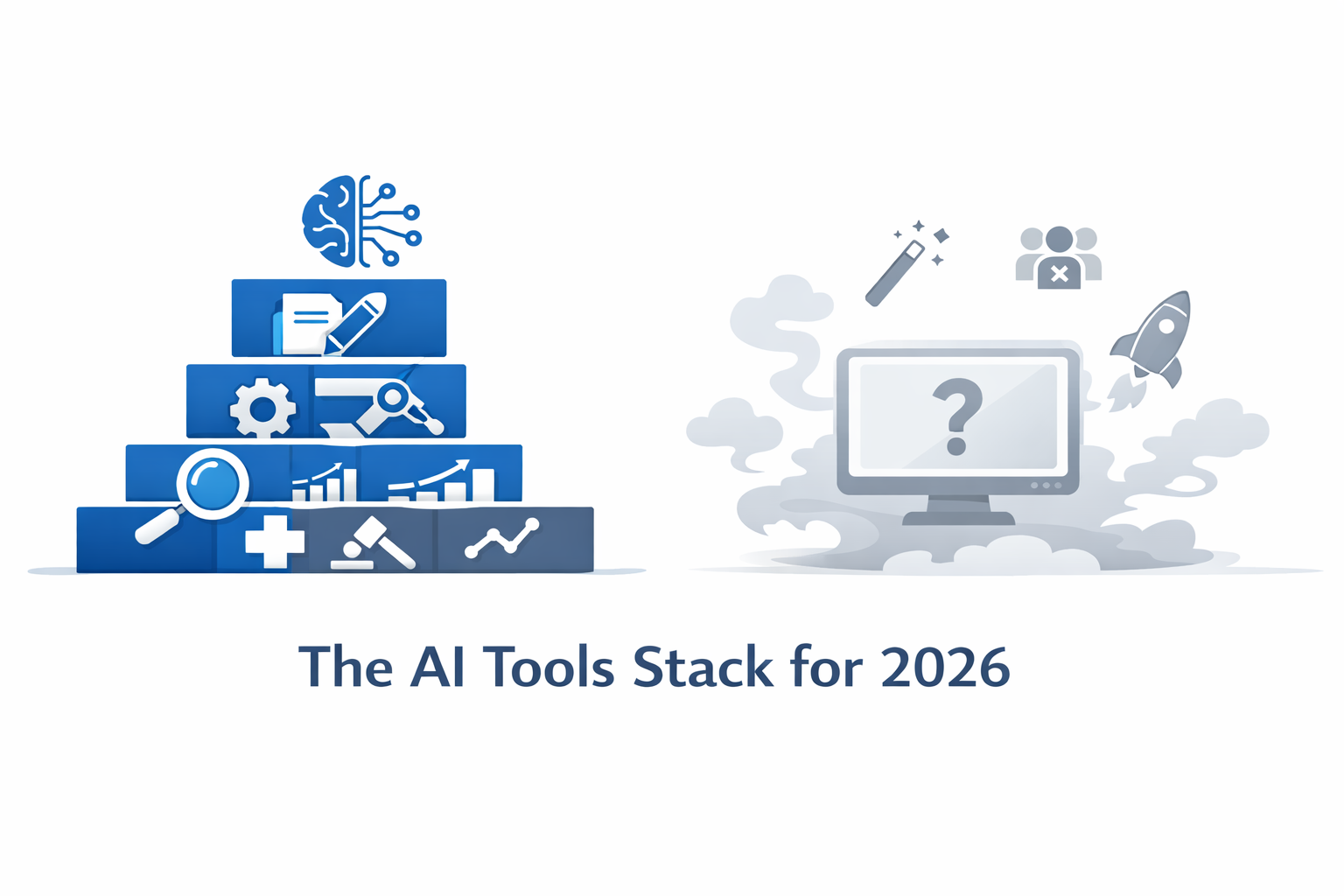
The new AI tools stack for 2026 is crowded, confusing, and expensive. This expert guide breaks down what’s worth paying for, what’s optional, and what’s pure vaporware.
Artificial intelligence is no longer “the future.” By 2026, it’s infrastructure. The new AI tools stack for 2026 has exploded into hundreds of platforms promising productivity, automation, and growth. Some genuinely deliver ROI. Others are shiny demos held together by marketing buzzwords.
This article cuts through the noise with a practical, experience-driven breakdown of what’s worth paying for, what’s situational, and what you should avoid entirely, whether you’re a founder, marketer, developer, or operator.
Understanding the new AI tools stack for 2026
The AI stack is no longer one tool doing everything. It’s layered just like modern cloud software.
Core layers of the 2026 AI stack
| Layer | Purpose |
|---|---|
| Foundation models | Reasoning, language, vision |
| Productivity AI | Writing, research, planning |
| Automation & Agents | Task execution & workflows |
| Data & Analytics AI | Insights, forecasting |
| Creative AI | Design, video, audio |
| Vertical AI | Industry-specific tools |
If a tool doesn’t clearly fit into one of these layers and show measurable output, that’s your first red flag.
Layer 1: Foundation models – Worth paying for
These are the engines powering everything else.
What’s Worth It
- OpenAI (GPT-class models) – Best general reasoning and ecosystem
- Anthropic (Claude) – Excellent for long-context and safety-critical work
- Google DeepMind (Gemini) – Strong multimodal and enterprise integration
- Meta (LLaMA ecosystem) – Best open-source flexibility
💡 Why pay:
You’re buying capability density. Better models mean fewer prompts, fewer errors, and faster output.
🚩 Vaporware warning:
Any “proprietary superintelligence model” from an unknown startup with no benchmarks.
Layer 2: AI productivity tools – Pay selectively
These tools sit on top of foundation models and save time if used correctly.
Worth paying for
- Research copilots that cite sources
- Writing tools with style memory and brand voice
- Meeting tools that summarise decisions, not just transcripts
Examples:
- AI research assistants
- Long-form content editors
- Knowledge-base copilots
⚠️ When they’re not worth it:
If they’re just a thin UI wrapper over GPT with no workflow memory or integrations.
Layer 3: AI agents & automation — High ROI, high risk
Agents are where the hype peaks, and where real value can exist.
Worth paying for (carefully)
- Agent platforms that:
- Log actions
- Allow human approval
- Integrate with your tools (CRM, email, databases)
Used well, they:
- Handle lead qualification
- Run internal ops
- Monitor systems and alerts
🚨 Pure vaporware signs
- “Fully autonomous business” claims
- No rollback or audit trail
- No human-in-the-loop control
If you can’t pause or inspect an agent, don’t deploy it.
Layer 4: Data, analytics & decision AI – Quietly essential
This layer doesn’t trend on social media, but it pays the bills.
What’s worth paying for
- AI forecasting tools connected to your data
- Anomaly detection for finance, ops, or security
- Natural-language querying of databases
These tools reduce decision latency, which is real money.
🟢 Green flag: Clear accuracy metrics
🔴 Red flag: “Black box insights” with no explanation
Layer 5: Creative AI – Subscription traps everywhere
Creative AI is powerful, but massively oversold.
Worth paying for
- Tools embedded in professional workflows
- AI that speeds up drafts, not replaces judgment
Mostly vaporware
- “Hollywood-quality video in one click”
- “Instant brand identity generators”
- Tools with usage caps so low they’re unusable
💡 Rule: If it doesn’t save at least 30% time, cancel it.
Layer 6: Vertical AI tools – Hidden gold
Vertical AI is where 2026 quietly wins.
Examples
- Legal document review
- Medical imaging support
- Financial compliance monitoring
- Supply-chain optimization
These tools:
- Know the language of the industry
- Reduce costly errors
- Outperform general AI in narrow domains
If you work in a regulated or technical field, this is where to invest first.
What’s pure vaporware in the 2026 AI stack
Avoid tools that promise:
- “No prompts needed, just magic”
- “Replace your entire team”
- “AGI-level intelligence”
Common signs of vaporware:
- No case studies
- No real users
- No pricing transparency
- Founder-led demos only
If the product page talks more about the future than current features, walk away.
Many professionals wrongly fear that AI will replace them entirely, but as highlighted in my article “AI is not taking your job – Your bland workflow is”, the real risk isn’t automation, it’s outdated, repetitive workflows that lack creativity and strategic thinking. This post dismantles the “AI will steal your job” myth and shows how upgrading processes, embracing smart systems, and focusing on high-value human skills are what actually secure your future in a rapidly changing workplace.
FAQs: The new AI tools stack for 2026
1. Is the new AI tools stack for 2026 worth investing in now?
Yes, but selectively. Focus on tools that integrate into existing workflows and show measurable ROI.
2. How many AI tools should a business realistically pay for?
Most teams only need 3–6 core tools. More than that creates friction, not efficiency.
3. Are AI agents safe to use in 2026?
They can be, if they include human oversight, logging, and permission controls.
4. Is open-source AI better than paid tools?
Open-source is powerful for technical teams. Paid tools win on usability and support.
5. Will AI replace SaaS tools entirely?
No. AI is becoming a layer inside SaaS, not a replacement.
6. What’s the biggest mistake buyers make with AI tools?
Buying based on hype instead of workflow fit.
Conclusion: Build an AI stack, not an AI subscription graveyard
The new AI tools stack for 2026 rewards clarity, not curiosity. The winners aren’t the teams with the most tools—they’re the ones with the fewest tools doing real work.
Pay for:
- Strong foundation models
- Workflow-integrated productivity tools
- Vertical AI with domain expertise
Avoid:
- “Magic” promises
- Overlapping subscriptions
- Tools with no accountability
AI in 2026 isn’t about experimentation anymore. It’s about execution.