
Amrudin Ćatić
Strategy, creativity, and technology are combined to craft digital experiences that perform. Smart marketing meets creative execution, always focused on growth, problem-solving, and real impact.
How I combined AI and marketing and why everyone should learn to do the same
If you’re a marketer wondering how AI can reshape your strategy, you’re not alone.
Introduction to AI in the marketing world
Artificial Intelligence, or AI, is reshaping the modern marketing strategy. What once was a buzzword is now central to how we build scalable, data-driven campaigns. Once a buzzword, AI now sits at the center of innovative digital strategies. From personalized ads to predictive analytics, AI reshapes how brands connect with customers.
Historically, marketers relied on instinct, spreadsheets, and traditional media campaigns. Fast forward to today, and we have AI tools that can analyze massive data sets, craft targeted content, automate customer interactions, and even predict purchasing behavior.
As the marketing world becomes more complex and competitive, AI offers a clear path to working smarter, not harder. For me, this became apparent the moment I saw the results AI could produce—and I’ve never looked back.
My personal journey – from traditional marketing to AI-powered strategy
I started out in a traditional marketing role, think billboard ads, newspaper spots, and email blasts sent manually. It was effective, but slow and often lacked the insights I needed.
My first exposure to AI came through a webinar showcasing an AI tool that could write blog posts. Skeptical but curious, I tried it. The results? Surprisingly solid content in seconds. That sparked a journey into exploring what else AI could do.
Over time, I started using AI to analyze customer data, automate email workflows, and test ad variations. I wasn’t just working faster, I was making smarter decisions with greater confidence.
Key AI tools I use to boost marketing performance
Integrating AI into marketing isn’t about replacing humans. It’s about enhancing human creativity and decision-making. Here are the tools I rely on:
- AI content generators: Tools like Jasper and Copy.ai help draft emails, blog posts, and ad copy in seconds.
- Predictive analytics: Platforms like HubSpot and Salesforce Einstein anticipate customer actions and suggest optimal touchpoints.
- Chatbots: AI-driven bots handle customer support and lead generation around the clock.
- Customer data platforms (CDPs): These unify customer data from multiple sources, creating a full 360° view of your audience.
These tools aren’t gimmicks. They’ve helped me streamline my workflow and deliver more value to clients.
How AI transformed my marketing strategy into a scalable system
The shift was dramatic. With AI:
- Personalization became scalable
- Ad targeting got smarter
- Customer engagement became instant
AI turned my marketing from reactive to proactive, and it continues to evolve.
Benefits I experienced by Integrating AI into my Strategy
Here’s what changed for me:
- Saved sours every week: AI automated routine tasks like email scheduling, freeing time for strategy.
- Better ROI: AI targeting reduced ad spend waste.
- Improved creativity: With AI handling the grunt work, I had more brainpower for ideation and storytelling.
- Happier customers: Faster responses and personalized experiences improved customer satisfaction.
These aren’t just metrics, they’re competitive advantages.
Top challenges I faced (and how I overcame them)
No transformation is without hurdles:
- Learning curve: I started slow, watching tutorials, reading guides, and practicing.
- Trust issues: Initially, I second-guessed AI outputs. Over time, results built trust.
- Cost: I began with freemium tools to stay lean.
- Integration: Aligning AI with my existing CRM and content tools took time, but support teams were helpful.
The secret? Start small. Master one tool before adding another.
Common misconceptions about AI in marketing
Let’s bust some myths:
- “AI will replace marketers” – False. It enhances what we do, not replaces us.
- “It’s only for tech experts” – Nope. Many tools are user-friendly with minimal setup.
- “AI can’t be creative” – It can spark ideas and handle data-heavy creativity like A/B testing.
Don’t let fear hold you back.
Practical tips for marketers who want to start using AI
Ready to try AI? Here’s what I recommend:
- Start with a problem – What’s slowing you down? Use AI to solve that first.
- Pick one tool – Don’t get overwhelmed. Start with content generation or analytics.
- Train your team – Everyone needs to understand the basics.
- Track performance – Measure what matters and adjust as you go.
Momentum builds quickly with the right first step.
The skills you need to combine AI and marketing successfully
You don’t need to be a data scientist. But some foundational skills help:
- Basic data literacy – Know how to read metrics.
- Tech comfort – Be willing to experiment with new tools.
- Creative strategy – Know how to align tech with brand messaging.
It’s a blend of tech and art—and that’s where marketers thrive.
Want to go deeper into search optimization? Read my guide on Top SEO Tools for 2025.
Case studies that prove AI works in marketing
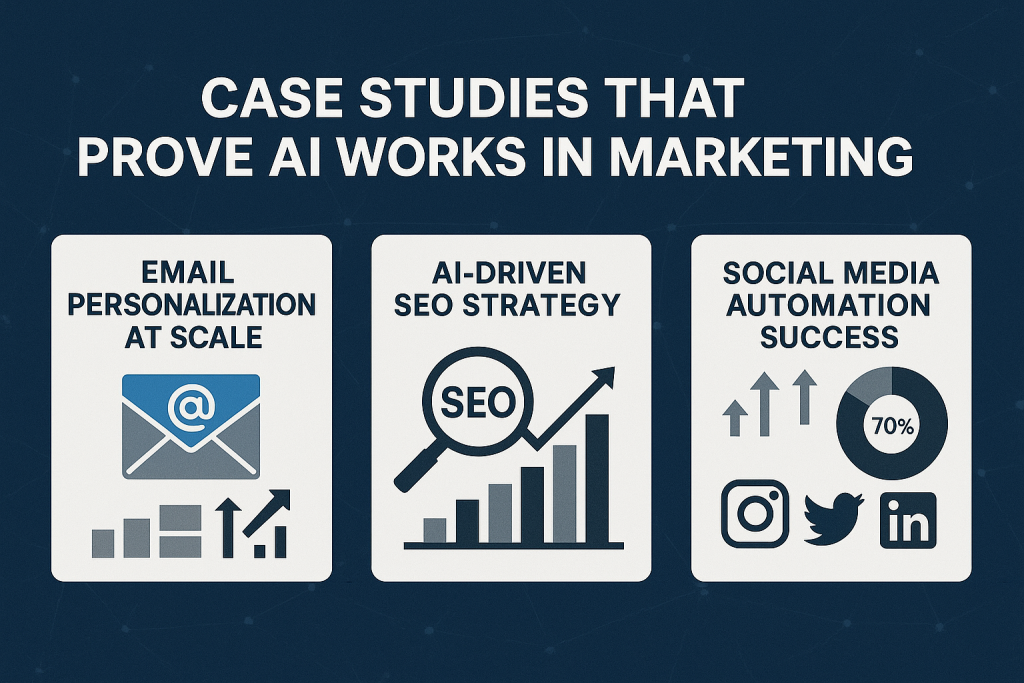
1. Email personalization at scale
Using an AI-driven email tool, I launched a campaign that personalized subject lines and content blocks based on user behavior.
Result: 45% increase in open rates and a 30% jump in click-through rates.
2. AI-driven SEO strategy
With an AI SEO tool, I was able to audit my website, optimize for keywords, and even generate content outlines.
Result: 60% organic traffic growth in 3 months.
3. Social media automation success
Using AI-powered social schedulers and performance analyzers, I increased engagement on Instagram and LinkedIn by 70%.
Result: Higher visibility and consistent content output with less manual work.
Future trends in AI marketing you should prepare for
- AI-powered voice search: Optimize content for voice queries as usage of voice assistants grows.
- Hyper-personalization: Expect emotionally intelligent campaigns based on mood, tone, and context.
- Predictive customer behavior modeling: Forecast actions like churn or upsell potential before they happen.
Staying ahead means staying informed and adaptable.
Why every marketer should embrace AI – The Bigger Picture
This isn’t just a “nice to have”, it’s survival.
- Stay relevant: Your competitors are using AI.
- Deliver better user experiences: Customers expect speed, personalization, and value.
- Scale without stress: AI allows small teams to do the work of large ones.
It’s not about man vs. machine, it’s about man with machine.
Ethical considerations when using AI in marketing
With great power comes great responsibility:
- Data privacy: Be transparent and comply with laws like GDPR.
- Algorithmic bias: Ensure your AI tools don’t reinforce stereotypes.
- Responsible usage: Disclose when AI creates content or interacts with users.
Trust is built through ethical practice.
How to learn AI for marketing – resources & courses
- Free platforms: Google’s AI for Everyone, HubSpot’s AI courses, Coursera’s AI basics.
- Paid courses: Udemy, LinkedIn Learning, CXL.
- Certifications: IBM’s AI for Business, MIT’s AI in Marketing.
- Hands-on projects: Start a blog, automate a newsletter, or test AI chatbots.
Learning by doing is the best way.
FAQs about combining AI and marketing
Q1: What is the best AI tool for beginners in marketing?
A: Tools like Jasper for content and ChatGPT for ideation are excellent starting points.
Q2: How much does AI marketing software cost?
A: Many offer free tiers; premium tools range from $20 to $500/month.
Q3: Can AI work for small businesses?
A: Absolutely. AI levels the playing field by offering automation and insights to all.
Q4: Will AI replace marketing jobs?
A: No. It replaces repetitive tasks, strategic roles are more needed than ever.
Q5: How do I convince my boss to invest in AI?
A: Show ROI from a small pilot project, time saved, and customer impact.
Q6: What industries benefit most from AI marketing?
A: E-commerce, finance, SaaS, healthcare, real estate, but most industries can benefit.