
Amrudin Ćatić
Strategy, creativity, and technology are combined to craft digital experiences that perform. Smart marketing meets creative execution, always focused on growth, problem-solving, and real impact.
10 Critical Google Ads mistakes that are burning your budget (and how to fix them fast)
Introduction: Why so many brands waste money on Google Ads
Most businesses don’t fail on Google Ads because their product is weak, they fail because their ad structure bleeds cash invisibly. A single mistake in keyword targeting, audience segmentation, or conversion tracking can silently drain thousands per month.
If your CPCs keep climbing and conversions aren’t following, you’re not unlucky, you’re making predictable, fixable mistakes. Let’s expose the 10 biggest ones that are burning your budget and break down how to stop them fast.
Mistake #1: Using broad match keywords without control
The hidden danger of broad match
Broad match looks innocent, more reach, more clicks, right? Wrong. Broad match tells Google to show your ad for loosely related searches, which often attract unqualified traffic. For example, a “luxury watches” campaign might trigger for “cheap wristbands,” wasting money instantly.
How to Fix It: Use phrase match + Negative keywords
Use phrase and exact match to control relevance. Pair that with negative keywords to filter irrelevant intent. This small shift alone can cut waste by 20–40% in most accounts.
Mistake #2: Ignoring search intent and ad relevance
The Cost of mismatched Ads
Running “buy now” ads on informational searches (like “how does X work?”) burns budget fast. Every mismatch between search intent and ad message lowers CTR, raises CPC, and kills conversions.
Aligning ad copy with intent for higher CTR
Segment keywords by intent (informational, commercial, transactional). Then, build ad copy that matches user’s mindset. Example:
- Informational → “Learn how to…”
- Commercial → “Compare the best…”
- Transactional → “Get instant quotes now.”
Mistake #3: Neglecting negative keywords
Why every account needs a negative keyword strategy
Without negatives, your ads show for irrelevant terms that never convert. Over time, these add up to thousands wasted.
Tools and tactics to identify wasteful search terms
Use Google’s “Search Terms Report” weekly. Add irrelevant queries as negatives manually, or automate with scripts that flag zero-conversion terms.
Mistake #4: Poor ad copy that fails to convert
Common copywriting pitfalls in Google Ads
Lazy copy kills performance. Generic headlines like “Best Services in 2025” mean nothing.
How to craft ad copy that drives action
Use emotional hooks, proof, and urgency:
- “Join 10,000+ businesses saving 30% on ads”
- “Free demo, see results in 7 days”
Keep it tight, benefit-driven, and aligned with your landing page.
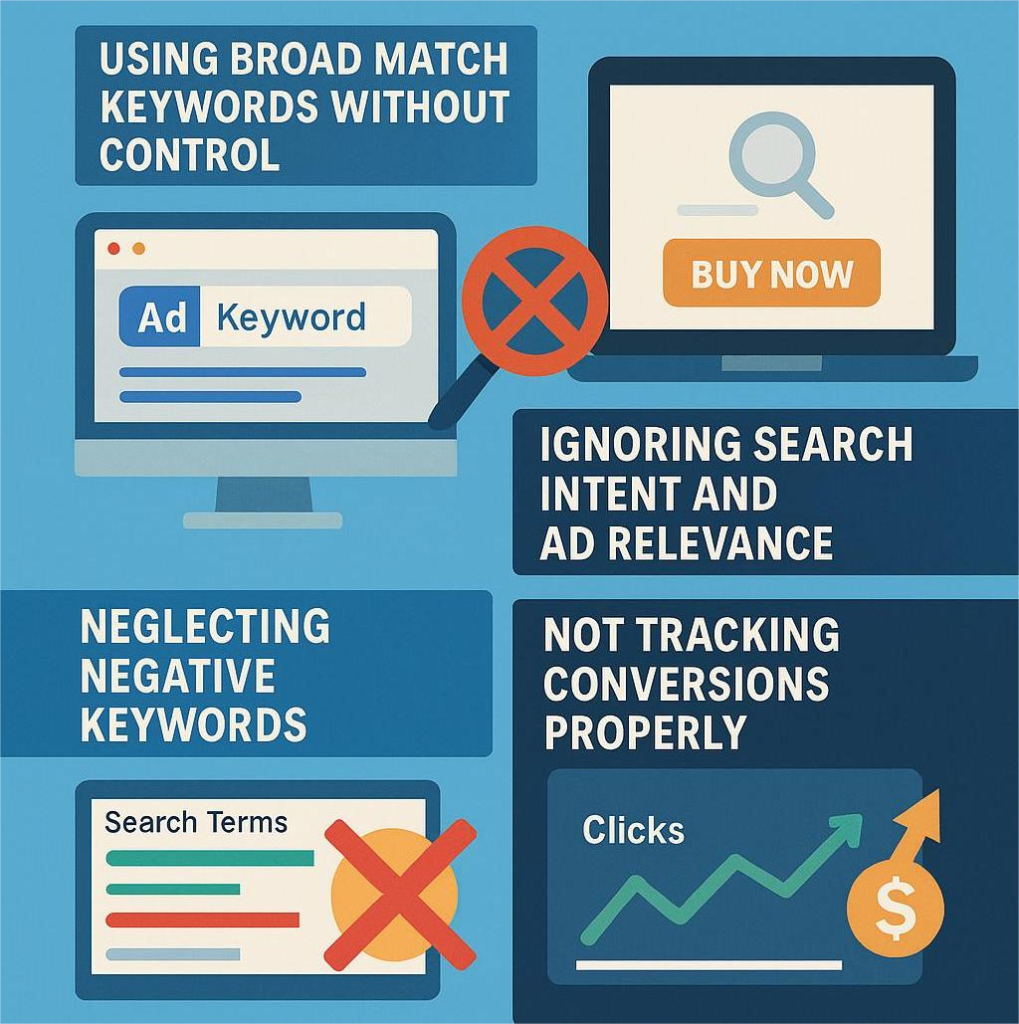
Mistake #5: Not tracking conversions properly
Why “Clicks” are a trap metric
Clicks are vanity. They don’t tell you whether you made money.
Setting up conversion tracking that actually matters
Set up conversion tracking for sales, sign-ups, calls, or booked meetings, not just page visits. Use Google Tag Manager or import conversions from your CRM to close the loop between click and ROI. Learn more about the most important metrics to track in my post on Google Ads metrics that actually matter.
Mistake #6: Ignoring audience targeting and segmentation
The power of smart segmentation in PPC
Your audience isn’t “everyone.” Layer audiences based on behaviour, demographics, or engagement to narrow focus.
Custom audiences, remarketing, and layered targeting
Build remarketing lists for visitors who didn’t convert. Test lookalikes, customer match, and affinity segments for precision targeting.
Mistake #7: Letting Google’s automated recommendations run wild
When “Smart” suggestions turn dumb
Google’s automated “optimisations” often push you toward higher spend, not higher profit.
How to take back manual control of your ads
Disable auto-applied recommendations. Review suggestions manually, and only accept those that improve CTR or ROAS. Never outsource judgment to algorithms that profit from your spending.
Mistake #8: Poor landing page experience
Why great ads fail on bad pages
A high CTR means nothing if your landing page converts like trash. Bounce rates skyrocket when pages load slowly or fail to match the ad promise.
How to optimise landing pages for conversions
Match headline to ad copy. Use one clear CTA. Optimise for speed (<2s load). Include social proof and remove friction. Tools like Hotjar and PageSpeed Insights help visualise drop-off points.
Mistake #9: Not testing enough (or testing the wrong things)
The science of split testing in PPC
Testing is the backbone of performance. If you’re not running at least one A/B test monthly, you’re coasting.
What to test for maximum ROI
Test headlines, CTAs, and landing page layouts, not trivial colour changes. Each test should aim for a measurable revenue impact.
Mistake #10: Not reviewing data and adjusting strategy regularly
Why “Set and forget” kills ROI
Google Ads evolves fast. Audience behaviour, competition, and CPCs shift weekly. If you’re not checking reports, you’re already behind.
How to create a data-driven optimisation routine
Audit campaigns weekly, analyse conversion paths, and pause underperforming ad groups ruthlessly. Reinvest savings into proven winners.
FAQs about Google Ads mistakes and budget waste
Q1: How much budget is typically wasted in mismanaged Google Ads accounts?
A: On average, 25–40% of spend is wasted on irrelevant clicks, poor targeting, or bad landing experiences.
Q2: How often should I review my campaign performance?
A: Weekly. PPC is a living system, monthly reviews are too slow.
Q3: Should I use automated bidding strategies?
A: Only after you have stable conversion data (50+ per month). Before that, manual CPC gives more control.
Q4: What’s the most underrated fix for reducing waste?
A: Negative keyword expansion. It’s low-effort, high-impact.
Q5: How do I know if my ads are burning budget silently?
A: Check search term reports and cost-per-conversion trends. Sudden rises mean inefficiency.
Q6: Can I run Google Ads profitably with a small budget?
A: Yes, if targeting and conversion tracking are sharp. Quality beats volume.
Conclusion: Take back control of your Google Ads spend
Every wasted click is a symptom of neglect. Tighten targeting, clarify messaging, and optimise landing pages ruthlessly. When every element aligns, keyword, copy, audience, and page, your ad spend transforms from a cost centre to a growth engine.
External Resource:
Learn more from Google Ads Help Center.